Have you ever written a sentence and stopped to wonder whether it should be shrank or shrunk? You are not alone. Many English speakers get confused because both words come from the verb shrink, and both are considered correct in certain situations.
The confusion often appears in everyday writing, school assignments, business emails, and even professional publications. Some people say, “My sweater shrank in the wash,” while others write, “My sweater has shrunk.” Since both forms look similar, it can be difficult to know which one fits your sentence.
Understanding the difference between shrank and shrunk is important because they serve different grammar roles. Using the wrong form can make a sentence sound awkward or incorrect.
This guide explains the meaning, history, grammar, and proper usage of shrank or shrunk. You’ll also find examples, comparison tables, common mistakes, FAQs, and practical advice to help you choose the correct word every time.
Shrank or Shrunk – Quick Answer
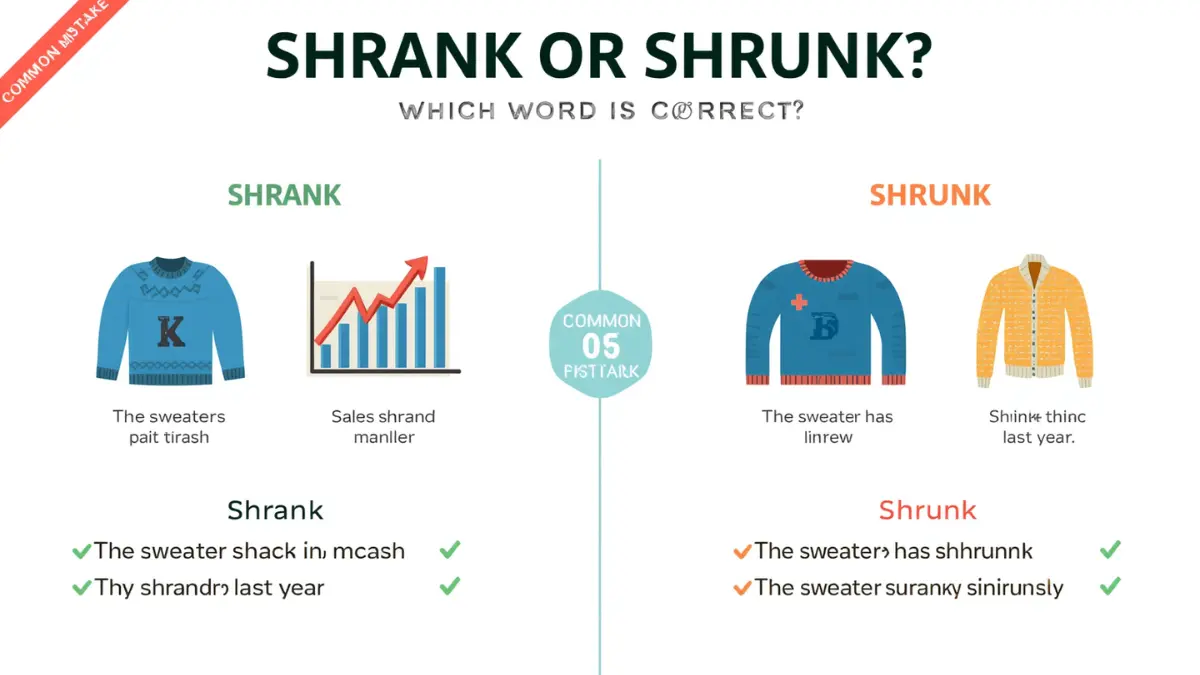
Both shrank and shrunk are correct, but they are used differently.
- Shrank = simple past tense of shrink
- Shrunk = past participle of shrink
Read more: Due to or Because of: Simple Grammar Guide for English
Examples
✅ The shirt shrank after washing.
✅ The company’s profits shrank last year.
✅ The shirt has shrunk after several washes.
✅ The economy has shrunk by 2%.
Quick Rule
- Use shrank when talking about a completed action in the past.
- Use shrunk with helping verbs such as has, have, or had.
The Origin of Shrank or Shrunk
The verb shrink comes from Old English scrincan, meaning “to contract,” “draw together,” or “become smaller.”
Over time, English developed different forms of the verb:
| Verb Form | Word |
| Base Form | shrink |
| Past Tense | shrank |
| Past Participle | shrunk |
Historically, some English speakers also used shrunk as a simple past tense. While this usage still appears in casual speech, modern grammar guides generally prefer shrank as the standard past tense and shrunk as the past participle.
Read more: Unique or Very Unique: Which One Is Correct
This distinction became more common as English grammar rules became standardized.
British English vs American English Spelling
Unlike many spelling differences between British and American English, shrank and shrunk are not regional spellings. Both varieties of English follow the same grammatical pattern.
Comparison Table
| Usage | British English | American English |
| Simple Past | shrank | shrank |
| Past Participle | shrunk | shrunk |
| Example 1 | The fabric shrank. | The fabric shrank. |
| Example 2 | The fabric has shrunk. | The fabric has shrunk. |
Key Point
The difference is grammatical, not geographical.
Both British and American English writers generally use:
- shrank for past tense
- shrunk for past participle
Which Spelling Should You Use?
Your choice depends on the sentence structure.
For US Audiences
Use:
- shrank for past tense
- shrunk after has, have, or had
For UK Audiences
Use the same rule:
- shrank = past tense
- shrunk = past participle
For Global Audiences
Following the standard grammar rule works best worldwide.
Simple Formula
| Sentence Type | Correct Word |
| Simple past action | shrank |
| Has/have/had + verb | shrunk |
Examples
✅ Sales shrank last quarter.
✅ Sales have shrunk since January.
Common Mistakes with Shrank or Shrunk
Many writers mix up the past tense and past participle forms.
Mistake 1
❌ The shirt has shrank.
✅ The shirt has shrunk.
Mistake 2
❌ The sweater shrunk yesterday.
✅ The sweater shrank yesterday.
Mistake 3
❌ Our profits had shrank.
✅ Our profits had shrunk.
Mistake 4
❌ The market has shrank significantly.
✅ The market has shrunk significantly.
Easy Memory Tip
If you use has, have, or had, choose shrunk.
Without a helping verb, choose shrank.
Shrank or Shrunk in Everyday Examples
Emails
✅ Our budget shrank due to rising costs.
✅ Our budget has shrunk considerably this year.
News Writing
✅ The country’s economy shrank by 1%.
✅ The economy has shrunk for three consecutive quarters.
Social Media
✅ My favorite sweater shrank in the dryer!
✅ My jeans have shrunk again.
Formal Writing
✅ Revenue shrank during the recession.
✅ Revenue has shrunk compared with last year’s figures.
Shrank or Shrunk – Google Trends & Usage Data
Search interest in shrank or shrunk remains steady because many people struggle with irregular verbs.
Countries Where Searches Are Common
- United States
- United Kingdom
- Canada
- Australia
- India
Common Search Queries
- Is shrank correct?
- Shrank vs shrunk
- Has shrunk or has shrunk?
- Shrink past tense
- Shrink past participle
Usage Contexts
| Context | More Common Form |
| Grammar learning | Both |
| School assignments | Both |
| Business writing | shrank and shrunk |
| News reports | shrank and shrunk |
| Everyday conversation | Both |
The most frequent confusion occurs when writers use helping verbs and accidentally choose shrank instead of shrunk.
Shrank vs Shrunk Comparison Table
| Feature | Shrank | Shrunk |
| Part of Speech | Past tense | Past participle |
| Standard Usage | Yes | Yes |
| Used with Has/Have/Had | No | Yes |
| Example | The shirt shrank. | The shirt has shrunk. |
| Formal Writing | Common | Common |
| Modern Grammar Preferred | Yes | Yes |
FAQs
Is shrank a real word?
Yes. Shrank is the standard simple past tense of shrink.
Is shrunk a real word?
Yes. Shrunk is the standard past participle of shrink.
Which is correct: has shrank or has shrunk?
Has shrunk is correct.
✅ The sweater has shrunk.
Which is correct: the shirt shrank or shrunk?
In standard grammar, the shirt shrank is preferred because it is a simple past tense.
Can shrunk be used as a past tense?
Some speakers use it informally, but most grammar guides prefer shrank as the standard past tense.
Why do people confuse shrank and shrunk?
Because both words come from the same verb and refer to a reduction in size.
What is the full verb form of shrink?
- Present: shrink
- Past: shrank
- Past participle: shrunk
Conclusion
The difference between shrank or shrunk is simple once you understand their grammar roles. Shrank is the simple past tense and is used when describing an action that happened in the past. Shrunk is the past participle and should be used with helping verbs such as has, have, and had.
For example, you would say, “The sweater shrank in the wash,” but “The sweater has shrunk after several washes.” This rule applies in American English, British English, and most forms of standard written English.
Although some people use shrunk as a past tense verb in casual conversation, professional and academic writing generally follows the traditional distinction. Learning this pattern can improve your grammar, make your writing clearer, and help you avoid common mistakes.
Whenever you’re unsure, remember this simple rule: past action = shrank; has/have/had = shrunk. Following that guideline will help you choose the correct word confidently in every situation.

I am Arshman Ali, a professional content writer and the author behind tensestutor.com . I am passionate about making grammar simple and accessible for everyone. Through my writing, I aim to help learners and professionals communicate with clarity and confidence.