Have you ever typed “truely” and wondered if it was correct? You are not alone. Many English learners, students, writers, and professionals search for “truly or truely” because the spelling can seem confusing at first glance.
The confusion comes from a common English spelling pattern. Many words ending in -y change when a suffix is added. Because of this, people often assume that true becomes truely. However, English spelling does not always follow the same rule for every word.
Understanding the difference between truly and truely can help you avoid spelling mistakes in emails, academic writing, business documents, social media posts, and everyday communication. Using the correct spelling also improves your credibility and ensures your writing looks professional.
In this guide, you will learn the correct spelling, the history behind the word, differences between British and American English usage, common mistakes to avoid, and practical examples. By the end, you will know exactly when and why to use truly.
Truly or Truely – Quick Answer
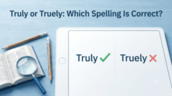
Truly is the correct spelling.
Truely is incorrect and is considered a spelling mistake in both British English and American English.
Examples
✅ She was truly happy to see her family.
✅ This is a truly remarkable achievement.
❌ I truely appreciate your help.
❌ She was truely happy.
Quick Rule: Always use truly, never truely.
Read more: You’ve Probably Been Using “Segway” Wrong:
The Origin of Truly or Truely
The word truly comes from the adjective true, which has roots in Old English. It developed from words meaning faithful, trustworthy, and genuine.
When the adverb form was created, English dropped the final e from true before adding -ly.
true + ly = truly
This spelling has been standard for centuries.
Many people write truely because words ending in e often keep the letter when another ending is added. However, truly is one of several exceptions in English spelling.
Why the Confusion Exists
People often compare it with words such as:
- Nice → Nicely
- Wise → Wisely
- Brave → Bravely
Because true ends with e, writers may assume truely follows the same pattern. However, standard English removes the e, creating truly.
British English vs American English Spelling
Unlike many spelling differences between British and American English, there is no difference here.
Both countries use truly.
Comparison Table
| English Version | Correct Spelling | Incorrect Spelling |
| British English | Truly | Truely |
| American English | Truly | Truely |
| Canadian English | Truly | Truely |
| Australian English | Truly | Truely |
Examples
| Region | Example Sentence |
| United Kingdom | I am truly grateful for your support. |
| United States | This product is truly innovative. |
| Australia | She truly enjoys traveling. |
| Canada | The team truly deserved the award. |
No major English-speaking country recognizes truely as a standard spelling.
Which Spelling Should You Use?
The answer is simple: use truly everywhere.
If Your Audience Is in the United States
Use truly in:
- Business emails
- Academic papers
- Websites
- Marketing content
If Your Audience Is in the United Kingdom
Use truly in:
- Formal documents
- Newspapers
- Professional communication
If Your Audience Is Global
Use truly because it is accepted worldwide and understood by all English speakers.
Professional Advice
If you write for clients, employers, publishers, or online audiences, always choose truly. Spell-check tools may flag truely as an error.
Common Mistakes with Truly or Truely
Many writers make similar mistakes when using this word.
Mistake 1: Adding an Extra “E”
❌ Truely
✅ Truly
Mistake 2: Assuming British English Uses “Truely”
❌ British English prefers truely.
✅ British English uses truly.
Mistake 3: Using Both Spellings in One Document
❌ Truly in one paragraph and truely in another.
✅ Use truly consistently throughout your writing.
Mistake 4: Ignoring Spell Check Warnings
Most grammar tools identify truely as incorrect.
Common Corrections
| Incorrect | Correct |
| Truely | Truly |
| Truely grateful | Truly grateful |
| Truely sorry | Truly sorry |
| Truely amazing | Truly amazing |
Truly or Truely in Everyday Examples
In Emails
✅ I truly appreciate your quick response.
✅ We are truly thankful for your business.
In News Articles
✅ The event was truly historic.
✅ The athlete delivered a truly impressive performance.
On Social Media
✅ I am truly excited about this project!
✅ This sunset is truly beautiful.
In Formal Writing
✅ The research provides a truly unique perspective.
✅ The organization is truly committed to sustainability.
In Academic Writing
✅ The findings are truly significant.
✅ This study offers a truly valuable contribution.
Truly or Truely – Google Trends & Usage Data
Search data consistently shows that many people look for “truly or truely” because they are unsure which spelling is correct.
Popular Search Intent
Users often search:
- Is truely a word?
- How do you spell truly?
- Truly vs truely
- Correct spelling of truly
Usage by Country
| Country | Common Usage |
| United States | Truly |
| United Kingdom | Truly |
| Canada | Truly |
| Australia | Truly |
| New Zealand | Truly |
Online Usage
| Spelling | Status |
| Truly | Standard and accepted |
| Truely | Misspelling |
| Truly yours | Correct closing phrase |
| Truely yours | Incorrect closing phrase |
Modern dictionaries, grammar guides, publishers, and educational institutions recognize truly as the only correct spelling.
Comparison Table: Truly vs Truely
| Feature | Truly | Truely |
| Dictionary Accepted | Yes | No |
| British English | Yes | No |
| American English | Yes | No |
| Formal Writing | Yes | No |
| Academic Writing | Yes | No |
| Business Writing | Yes | No |
| Search Popularity | Very High | Mostly searched as a spelling question |
| Recommended Usage | Always | Never |
FAQs
1. Is truly or truely correct?
Truly is correct. Truely is a misspelling.
2. Is truely a real word?
No. Standard English dictionaries do not recognize truely as a correct spelling.
3. Why is truly spelled without the letter “e”?
The final e in true is dropped before adding -ly, creating truly.
4. Do British and American English spell it differently?
No. Both British and American English use truly.
5. Can I use truely in formal writing?
No. Use truly in all formal and professional writing.
6. How do I remember the correct spelling?
Think of the formula:
true + ly = truly
The extra e is removed.
7. Is “truly yours” correct?
Yes. Truly yours is a correct and common closing phrase in letters and emails.
Conclusion
The debate over “truly or truely” has a simple answer: truly is the correct spelling, while truely is a spelling mistake. Although many people assume the extra e should remain because the word comes from true, English spelling follows a different pattern in this case. The final e is removed before adding -ly, resulting in truly.
This rule applies across all major forms of English, including British English, American English, Canadian English, and Australian English. Whether you are writing an email, preparing a report, posting on social media, or creating professional content, truly is the only spelling you should use.
Remember that spelling accuracy matters. Correct spelling improves readability, professionalism, and trust. If you ever hesitate between truly or truely, choose truly with confidence. It is the accepted form in dictionaries, style guides, educational materials, and professional writing around the world.
Meta Description: Learn the difference between truly or truely, discover the correct spelling, usage examples, common mistakes, and expert writing guidance.

I am Arshman Ali, a professional content writer and the author behind tensestutor.com . I am passionate about making grammar simple and accessible for everyone. Through my writing, I aim to help learners and professionals communicate with clarity and confidence.