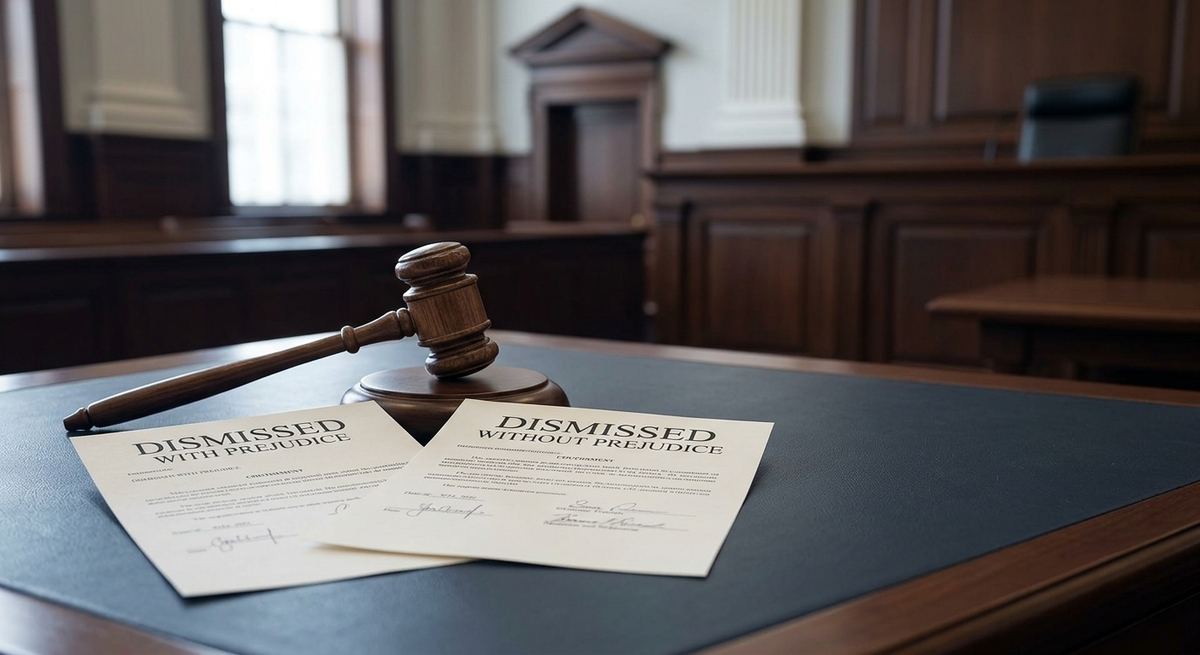
When a court dismisses a case, two words can make a major legal difference: with prejudice or without prejudice. Many people search for “dismissed with or without prejudice” because court orders often use these terms without explaining what they mean.
In simple terms, a dismissal with prejudice generally prevents the same claim from being brought again, while a dismissal without prejudice generally leaves the door open for a later filing. In U.S. federal civil procedure, Rule 41 sets out important rules for voluntary and involuntary dismissals. (Legal Information Institute)
The phrase can cause confusion because “prejudice” here does not mean personal bias, discrimination, or unfair treatment. It describes the legal effect of the dismissal on a party’s ability to pursue the claim again.
The exact effect can depend on the court, type of case, reason for dismissal, and wording of the order. State and federal rules can also differ. This guide explains the basic distinction in clear language so you can understand what these terms usually mean and why the wording matters.
Dismissed With or Without Prejudice – Quick Answer
Dismissed with prejudice usually means the court has ended the claim in a way that prevents the plaintiff from bringing the same claim again. Cornell’s Legal Information Institute describes it as an adjudication on the merits, subject to applicable rules and exceptions. (Legal Information Institute)
Dismissed without prejudice usually means the court has ended the current case but has not barred the plaintiff from bringing the claim again. (Legal Information Institute)
| Term | Basic meaning | Can the claim usually be filed again? |
| Dismissed with prejudice | Final dismissal of the claim | Generally no |
| Dismissed without prejudice | Current case ends without the same final bar | Generally yes |
| Dismissed | Case or claim ends | Check the court order |
| Dismissal on the merits | Court treats the matter as decided on the merits | Generally prevents relitigation |
| Voluntary dismissal | Plaintiff chooses to end the action | Depends on the applicable rule and order |
| Involuntary dismissal | Court dismisses after a motion or other circumstance | Depends on the reason and applicable rule |
For example:
- “The complaint was dismissed without prejudice.” → The plaintiff may have an opportunity to correct the problem and file again.
- “The complaint was dismissed with prejudice.” → The plaintiff generally cannot bring the same claim again.
- “The court dismissed the case for lack of jurisdiction.” → The effect can differ from an ordinary merits-based dismissal. Federal Rule 41 specifically identifies lack of jurisdiction, improper venue, and failure to join a required party as exceptions to its general involuntary-dismissal rule. (Legal Information Institute)
Always read the actual dismissal order before assuming what you can or cannot do next.
The Origin of “Dismissed With or Without Prejudice”
The word prejudice has a special legal meaning in this phrase. It does not refer to personal dislike or bias.
In civil procedure, the distinction developed as a way to describe whether a dismissal should affect a party’s ability to bring the same claim again. A dismissal with prejudice carries a final effect, while a dismissal without prejudice generally leaves the claim open to another filing. (Legal Information Institute)
The phrase also reflects older legal traditions in which courts needed a clear way to distinguish between ending a particular proceeding and ending the underlying claim.
Modern U.S. federal procedure gives the distinction a clear place in Federal Rule of Civil Procedure 41. For certain voluntary dismissals, the rule says the dismissal is without prejudice unless the notice or stipulation says otherwise. The rule also contains a “two-dismissal” provision that can make a later dismissal operate as an adjudication on the merits. (Legal Information Institute)
So, the phrase is not really a spelling issue. “With prejudice” and “without prejudice” are different legal terms with different effects.
British English vs American English Spelling
Unlike words such as color/colour or catalog/catalogue, “dismissed with prejudice” does not have a normal American-versus-British spelling difference.
The spelling is generally the same:
- dismissed
- prejudice
- without prejudice
- with prejudice
- dismissal
The larger difference involves legal usage and context, not spelling.
| Term | American English | British English | Main difference |
| Dismissed with prejudice | Used | Less central as a standard civil-procedure label | U.S. federal procedure commonly uses the phrase |
| Dismissed without prejudice | Used | Less central as a standard civil-procedure label | U.S. usage often concerns refiling |
| Without prejudice | Used | Very common | In the UK, it also commonly relates to settlement negotiations |
| Dismissal | Used | Used | Same spelling |
| Prejudice | Used | Used | Same spelling |
The U.S. Federal Rules of Civil Procedure specifically use “with prejudice” and “without prejudice” when describing dismissal effects. (Legal Information Institute)
In England and Wales, without prejudice also has an important settlement meaning. The UK Ministry of Justice explains that settlement negotiations often take place “without prejudice,” which restricts when the content can be revealed to the court. (GOV.UK Justice)
That means you should not assume that every use of without prejudice means “this case can be filed again.”
Which Spelling Should You Use?
There is no spelling choice between with prejudice and without prejudice. Choose the phrase based on the legal meaning you intend.
For U.S. readers
Use:
- dismissed with prejudice
- dismissed without prejudice
- dismissal with prejudice
- dismissal without prejudice
U.S. federal civil procedure provides specific rules for these terms, but state courts may have their own procedures. (Legal Information Institute)
For UK readers
Be careful with context. Without prejudice has a well-established meaning in settlement discussions. The UK Ministry of Justice describes it as a protection that generally limits disclosure of settlement negotiations to the court. (GOV.UK Justice)
For global readers
If you are writing about a court case, identify the jurisdiction. A phrase can have a different procedural effect under different legal systems.
Common Mistakes With “Dismissed With or Without Prejudice”
1. Thinking “prejudice” means bias
Incorrect: “The judge dismissed it with prejudice because the judge was biased.”
Better: “The court dismissed the claim with prejudice, which generally prevents the same claim from being brought again.”
Here, prejudice describes the legal effect of the dismissal.
2. Assuming every dismissal is permanent
A dismissal does not automatically mean that the plaintiff can never file again. The order may specify without prejudice, which can leave a route to refiling. (Legal Information Institute)
3. Assuming “without prejudice” always means “you can refile”
That is too broad. The exact order, applicable rules, deadlines, and type of case matter.
4. Ignoring deadlines
A dismissal without prejudice does not necessarily erase filing deadlines. A person may still need to meet the applicable statute of limitations or other procedural deadlines.
5. Treating civil and criminal cases as identical
The terms can appear in different legal settings, but their practical operation can vary. You should check the specific law and court procedure involved.
6. Confusing a dismissal with an appeal
A dismissal with prejudice may have final effects, but that does not automatically answer whether an appeal is available. Appeals depend on the applicable rules and circumstances.
“Dismissed With or Without Prejudice” in Everyday Examples
In an email
“The court dismissed the complaint without prejudice, so we are reviewing whether a new filing is possible.”
This wording stays neutral and avoids promising that refiling will definitely succeed.
In a news report
“The judge dismissed the lawsuit without prejudice, allowing the plaintiff to pursue the claim again subject to applicable requirements.”
This gives readers the basic legal effect without saying that a new lawsuit will definitely succeed.
On social media
“The case was dismissed without prejudice, which is different from a dismissal with prejudice.”
This is a simple way to explain the distinction.
In formal legal writing
“The court dismissed the plaintiff’s claim without prejudice.”
Or:
“The court dismissed the claim with prejudice.”
These forms are concise and commonly used in legal writing.
In a settlement discussion
Be careful. In England and Wales, without prejudice can refer to settlement negotiations rather than the dismissal of a case. The UK Ministry of Justice specifically recognizes this use. (GOV.UK Justice)
Dismissed With or Without Prejudice – Google Trends & Usage Data
Search interest in legal phrases often comes from people trying to understand language found in a court order, lawsuit, legal notice, or news report.
However, Google Trends does not itself establish the legal meaning of a phrase. Search volume can also change because of major court cases, news events, legal disputes, or changes in public interest.
For this keyword, context matters more than spelling. People may search for:
- “dismissed with prejudice meaning”
- “dismissed without prejudice meaning”
- “can I refile after dismissal”
- “what does dismissal with prejudice mean”
- “what does dismissal without prejudice mean”
- “dismissed with prejudice vs without prejudice”
Country differences also matter. U.S. federal procedure expressly uses these terms in Rule 41, while UK legal materials prominently use without prejudice in the context of settlement negotiations. (Legal Information Institute)
Because legal rules vary by jurisdiction, search popularity should not be treated as evidence that one legal meaning applies everywhere.
Dismissed With or Without Prejudice: Key Differences
| Feature | With Prejudice | Without Prejudice |
| Current case ends | Yes | Yes |
| Same claim can usually be refiled | No | Often yes |
| Final effect | Generally final as to the claim | Generally not a merits-based final bar |
| Legal significance | Stronger finality | Leaves room for another filing |
| Common reason | Claim cannot proceed or final resolution applies | Procedural problem or voluntary dismissal |
| Deadlines still matter | Yes | Yes |
| Court order matters | Yes | Yes |
| Meaning of “prejudice” | Legal effect on future claim | Legal effect is not final in the same way |
Under Federal Rule 41, voluntary dismissal generally operates without prejudice unless the relevant notice, stipulation, or order states otherwise, subject to the rule’s exceptions. (Legal Information Institute)
FAQs About Dismissed With or Without Prejudice
1. What does dismissed with prejudice mean?
It generally means the court has dismissed the claim in a way that prevents the plaintiff from bringing the same claim again. In federal civil procedure, Rule 41 generally treats certain involuntary dismissals as adjudications on the merits unless an exception applies or the order states otherwise. (Legal Information Institute)
2. What does dismissed without prejudice mean?
It generally means the current case has ended, but the dismissal does not itself prevent the plaintiff from bringing the same claim again. Other legal requirements, such as filing deadlines, can still apply. (Legal Information Institute)
3. Does dismissed without prejudice mean I can sue again?
Often, yes. But you must check the dismissal order and applicable law. A statute of limitations or another procedural rule may prevent a later filing.
4. Is dismissed with prejudice the same as losing a case?
Not exactly. A dismissal with prejudice can have a final legal effect even when the court did not conduct a full trial. The exact basis for the dismissal matters.
5. Does “prejudice” mean the judge was biased?
No. In this context, prejudice refers to the legal effect of the dismissal. It does not mean that the judge personally disliked or discriminated against someone. (Legal Information Institute)
6. Can a case dismissed with prejudice ever be challenged?
Depending on the jurisdiction and circumstances, a party may have options such as an appeal or a motion for relief from judgment. Those options depend on applicable rules and deadlines.
7. Does “without prejudice” have another legal meaning?
Yes. In England and Wales, without prejudice commonly describes settlement negotiations. The UK Ministry of Justice explains that such negotiations generally receive restrictions on disclosure to the court. (GOV.UK Justice)
Conclusion
The phrase “dismissed with or without prejudice” describes two different legal effects. A dismissal with prejudice generally ends the claim in a final way and prevents the same claim from being brought again. A dismissal without prejudice generally ends the current case while leaving the possibility of another filing open. (Legal Information Institute)
The key point is that prejudice does not mean bias in this context. It describes how the dismissal affects future legal action.
For U.S. federal civil cases, Rule 41 provides important rules for voluntary and involuntary dismissals. For example, certain voluntary dismissals normally occur without prejudice, while some involuntary dismissals operate as adjudications on the merits unless an exception applies. (Legal Information Institute)
The terms also vary in practical use across legal systems. In England and Wales, without prejudice often refers to settlement negotiations, so context matters. (GOV.UK Justice)
If you receive a dismissal order, read its exact wording. The jurisdiction, reason for dismissal, deadlines, and type of case can all affect what happens next. For a real case, a qualified lawyer can explain how the specific order applies.

I am Arshman Ali, a professional content writer and the author behind tensestutor.com . I am passionate about making grammar simple and accessible for everyone. Through my writing, I aim to help learners and professionals communicate with clarity and confidence.