Imagine you are writing an email, finishing one thought, and starting another. You type out “Segwaying,” but are you actually supposed to use Segway or segue? It is one of the most common spelling mix-ups in modern writing.
While all that sounds good, there’s one problem.
When you’re referring to being more than fluent in transitioning from one concept to another, you don’t want to use “Segway”. Actually the name of a personal transporter with two wheels. The word spoken is “segue“.
This guide will help you clear up all the confusion, once and for all. You will find out today what each of these words is, its origins, when to use each and how not to fall into one of the most frequent internet writing errors.
“When you change topics, you need a segue and when you’re rolling down the street, you need a Segway.”
Read More: Freshman or Freshmen:
Segway or Segue (Quick Answer)
Here’s the short answer.
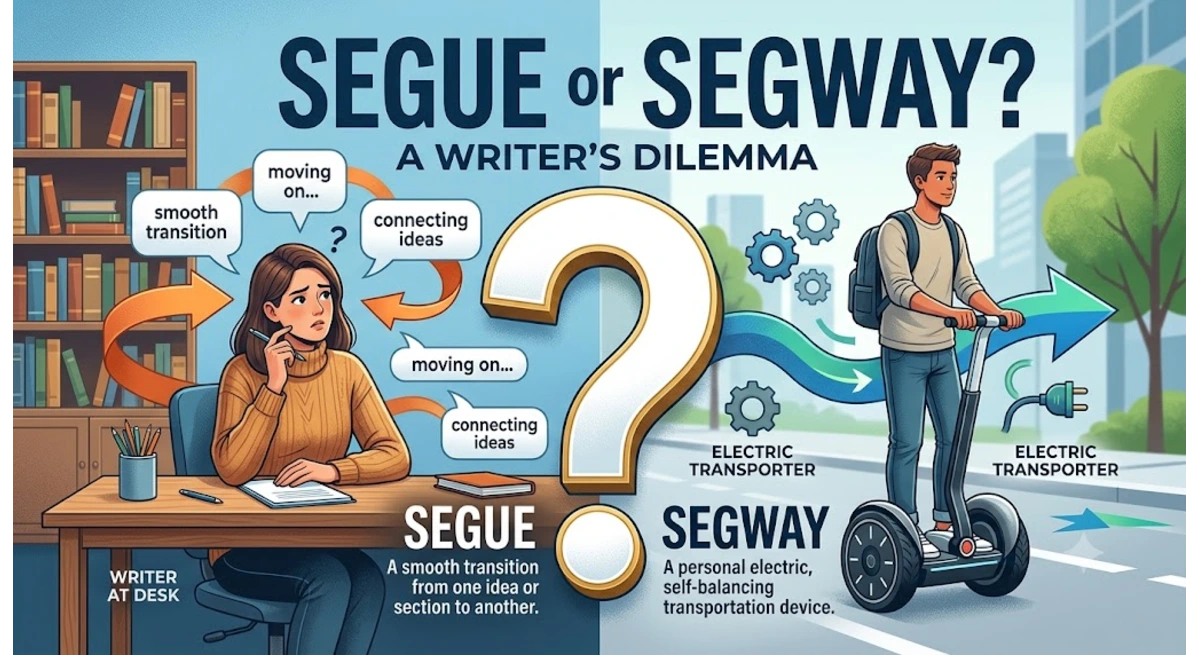
A transition from one topic, idea or activity to another that is smooth.
Segway is a two-wheeled, self-balancing electric vehicle, a trademarked design from Segway Inc.
Correct examples:
✅ “What a great segue that story provided to the lesson today”.
✅ “The tour guide used a Segway to tour the park.”
Incorrect example:
❌ “Let’s take the Segway to our next discussion.
✔ Correct:
“Let’s segue into our next discussion.”
Many writers use segway as it looks more suitable but it is not suitable for this.
Origin Of These Words
These words seem connected at first glance together.
They’re not.
This is precisely why it’s so normal for individuals to get confused.
Understanding the True Segue Meaning
The term ‘segue’ is derived from Italian.
It simply means “it follows”.
The term was first used in music. It was used in printed music by composers to instruct performers to “skip” to the next composition’s consecutive line without pause.
Suppose one movement of an orchestra ends and another begins without a pause. That’s a segue.
As the time passed, it was adopted by the English.
Today it refers to any potential smooth transition among:
- conversations
- meetings
- presentations
- articles
- Scenes
- podcasts
- Ideas
- speeches
For example:
Her travel story was just like a transition to her conversation of moving overseas.
The original meaning of music remains but for most people today the word is used in common speech.
What is the Segway Meaning and Origin?
Segway is in a whole other league.
It’s a trademark.
In 2001, Segway made history by releasing a revolutionary self-balancing electric vehicle, the Segway Personal Transporter.
But its inventor wanted the name of the new machine to indicate its ability to smoothly move from one place to another.
The business decided to have a name that was akin to the name segue since both actions are about moving smoothly.
That’s when the confusion of today started.
The product name was used a million times by millions of people before the word segue was ever written.
When they wanted to write about changing subjects, they did so figuratively anyway and of course, wrote Segway.
It feels right.
But it isn’t.
Why is there a mix-up between these?
There are various reasons.
- First, they’re pronounced almost exactly the same.
- Secondly, Segway can be seen in ads, TV programmes, and in the news and as a tourist attraction.
- Third, many people have never encountered the word segue when they learn to read it.
- Last but not least, Segway tends to be uncorrectable, being such a recognized brand name.
There’s a recipe for typos out there!
Here’s the thing.
It’s more than just a minor grammatical error.
The wrong word will detract from readers, particularly when writing professionally.
Suppose you read this sentence in a business letter.
I’d like to ride Segway to the results of our quarterly release!
Not all readers will detect it.
Others will.
As soon as they do, they might start considering scooters again rather than your presentation.
That’s not what you want to leave your kids with.
Key Differences
Unlike other word pairs like “judgment or judgement”, Segway and segue are not synonyms or variations in spelling.
They’re completely different words with different meanings.
| Feature | Segue | Segway |
| Transitions | Dr. Seuss’S words | Seuss Name trademarked brand names |
| Meaning | A smooth transition | Personal electric vehicle |
| Used as a verb? | Yes | Informally, generally thought of as being incorrect to write |
| Pronunciation | “SEG-way” | “SEG-way” |
Correct in formal writing?
| Feature | Segue | Segway |
| Correct in formal writing? | No | Not always, or not when referring to the vehicle or company |
Notice something interesting?
It is pronounced almost the same.
The spelling-not the meaning-is not.
Imagine it is that way.
Between ideas: a ‘segue’.
If you are walking while on a Segway, then it is also a Segway.
This little mind trick assists many writers remember:
Picture aids. Picture supports.
Segue
- The speaker began with humor that led to the topic of the presentation with seriousness.
- May I add – Can I transition to another question?
- The documentary flows to the interviews smoothly.
Segway
- During our city tour, Segway rentals were performed.
- The officer on police duty rode his Segway in the park.
- It takes her only about fifteen minutes to learn how to ride a Segway.
WQF is one word that belongs in the realm of writing.
The other should be in the garage.
Which One to Use?
Well that depends upon what you’re talking about.
When writing about transitions.
Always choose segue.
Examples include:
- essays
- emails
- presentations
- speeches
- blog posts
- meetings
- podcasts
- conversations
Examples:
Let’s take a transition to the last statement.
That was a joke, which led the way to the next chapter.
That is the spelling used by the editors, teachers, and publishers, as well as most professional readers.
If you’re writing about the vehicle
Use Segway.
The fact that it’s the trademark requires you to capitalise it.
Examples:
“The museum has a ‘Segway’ available.
“She purchased a secondhand Segway.
Do refer to the capital “S. Look out for the capital letter “S.
Another Simple Tip
Another simple tip is that.That’s another simple tip.
| Rule | Explanation |
| Brand names are capitalized. | Typical “verbs” tend not to be |
What about informally writing?
Folks can typically interpret the things they see like:
“Segwaying to another topic…”
| Informal Writing |
| There you can find it everywhere on social media. |
| The perceived oxygen cost of text messaging is also too. |
| Individuals recognize the writer’s point. |
However, if you’re writing something that would be able to be edited, published, graded, or shared professionally, use segue.
This is the dictionary/correct spelling used by dictionaries and style guides.
Guidance by Audience
| Audience | Best Choice |
| In both cases, the term segue refers to a segue or transition in the United States of America. | |
| UK readers | Same rule |
| Australian readers | Same rule |
| Canadian readers – same rule (slicker if you prefer) | |
| Academic writing | Always segues |
| Business writing | Always segue |
Casual texting: People can write Segway, but segue is correct
Riding the Segway or Segue can have PITFALLS!
Despite learning this lesson, it is not too difficult to fall back into those old habits.
Here are some of the most common errors and what you can do to prevent them.
Common Error Number 1: Mistaking the word Segway for meaning transition.
| Error | Details |
| Error #1 | Mistaking the word Segway for meaning transition. |
Incorrect:
It’s time to decide to Segway into the next section.
Correct:
OK, so let’s move on to the next section.
Why it occurs
| Reason |
| The word sounds the same, which prevents many people from knowing which word to write. |
Error #2: Forgetting to capitalize the word “Segway”.
| Error | Details |
| Common mistake | Forgetting to capitalize the word “Segway”. |
Incorrect:
We hired a segway in town.
Correct:
Rental of a Segway downtown.
| How it started |
| Sometimes it’s used as a verb in online content, so they conveniently assume it’s a common word. |
Error #3 – Using “segue” only for music.
| Incorrect assumption |
| “segue” can only be used with music. |
Correct:
In the present day, the term segue is popular not only for making a smooth transition in writing, but also in a speech, a conversation, a presentation, a movie, a podcast or anywhere else.
Mistake 4: The use of ‘segway’ in professional writing.
Incorrect:
As I wish you all would come along on a Segway, I would like to report the financial situation.
Correct:
I would now like to pass on to our financial report.
| Why it matters: |
| An incorrect spelling will draw the reader’s attention to your business proposal, report or academic paper and detract from the quality of your work. |
The common error in this joke is that you think they are different spellings.
| Belief | Reality |
| There are those who believe that “Segway” is the American version and “segue” is the British version. | That’s incorrect. |
| These are NOT regional variants of spelling. | These are alternative word choices and their meanings. |
Let’s Talk About Segway (or Segue) in Everyday Examples with Your Child.
It is sometimes easiest to remember words when viewing them within a context.
| Example |
| Suppose that you are rolling out your team after a meeting. |
| Many thanks for all your responses. Let’s go over some of our timelines for the upcoming project. |
Explanation
| In this, you are able to move in a fluent way from one subject to another. |
Text Message
| Example |
| During a discussion, change the topic. |
Random segue – are you on your holiday plans?
| Explanation |
| This is an informal yet appropriate application. |
News Headline
In the Mayor’s speech about the environment, he also discards his previous climate policy.Mayor’s environmental speech contains a segue to a new climate policy.
| Explanation |
| This is a smooth transition between topics indicated by the headline. |
Social Media Post
Quick segue from coffee photos to travel pictures…
| Explanation |
| It is a practice that is observed when speaking conversationally, as in blogs, social media and various other personal, business, and private communication platforms. |
Formal Document
This section of the report transitions from the research and findings to conclusions and recommendations.
| Explanation |
| Segue can be used effectively in formal writing due to its conciseness and clarity. |
Talking about the vehicle
Now take this and compare it with a sentence on the product.
History was the area covered in Segway guided tours.
| Explanation |
| This is for the brand name only. |
Try this memory trick.
| Use | Remember |
| Changing ideas | Write segue if you’re changing ideas. |
| Moving to a new location | On two wheels, mention Segway if you are moving to a new location. |
Segway or Segue – Search Trends & Usage
Although we don’t have any live search statistics, it’s not difficult to come to some reasonably accurate conclusions about the use of these words today.
Overall, “segway or segue” continues to be among the most Googled comparisons of word meanings.
This confusion is due to the fact that there is close similarity in the pronunciation of both words, and that only one to a transition.
The Segway is most commonly used by modern English speakers due to its well-known personal transporter and the numerous Segway Tours available.
Traditionally, this is why many think that the word spelt this way is the right spelling of the verb.
According to all four sources, the word segue is recommended at every point in your writing where you’re referring to the move from one idea, topic or section to another.
When users read the words Let’s segway into… online, they tend to become curious about it when they see them, so that’s another time when search for it tends to rise.
But the swirl won’t end anytime soon and all it takes to prevent it is some knowledge on the difference.
Read More: Stint or Stent: Which word is correct to use and Where!!
There is also a table comparing Segway’s technology with Segue’s.
| Feature | Segue | Segway |
| Meaning | Smooth transition | Two-wheeled personal transporter |
| Part of Speech | Noun and verb | Proper noun (brand name) |
| Pronunciation | SEG-way | SEG-way |
| Capitalized? | No | Yes |
| Used in essays? | Yes | No |
| Used in business writing? | Yes | No |
| Used for transportation? | No | Yes |
| Example | “Let’s segue into chapter two.” | “We toured the city on a Segway.” |
| Common mistake | Misspelled as “Segway” | Used incorrectly as a verb |
Frequently Asked Questions
Frequently Asked Questions
Well, it is segway or segue!
| Question | Answer |
| Well, it is segway or segue! | The right word to use if you are trying to switch topics is ‘segue’. Segway is a trademarked, personal mode of transportation. Though both words are similar in sound, there is a different meaning and these words are not better suited to be used in the same context. |
Yes, you can use the word Segway as a verb.Segway is a verb.
| Question | Answer |
| Yes, you can use the word Segway as a verb.Segway is a verb. | Some people use the word “segway” as a verb in casual conversation or in other social situations. It is normally not used in edited or academic or business writing, however. Seize is highly recommended as the preferred verb. |
Why are segue and Segway pronounced the same?
| Question | Answer |
| Why are segue and Segway pronounced the same? | The Segway transporter’s name was meant to have a segue-like sound because this company was looking for a name that symbolizes smooth movement. One of the greatest confusions for people between the two words is their similar pronunciation. |
Can you say “segue” in English?
| Question | Answer |
| Can you say “segue” in English? | Yes. Segue is certainly not a completely new term added to English; it is an Italian word that has been in use for some time in the English language. Dictionaries have accepted it and it is in common use in writing, broadcasting, public speaking and daily conversation. |
Do Americans say Segway instead of segue?
| Question | Answer |
| Do Americans say Segway instead of segue? | Some Americans foresee some people making sure to write Segway, meaning they’re thinking Segue, but it’s not a preference—it’s just a spelling error. The same applies with respect to American, British, Canadian, Australian, and other varieties of English. |
Is “segue” only used in music?
| Question | Answer |
| Is “segue” only used in music? | No. The meaning of the word was originally musical, with the meaning ‘continue without any pause’, however in a more contemporary context, it’s used much more broadly. It’s usually used today to convey a smooth flow of speech, as in a speech or conversation, movie, book, podcast or article. |
Why is “Segway” acceptable in spellcheck?
| Question | Answer |
| Why is “Segway” acceptable in spellcheck? | Since Segway is a brand name. Even if it’s not the word you’re looking for in your sentence, Spellcheck will recognize it as a correctly spelled word. This is why it is just as crucial to proofread for context as it is to proofread for spelling. |
I’ll have to memorize the difference…?
| Memory Aid | Meaning |
| Ideas → segue. | When linking thoughts, put use on segue. |
| Scooter → Segway. | If you’re referring to the electric transporter, then Segway. |
Conclusion?
No wonder that so many people get Segway and segue confused.
| Reason | Details |
| Similar names | Their names are nearly identical and the one is of an established brand known for years. |
| Easy choice | Once you understand this, though, it’s an easy choice. |
Unless you are depicting a smooth transition between ideas, topics or sections of writing, use segue.
“Use Segway” should only be used in reference to the Segway two-wheel personal transporter, or the company behind it.
| Final Reminder |
| The little detail is essential to make your writing seem more polished and error free and to avoid readers having an image of someone on a scooter at a meeting or perhaps at his desk. |
Every time you are about to say:
“Let’s segway into our next topic…”
pause for a moment and say:
“If you think you are moving into your topic, then you are searching for a segue”.
Share This Guide
If you liked this guide, share it with a friend who’s learning English, print it out for later use, or if you see a similar confusion you’ve slipped into your own writing, pinpoint it so that you don’t make it again!

I am Bahadar Ali, a professional content writer and the author behind Tensestutor.com I am passionate about making grammar simple and accessible for everyone. Through my writing, I aim to help learners and professionals communicate with clarity and confidence.