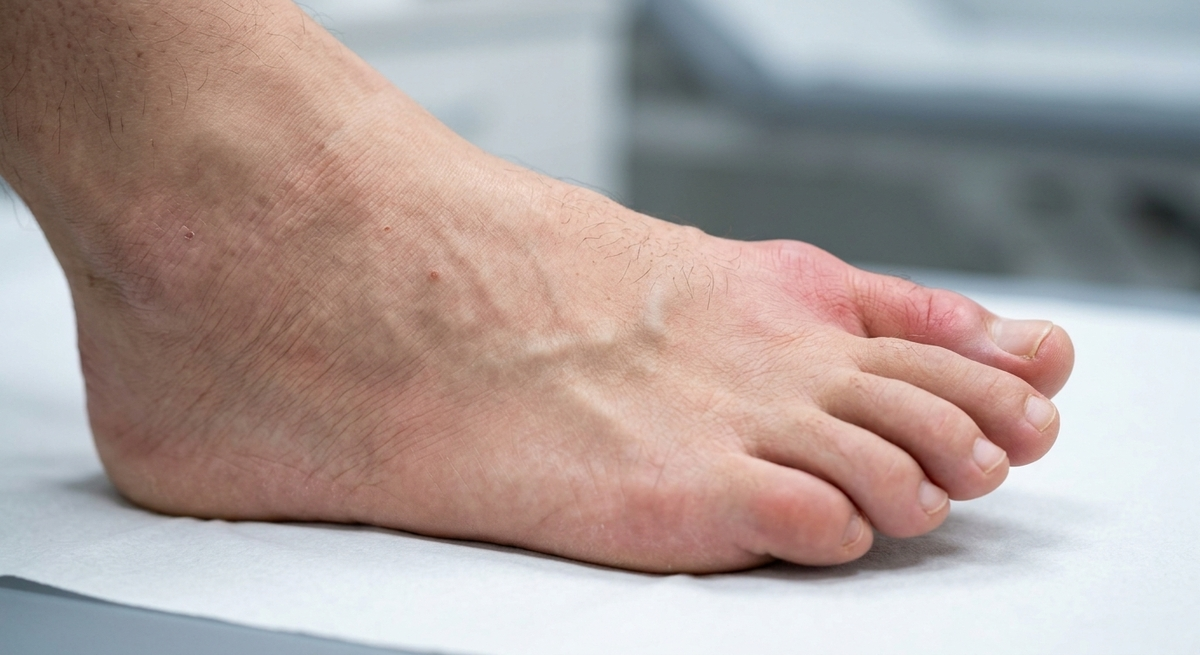
Pain at the base of your big toe can make you wonder: gout or bunion? These two conditions can look similar, but they have different causes and often behave in different ways. Knowing the difference can help you understand what your foot may be telling you.
Gout is a form of arthritis caused by urate crystal buildup in a joint. It often causes a sudden attack of severe pain, swelling, warmth, and redness. The big toe is a common location. (Mayo Clinic)
A bunion, on the other hand, is a structural change in the foot. It creates a hard bump at the base of the big toe and can gradually become painful, especially when shoes press against it. (Mayo Clinic)
People search for gout or bunion because both can affect the big-toe area. This guide explains their key differences, common mistakes, everyday usage, and what the available data tells us.
Gout or Bunion – Quick Answer
| Feature | Gout | Bunion |
| Main cause | Urate crystals in a joint | Change in foot alignment |
| Pain pattern | Often sudden and intense | Often gradual or recurring |
| Common location | Base of the big toe | Base of the big toe |
| Appearance | Red, swollen, hot joint | Visible hard bump |
| Common trigger | Gout attacks can start suddenly | Pressure from shoes can worsen symptoms |
| Main issue | Inflammation | Structural foot change |
Gout often begins suddenly. The joint may become very painful, warm, swollen, and red. Attacks can start at night and reach peak pain within hours. (Mayo Clinic)
A bunion usually produces a visible bump. The big toe may move toward the smaller toes, while the joint at its base sticks outward. (Mayo Clinic)
Simple example:
- Sudden, hot, swollen, extremely painful big-toe joint → gout may be possible.
- A long-standing hard bump that hurts in shoes → a bunion may be possible.
These signs do not prove a diagnosis. Several foot conditions can cause similar symptoms, so a healthcare professional may need to examine the foot. (Cleveland Clinic)
The Origin of Gout or Bunion
The words gout and bunion have different histories.
Gout comes from an old word associated with a “drop” or “fall,” reflecting an old medical belief that disease came from drops of harmful fluid entering a joint. The modern medical term describes a form of inflammatory arthritis linked to urate crystals.
Bunion comes from an older English word related to swelling or enlargement. In modern medicine, a bunion commonly refers to a deformity at the base of the big toe, also known as hallux valgus. (Cleveland Clinic)
Unlike spelling pairs such as color/colour or center/centre, gout and bunion are not British-versus-American spelling variants. They are two separate medical terms.
Why the Terms Cause Confusion
The confusion comes mainly from location and symptoms. Both conditions can affect the big-toe joint and can cause pain and swelling.
The NHS specifically notes that a red, hot, swollen foot problem that comes and goes can be associated with gout, while a hard lump near the big toe is typical of a bunion. (nhs.uk)
British English vs American English Spelling
There is no major British-American spelling difference between gout and bunion.
Both forms remain:
- gout in American English
- gout in British English
- bunion in American English
- bunion in British English
The difference appears more in related medical vocabulary and general style than in these two words themselves.
| Term | American English | British English |
| Gout | gout | gout |
| Bunion | bunion | bunion |
| Big toe | big toe | big toe |
| Hallux valgus | hallux valgus | hallux valgus |
| Podiatrist | podiatrist | podiatrist |
Important Point
Do not change gout to another spelling when writing for a British audience. Likewise, bunion stays the same in both major varieties of English.
Which Spelling Should You Use?
Use gout and bunion regardless of whether your readers are in the United States, United Kingdom, Canada, Australia, or another English-speaking region.
For example:
- US audience: “Could this pain be gout or a bunion?”
- UK audience: “Could this pain be gout or a bunion?”
- Global audience: “How can you tell gout or a bunion apart?”
For professional medical writing, keep the standard medical terms. You can also use hallux valgus when discussing the medical condition behind a bunion.
The bigger writing issue is not spelling. It is using the terms correctly.
Common Mistakes with Gout or Bunion
Mistake 1: Treating gout and bunions as the same thing
Incorrect: “A bunion is another type of gout.”
Correct: “A bunion and gout are different conditions.”
Mistake 2: Assuming every big-toe bump means gout
A visible, hard bump at the base of the big toe can be a bunion. (Mayo Clinic)
Mistake 3: Assuming every painful big toe means a bunion
Gout can cause sudden, intense pain in the big toe without being a bunion. (Mayo Clinic)
Mistake 4: Thinking gout always causes a permanent bump
Long-term gout can cause deposits called tophi, but these are different from the structural bump of a bunion. (Mayo Clinic)
Mistake 5: Trying to diagnose the condition from one symptom
Pain, swelling, and redness can have many causes. A healthcare professional can use an examination and, when needed, tests to distinguish possible conditions. (Cleveland Clinic)
Gout or Bunion in Everyday Examples
In an Email
“I have sudden pain and swelling around my big toe. Could this be gout or a bunion?”
This wording clearly describes the concern without claiming a diagnosis.
In News Writing
“Doctors explained how gout and bunions can both cause problems around the big toe.”
On Social Media
“How can you tell if big-toe pain is gout or a bunion?”
In Formal Writing
“Gout and bunions can both affect the big-toe region, but they have different underlying causes.”
In Health Searches
Common search-style questions include:
- “Gout or bunion?”
- “Is my big-toe pain gout or a bunion?”
- “Can a bunion look like gout?”
- “How do I know if I have gout?”
- “What does a bunion look like?”
These questions show why the two terms often appear together.
Gout or Bunion – Google Trends & Usage Data
Google Trends measures search interest, not the number of people who have a disease. It uses relative search interest rather than providing a medical diagnosis or a direct count of patients. (Google Trends)
For this topic, search interest can change based on:
- sudden foot pain
- health concerns
- seasonal interest
- medical articles
- searches about big-toe symptoms
- interest in gout treatment
- interest in bunion treatment or surgery
Medical research gives us a better picture of actual disease burden.
A global analysis estimated about 55.8 million people had gout worldwide in 2020, with the highest age-standardized prevalence occurring in high-income North America, Australasia, and southern Latin America. (PubMed Central (PMC))
More recent global research also found that gout prevalence increased between 1990 and 2021. (PubMed Central (PMC))
These medical statistics should not be confused with Google search popularity. Search trends tell us what people look for; epidemiological studies estimate how common a condition is.
Gout vs Bunion: Side-by-Side Comparison
| Category | Gout | Bunion |
| Condition type | Inflammatory arthritis | Foot deformity |
| Main cause | Urate crystal buildup | Misalignment of the big-toe joint |
| Typical onset | Often sudden | Usually develops over time |
| Pain | Can be severe and sudden | Often ongoing or worsens with pressure |
| Swelling | Common during attacks | Can occur around the bump |
| Redness | Common during attacks | May occur from irritation |
| Heat | Common during an acute attack | Possible local irritation |
| Visible bump | Not usually the main feature | Common |
| Big toe involvement | Very common | Very common |
| Shoe pressure | Not the main cause | Can worsen symptoms |
| Diagnosis | Clinical assessment and possible testing | Foot examination and sometimes X-ray |
| Treatment | Depends on gout and attack management | Footwear, symptom relief, and sometimes surgery |
Bunions result from changes in the position of bones in the front of the foot, while gout involves inflammation caused by urate crystals. (Mayo Clinic)
FAQs About Gout or Bunion
1. How can I tell if I have gout or a bunion?
A sudden attack with intense pain, warmth, redness, and swelling may fit gout. A firm bump at the base of the big toe, especially one that causes shoe pressure, may fit a bunion. A medical examination is needed for an accurate diagnosis. (nhs.uk)
2. Can a bunion cause sudden pain?
Yes. A bunion can become painful, especially when shoes press against it. However, sudden severe pain and inflammation can also have other causes, including gout. (nhs.uk)
3. Does gout cause a bump on the big toe?
Long-term gout can cause deposits called tophi. These are different from the structural bump associated with a bunion. (Mayo Clinic)
4. Can you have gout and a bunion at the same time?
Yes. Having one condition does not automatically prevent the other. A healthcare professional can assess symptoms and determine what is causing the pain.
5. Is a bunion the same as arthritis?
No. A bunion is a structural change around the big-toe joint. Gout is a type of inflammatory arthritis. Other types of arthritis can also affect the foot. (Mayo Clinic)
6. When should I see a doctor?
Seek medical advice for ongoing or severe foot pain, a new painful lump, or symptoms that interfere with normal activities. Sudden severe joint pain with a hot, inflamed joint deserves medical attention. A fever with a hot, inflamed joint can indicate an infection and needs prompt care. (Mayo Clinic)
7. Can shoes make a bunion worse?
Yes. Tight or narrow shoes can increase pressure on a bunion. Roomy shoes with enough space for the toes can reduce pressure and discomfort. (nhs.uk)
Conclusion: Gout or Bunion
When comparing gout or bunion, the key difference is their underlying cause. Gout is an inflammatory condition linked to urate crystals. It often produces a sudden attack of severe pain, swelling, warmth, and redness, especially around the big-toe joint. (Mayo Clinic)
A bunion is different. It creates a structural bump at the base of the big toe and can push the big toe toward the other toes. Pain often develops gradually or becomes worse when footwear puts pressure on the area. (Mayo Clinic)
The words themselves do not have different British and American spellings. Gout and bunion are standard spellings in both varieties of English.
If you have big-toe pain, do not rely on appearance alone. Gout, bunions, arthritis, injuries, and other foot problems can produce similar symptoms. A healthcare professional can examine your foot and decide whether further testing is needed. (Cleveland Clinic)

I am Arshman Ali, a professional content writer and the author behind tensestutor.com . I am passionate about making grammar simple and accessible for everyone. Through my writing, I aim to help learners and professionals communicate with clarity and confidence.