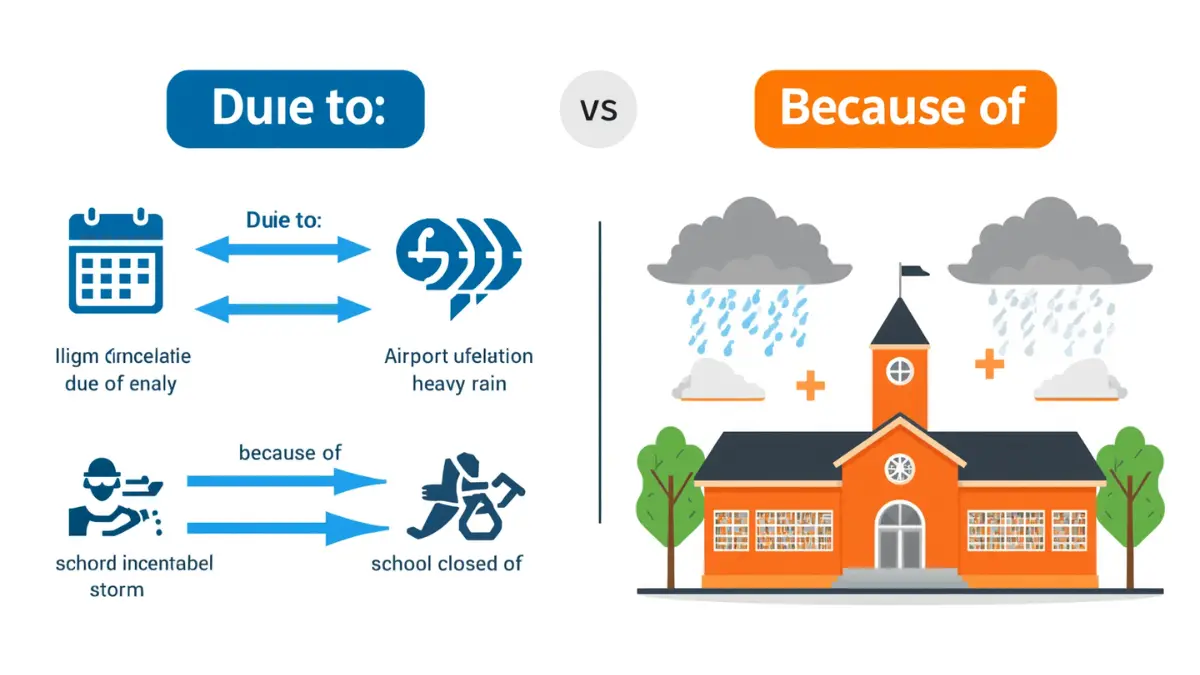
Many English learners get stuck when they write sentences like “The game was canceled due to rain” or “The game was canceled because of rain.” Both sound correct, so people often wonder which one is right. That is why thousands of users search for due to or because of every month.
The confusion happens because both phrases explain reasons, but they do not always work in the same way. In some cases, due to is used more formally, while because of is more natural in everyday English. However, many learners mix them up in essays, emails, and exams.
Understanding due to or because of helps you write clearer and more professional sentences. It also improves grammar accuracy and makes your English sound more natural. For example, saying “The delay was due to traffic” is correct, but only if used in the right sentence structure.
In this guide, you will learn the difference between due to or because of, their origin, rules, common mistakes, real-life examples, FAQs, and expert writing tips. By the end, you will confidently use both phrases correctly.
Due to or Because of – Quick Answer
Simple Rule
- Because of = used to explain a reason (adverbial phrase).
- Due to = used after a form of “to be” (formal explanation).
Examples
✅ The match was canceled because of rain.
✅ The cancellation was due to rain.
Easy Memory Trick
- Because of = action happens
- Due to = result is described
Read more : Fewer or Less: What’s the Difference and Which One Is Correct?
More Examples
| Phrase | Example |
| Because of | We were late because of traffic. |
| Due to | The delay was due to traffic. |
| Because of | The event stopped because of snow. |
| Due to | The stop was due to snow. |
The Origin of Due to or Because of
Both phrases developed in English over time as ways to explain cause and effect.
Origin of “Because of”
“Because” comes from Middle English by cause, meaning “for the reason of.” The phrase “because of” evolved naturally to link reasons with actions.
Origin of “Due to”
“Due” comes from Latin debere, meaning “to owe or be owed.” Over time, “due to” began to mean “caused by” in formal writing.
Why Confusion Exists
Confusion happens because:
- Both express reasons
- Both are used in formal writing
- Many speakers use them interchangeably
- Grammar rules are not always followed in speech
Read more; Which or That: What’s the Difference ?
British English vs American English Spelling
There is no spelling difference between British and American English for due to or because of. However, usage style differs slightly.
Comparison Table
| Feature | British English | American English |
| Because of | Common | Very common |
| Due to | Formal use | Formal use |
| Spoken English | Because of preferred | Because of preferred |
| Academic writing | Due to used carefully | Due to used carefully |
Examples
British English
- The flight was delayed because of fog.
- The delay was due to fog.
American English
- School closed because of snow.
- Closure was due to snow.
Which Spelling Should You Use?
Since spelling is identical, focus on grammar and context.
Use “Because of” When:
- Explaining a reason directly
- Writing casual or clear sentences
- Describing actions
Examples
- She missed school because of illness.
- We stopped because of the rain.
Use “Due to” When:
- Following “is/was/are/were”
- Writing formal or academic content
- Describing causes of results
Examples
- The accident was due to speeding.
- The success was due to hard work.
Global Advice
For most writers:
- Use because of for clarity
- Use due to for formal tone
Common Mistakes with Due to or Because of
Mistake 1
❌ He was late due to he missed the bus.
✅ He was late because he missed the bus.
Mistake 2
❌ The match canceled due to rain.
✅ The match was canceled due to rain.
Mistake 3
❌ Because of the success was the team happy.
✅ The team was happy because of the success.
Mistake 4
❌ She failed due to she did not study.
✅ She failed because she did not study.
Due to or Because of in Everyday Examples
In Emails
- The meeting was postponed because of technical issues.
- The delay was due to system maintenance.
In News Writing
- Flights were canceled because of heavy snow.
- The cancellation was due to weather conditions.
On Social Media
- I stayed home because of the rain.
- Plans changed due to unexpected events.
In Formal Writing
- Sales dropped because of market changes.
- The decline was due to economic factors.
Due to or Because of – Google Trends & Usage Data
Search interest for due to or because of is high because learners want to improve grammar accuracy.
Countries with High Interest
| Country | Popularity |
| United States | Very High |
| United Kingdom | High |
| India | Very High |
| Pakistan | High |
| Canada | High |
Why People Search This Keyword
People search it when:
- Writing essays
- Preparing for exams
- Learning English grammar
- Writing emails
- Improving professional writing
Common Contexts
| Context | Preferred Phrase |
| Casual writing | Because of |
| Formal writing | Due to |
| Academic writing | Both (carefully used) |
| Spoken English | Because of |
Comparison Table: Due to vs Because of
| Feature | Due to | Because of |
| Usage | Formal | General |
| Grammar Role | Adjective phrase | Adverbial phrase |
| Structure | Follows “to be” verbs | Used freely |
| Example | Delay was due to rain | We stopped because of rain |
| Tone | Formal | Natural |
FAQs About Due to or Because of
What is the main difference between due to and because of?
“Because of” explains a reason directly, while “due to” is used in formal sentence structures.
Can I use due to and because of interchangeably?
Not always. They follow different grammar rules.
Is due to more formal than because of?
Yes, “due to” is more formal.
Which is better for daily English?
“Because of” is more natural for everyday use.
Can due to start a sentence?
Usually no. It is used after “is/was/are.”
Why do people confuse these phrases?
Because both express cause and effect.
Is there a spelling difference in UK and US English?
No, both phrases are spelled the same in all English varieties.
Conclusion
Understanding due to or because of helps you write clearer and more correct English. Although both phrases explain reasons, they follow different grammar rules. Because of is used more freely and sounds natural in everyday speech, while due to is more formal and usually follows a form of the verb “to be.”
Many learners confuse these phrases because both express cause and effect. However, once you learn the structure rule, it becomes easy to choose the correct one. If you want simple and clear writing, “because of” is often the best choice. If you want a formal or academic tone, “due to” is more suitable.
There is no spelling difference in British or American English, making these rules universal. Practicing real examples will help you use both phrases naturally in writing, emails, essays, and conversations.
Mastering due to or because of improves your grammar accuracy and makes your English sound more professional and confident.

I am Arshman Ali, a professional content writer and the author behind tensestutor.com . I am passionate about making grammar simple and accessible for everyone. Through my writing, I aim to help learners and professionals communicate with clarity and confidence.