You’re composing a grocery list, a recipe, or perhaps a caption for that ridiculous garden harvest photo and type in “tomatos.” Then you stop. Something looks off. You add an e, remove an e, add an e. Now a five letter word has become a crisis.
Now this isn’t a case of overthinking it. Tomatoes or tomatos is one of the spelling errors that bedevils any good writer. Nor is it some esoteric grammar point no one knows or reads in a book. A straightforward pluralisation pattern that English unnecessarily made inconsistent.
Let’s clear it up, then. You will know which spelling is correct, why you might choose the wrong one, and how you will never again have to worry about the spelling of a vegetable that is a fruit.
Tomatoes or Tomatos – Quick Answer
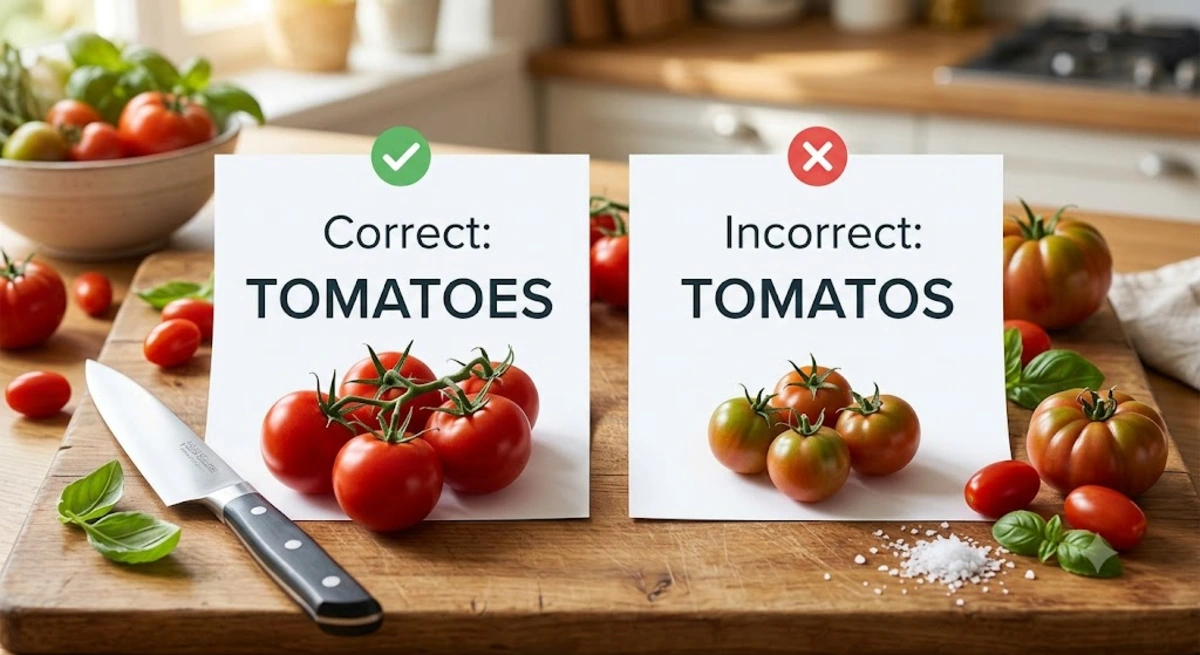
Tomatoes is the correct spelling. The only standard English plural for “tomato” is this one. Tomatos is a frequently misspelled word that appears with great frequency, but not in any significant dictionary.
✅ Correct: I bought three pounds of tomatoes at the farmers market.
❌ Incorrect: I bought three pounds of tomatos.
Read More: You’ve Probably Been Using “Segway” Wrong:
The Origin of “Tomatoes” vs. “Tomatos”
It’s not a British vs. American issue, nor is it historical coincidence. The question is really a baffling one in English: how to pluralize words ending in “o.”
There was no consistent way of dealing with this in English.
Some words simply add “s”
Others add “es”:
- potato → potatoes
- hero → heroes
- tomato → tomatoes
There is no single rule to tell which word goes in which category. As a general rule, it depends on factors such as its origin and the age of the word in English; however, it is not quite straightforward in all cases.
Read More: Which Spelling Koozie or Coozie?
It is one of those places where the rules of English say: look it up, don’t follow the rules.
Tomato happens to be in the “es” camp along with potato, hero, and echo. Many people assume that since most other “o” words are singular, “tomatos” is the correct plural form, but tomato is one that is different.
But, if you recognize this subject for a totally different reason, it most likely comes from the popular “you say tomato, I say tomato” quote. It is worth noting that this helps with pronunciation, not spelling.
The spelling is not really disputed in that context; it’s the pronunciation that differs. Two completely different debates which coincidentally share a vegetable.
The Main Difference Between “Tomatoes” and “Tomatos”
It is not a regional variant of the same language such as “colour” and “color.” It’s simply a matter of correct vs. incorrect spelling.
| Tomatoes | Tomatos |
| Status: Correct standard spelling | Status: Common misspelling |
| Recognized by dictionaries: Yes | Recognized by dictionaries: No |
| Used in: All formal, professional, and everyday writing, including reports, instructions, letters, essays, and paragraphs. | Some words miss their initial letters, words are short and concise, signage is sometimes used incorrectly. |
| Grammar rule: Uses the “o + es” pattern (as in potato, hero) | Uses the wrong “o + s” pattern (e.g. piano) |
| Best practice: Always spell this way. | Avoid, even casually. |
Tomatos is not equivalent to tomatoes; in the case of koozie/coozie, either spelling is valid depending on the level of formality. Here, only one spelling is right. The other is simply a very common mistake.
Which Spelling Should You Use?
Writing a recipe, a grocery list, a business document, an essay, or even a social post? Always use “tomatoes.” There is no context in which “tomatos” is the better choice.
Do you feel like you’re being picky when correcting someone? It’s not something to obsess over, but if you’re editing someone else’s writing professionally, it’s a simple and worthwhile fix.
Writing for an international audience? The good news is that British English and American English agree on this one. There’s no regional difference to worry about.
Common Errors When Using “Tomatoes” and “Tomatos”
Error #1: Copying the “Just Add S” Pattern
Piano, photo, and logo all take an “s”, so many people assume tomato should too.
It doesn’t.
Error #2: Trusting Autocorrect Too Much
Older or poorly configured spell checkers have occasionally allowed “tomatos” to slip through, especially in informal writing. Once people see the mistake repeatedly, they often assume it’s correct.
Error #3: Being Misled by Signs or Menus
Many hand painted farm stand signs and small business menus accidentally use “tomatos.” Seeing it in print can make the spelling seem legitimate—even when it isn’t.
Error #4: Confusing It with “Tomato/Tomahto”
As mentioned earlier, “tomato/tomahto” is about pronunciation, not spelling. Whether you pronounce it tomayto or tomahto, the plural is always spelled tomatoes.
Error #5: Assuming the Singular Changes Too
Once people become confused, they sometimes wonder whether the singular should be “tomatoe.”
It shouldn’t.
The singular is always tomato.
This exact spelling mistake even became famous after a public spelling error made by a U.S. vice president in 1992, which is one reason this particular mistake is still remembered decades later.
Error #6: Overcorrecting Other “O” Words
After learning that tomato takes “es,” some people assume every word ending in “o” should do the same.
That leads to mistakes like:
- photoes ❌
- pianoes ❌
These are just as incorrect as tomatos. Unfortunately, English doesn’t apply this rule consistently, which is exactly why this mistake is so common.
Tomatoes in Everyday Examples
Here are a few real life examples showing how tomatoes is correctly used in everyday writing.
In a Text Message
“On the way home, can you pick up some tomatoes? We’re out.”
In a Recipe
“Chop four ripe tomatoes and reserve for the pasta while it cooks.”
In a News or Lifestyle Headline
“Record Tomato Harvest Tops Dry Summer for Local Farm.”
In a Formal Document
“The nutrition profile analysis used fresh tomatoes as a main source of lycopene and vitamin C.”
Notice that none of these examples work with the incorrect spelling “tomatos.” It isn’t an informal alternative or a regional variation—it’s simply an incorrect spelling.
Analyze Search Trends and Usage Patterns
Why Do People Search “Tomatoes or Tomatos”?
When users search “tomatoes or tomatos,” they’re almost always looking for a quick spelling check before sending a text, posting a recipe, or publishing a social media caption.
It’s the classic “let me double check before I embarrass myself” search.
The confusion exists because English pluralization especially for words ending in “o” isn’t always intuitive.
Unlike koozie vs. coozie, where both spellings are accepted, this isn’t a debate between two valid forms. The answer is always the same:
Tomatoes are correct in every context and in every English speaking region.
Interestingly, this spelling mistake appears far more often in casual writing—such as text messages, captions, and quick notes than in professionally edited writing like essays, reports, and business documents.
That’s largely because formal writing tools are more likely to catch the error.
Comparing Tomatoes vs. Tomatos
| Aspect | Tomatoes | Tomatos |
| Correctness | Standard, correct spelling | Incorrect spelling |
| Plural pattern | Follows potato, hero, echo | Incorrectly follows photo, piano, logo |
| Regional variation | None — used everywhere | None |
| Recognized by dictionaries | Yes | No |
| Commonly found in | All forms of writing | Typos and informal mistakes |
Frequently Asked Questions
So, is it “tomatoes” or “tomatos”?
Tomatoes is the correct spelling.
The misspelling tomatos comes from the fact that many English words ending in “o” simply add “s” in the plural, leading people to assume tomato follows the same pattern.
Why does “tomato” end with “es” instead of just “s”?
English isn’t consistent with words ending in “o.”
Many older or more traditional words take “es,” including:
- potato → potatoes
- hero → heroes
- tomato → tomatoes
Meanwhile, many newer or borrowed words simply add “s,” such as:
- photo → photos
- piano → pianos
There isn’t one universal rule, so many of these spellings simply have to be remembered.
Is “tomatoe” ever correct as the singular form?
No.
The singular is always tomato.
Only the plural adds “es”, becoming tomatoes.
Do British and American English spell it differently?
No.
Both British English and American English use tomatoes as the standard plural.
Is this related to the phrase “tomato, tomahto”?
No.
That phrase refers to pronunciation, not spelling.
Whether you say tomayto or tomahto, the plural is always written as tomatoes.
Why do so many people make this mistake?
Because English doesn’t apply the same plural rule to every word ending in “o.”
When people encounter exceptions, they naturally fall back on the more familiar “just add s” pattern, which leads to the incorrect spelling tomatos.
Are there other words with the same kind of mistake?
Yes. Similar mistakes include:
- potato → potatoes
- hero → heroes
- echo → echoes
These words also require “es” instead of just “s.”
Is the plural of “avocado” the same?
This one is more flexible.
Today, avocados is the most common and widely accepted plural, while avocadoes also appears occasionally but is much less common.
Final Thoughts
At first glance, tomatoes and tomatos may seem like two acceptable spellings of the same word—but they are not.
Just as potato becomes potatoes and hero becomes heroes, the correct plural of tomato is always tomatoes. While English has many “o” words that simply add “s,” tomato isn’t one of them.
This isn’t a difference between British and American English, nor is it a matter of formality or personal preference. It’s simply a case of correct vs. incorrect spelling.
Here’s an easy rule to remember: if you’re writing a grocery list, a recipe, an email, an essay, or a social media caption, always use “tomatoes.”
Once you remember that tomato → tomatoes, you’ll never have to second guess the spelling again.

I am Arshman Ali, a professional content writer and the author behind tensestutor.com . I am passionate about making grammar simple and accessible for everyone. Through my writing, I aim to help learners and professionals communicate with clarity and confidence.