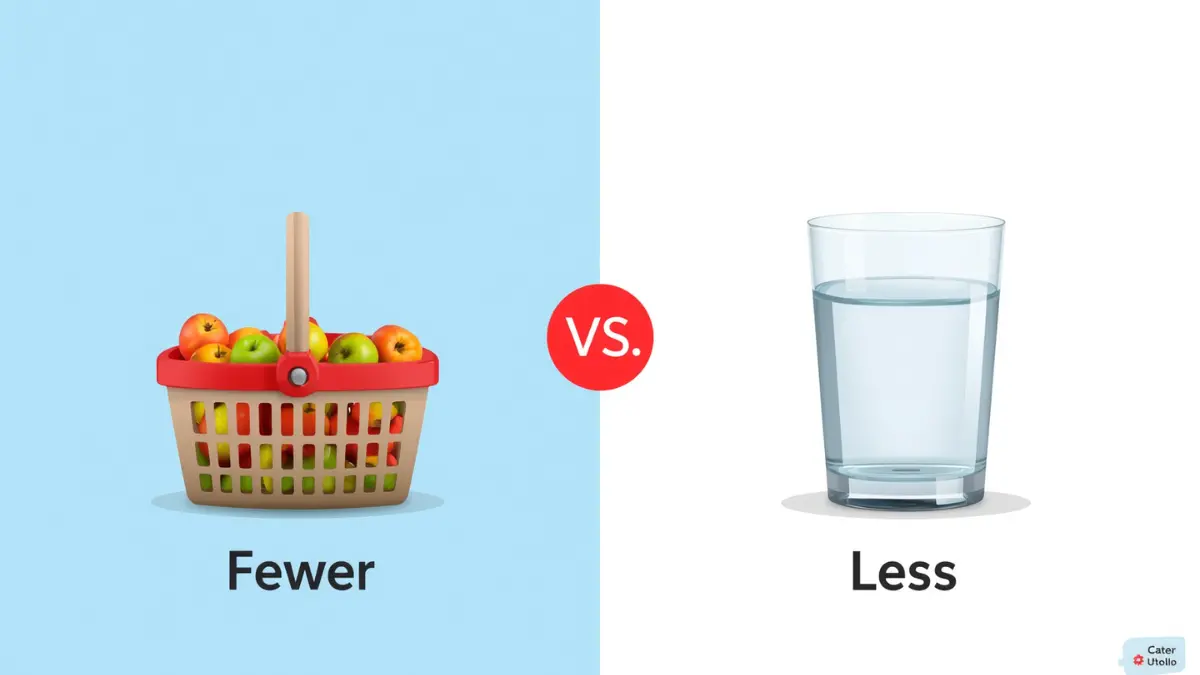
Many English learners stop while writing sentences like “less people” or “fewer people.” Both words talk about smaller amounts, so they seem similar. This is why thousands of people search for “fewer or less” every month. The confusion appears in school essays, office emails, advertisements, and even supermarket signs.
You may have seen phrases like “10 items or less” at stores. Some grammar experts say it should be “10 items or fewer.” This small difference creates big grammar debates. Understanding fewer or less helps writers sound more professional and accurate.
The basic rule is simple. Fewer is used for things you can count, while less is used for things you cannot count easily. Once you learn this rule, choosing the correct word becomes much easier.
In this guide, you will learn the meaning of fewer or less, their history, British and American usage, common mistakes, everyday examples, FAQs, and expert writing tips. By the end, you will confidently know when to use each word correctly.
Fewer or Less – Quick Answer
Simple Rule
- Use fewer for countable things.
- Use less for uncountable things.
Examples
✅ Fewer students attended the class.
✅ Less water remained in the bottle.
Easy Memory Trick
- Fewer = Number you can count
- Less = Amount you cannot count
Read more: Grey or Gray: Meaning and Correct Usage in English?
More Examples
| Correct Usage | Example |
| Fewer | Fewer cars were on the road. |
| Less | Less sugar is healthier. |
| Fewer | We need fewer chairs. |
| Less | She spends less money now. |
The Origin of Fewer or Less
The words fewer and less both come from Old English. Writers have used them for hundreds of years to describe smaller amounts or numbers.
Origin of “Less”
The word less comes from the Old English word læssa, meaning “smaller” or “not as much.”
Origin of “Fewer”
The word fewer developed later from the word few, meaning “a small number.”
Why the Confusion Exists
The confusion happens because:
- Both words describe reduction.
- People often hear incorrect usage in daily speech.
- Advertisements and signs sometimes ignore grammar rules.
- Spoken English is often less strict than formal writing.
Today, grammar experts usually recommend:
- Fewer for countable nouns
- Less for uncountable nouns
Read more: Draught or Draft: Meaning, Difference, and Simple Usage Guide
British English vs American English Spelling
There is no spelling difference between British and American English for fewer and less. However, usage styles can differ slightly.
Comparison Table
| Usage | British English | American English |
| Countable nouns | Fewer | Fewer |
| Uncountable nouns | Less | Less |
| Store signs | Sometimes “less” used casually | “Less” commonly seen |
| Formal writing | Grammar rules followed closely | Grammar rules followed closely |
Examples
British English
- Fewer people traveled this year.
- Less rain fell in summer.
American English
- Fewer employees attended the meeting.
- Less traffic was reported today.
Which Spelling Should You Use?
Since the spelling is the same worldwide, focus on grammar and audience.
Use “Fewer” When:
- Talking about countable items
- Writing formal English
- Creating academic or business content
Examples
- Fewer books
- Fewer mistakes
- Fewer customers
Use “Less” When:
- Talking about amounts or mass
- Discussing uncountable nouns
- Writing naturally in everyday English
Examples
- Less water
- Less time
- Less energy
Global Writing Tip
For professional writing worldwide:
- Use fewer for countable things.
- Use less for uncountable things.
Common Mistakes with Fewer or Less
Mistake 1
❌ Less people attended the concert.
✅ Fewer people attended the concert.
Mistake 2
❌ Fewer water was available.
✅ Less water was available.
Mistake 3
❌ We need less chairs.
✅ We need fewer chairs.
Mistake 4
❌ There are fewer milk cartons left.
✅ There is less milk left.
Exception
In everyday English, “less” is often used with time, money, and distance.
Examples:
- Less than 10 minutes
- Less than $20
- Less than five miles
These are accepted in modern usage.
Fewer or Less in Everyday Examples
In Emails
✅ We received fewer complaints this month.
✅ The project required less time than expected.
In News Writing
✅ Fewer voters attended the event.
✅ Less pollution improved air quality.
On Social Media
✅ Trying to eat fewer snacks.
✅ Spending less time online now.
In Formal Writing
✅ Researchers reported fewer errors.
✅ The machine used less energy.
Fewer or Less – Google Trends & Usage Data
Searches for “fewer or less” stay high because grammar learners often confuse the two words.
Countries with High Search Interest
| Country | Search Popularity |
| United States | Very High |
| United Kingdom | High |
| Canada | High |
| Australia | High |
| India | Growing |
Why People Search It
People commonly search this keyword when:
- Writing essays
- Editing emails
- Preparing exams
- Learning grammar
- Creating blog content
Common Usage Contexts
| Context | Common Word |
| Countable items | Fewer |
| Liquids and amounts | Less |
| Casual speech | Less |
| Formal grammar | Fewer and less correctly separated |
Comparison Table: Fewer vs Less
| Feature | Fewer | Less |
| Used For | Countable nouns | Uncountable nouns |
| Grammar Type | Number | Amount |
| Example | Fewer apples | Less juice |
| Common Context | Formal writing | Everyday speech |
| Easy Memory Tip | Can count | Cannot count |
FAQs About Fewer or Less
What is the main difference between fewer and less?
Use fewer for things you can count and less for things you cannot count.
Is “10 items or less” wrong?
Strict grammar says “10 items or fewer,” but “less” is common in stores.
Can less be used with numbers?
Yes, especially with time, money, and distance.
Which word is more formal?
“Fewer” is usually more formal when discussing countable items.
Why do people confuse fewer and less?
Both words describe smaller amounts, and casual speech often mixes them.
Is there a spelling difference in UK and US English?
No. Both countries spell and use the words the same way.
How can I remember the rule easily?
Remember:
- Fewer = countable
- Less = uncountable
Conclusion
Understanding fewer or less can improve your grammar and make your writing more professional. Although the words seem similar, they follow a simple rule. Use fewer for things you can count, like books, people, or cars. Use less for things you cannot count easily, like water, money, or time.
This rule is important in academic writing, business communication, blogs, and formal English. While casual speech sometimes mixes the two words, correct grammar helps your writing sound clear and polished.
There is also no spelling difference between British and American English, so the same grammar rule works worldwide. Once you practice using countable and uncountable nouns correctly, choosing between fewer and less becomes natural.
A small grammar improvement can make a big difference in how readers understand your message. Mastering fewer and less is one simple step toward stronger English writing skills.

I am Arshman Ali, a professional content writer and the author behind tensestutor.com . I am passionate about making grammar simple and accessible for everyone. Through my writing, I aim to help learners and professionals communicate with clarity and confidence.