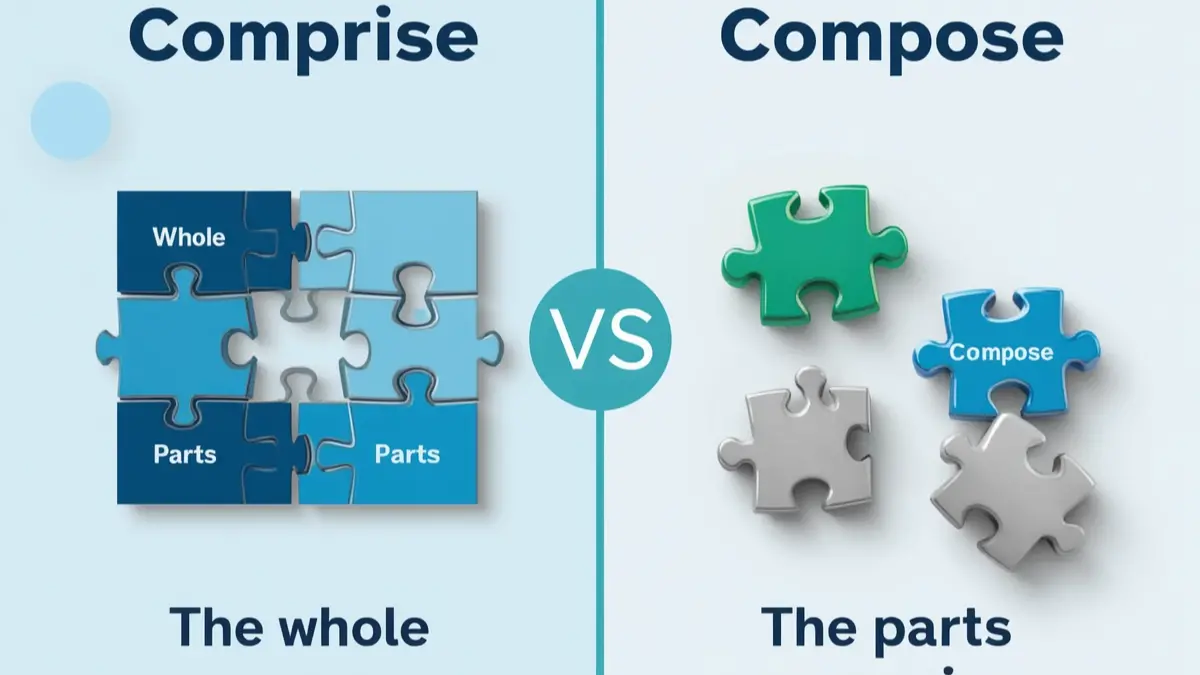
Many English learners and native speakers get confused by comprise and compose. The two words are closely related and often appear in similar sentences. Because of this, people frequently wonder which one is correct.
The confusion usually happens when describing parts and holes. For example, should you say, “The committee comprises ten members,” or “The committee is composed of ten members”? Both can be correct, but they do not work in exactly the same way.
Understanding the difference between comprise and compose helps you write more clearly in emails, reports, academic papers, and everyday communication. It also helps you avoid a common grammar mistake that many writers make.
In this guide, you will learn the meaning of each word, where they came from, how they are used in British and American English, common mistakes to avoid, and practical examples you can use right away.
Comprise or Compose – Quick Answer
Comprise means to include or contain.
Compose means to make up or form something.
Examples
✅ The team comprises 15 players.
✅ Fifteen players compose the team.
✅ The book comprises ten chapters.
✅ Ten chapters compose the book.
Simple Rule
- The whole comprises the parts.
- The parts compose the whole.
Read more: Fewer or Less: What’s the Difference and Which One Is Correct?
The Origin of Comprise or Compose
Both words come from Latin and entered English centuries ago.
Comprise
The word comprise comes from the Latin word comprehendere, meaning “to contain” or “to include.”
It entered English through French and gradually developed the meaning of including all parts within a whole.
Compose
The word compose comes from the Latin word componere, meaning “to put together.”
Over time, it became associated with forming or creating something from separate parts.
Why the Confusion Exists
The confusion exists because both words describe relationships between parts and wholes. Their meanings are connected, but their sentence structures are different.
British English vs American English Spelling
Unlike words such as colour/color or organise/organize, comprise and compose have the same spelling in both British and American English.
Comparison Table
| Meaning | British English | American English |
| Include or contain | Comprise | Comprise |
| Form or make up | Compose | Compose |
| Committee example | The committee comprises ten members. | The committee comprises ten members. |
| Team example | Ten players compose the team. | Ten players compose the team. |
There are no spelling differences between the two versions of English.
Read more: Which or That: What’s the Difference ?
Which Spelling Should You Use?
Since the spelling is identical in both regions, you do not need to choose between British and American versions.
If Your Audience Is American
Use comprise and compose according to their meanings.
If Your Audience Is British
The same rules apply.
If Your Audience Is Global
Choose the word that accurately matches your sentence structure.
Remember:
- Whole → comprises parts.
- Parts → compose whole.
Common Mistakes with Comprise or Compose
Many writers mix these words because they focus on meaning rather than grammar structure.
Mistake 1: Using “is comprised of”
❌ The team is comprised of 15 players.
✅ The team comprises 15 players.
✅ The team is composed of 15 players.
Although “is comprised of” is common in modern English, many style guides prefer the alternatives above.
Mistake 2: Reversing the Relationship
❌ Ten chapters comprise the book.
✅ The book comprises ten chapters.
✅ Ten chapters compose the book.
Mistake 3: Treating Them as Perfect Synonyms
❌ Comprise and compose always mean the same thing.
✅ They are related but used differently.
Comprise or Compose in Everyday Examples
Emails
- Our package comprises three services.
- Three services compose our package.
News Writing
- The council comprises representatives from five districts.
- Five districts compose the council’s membership.
Social Media
- My playlist comprises 100 songs.
- These songs compose my favorite playlist.
Formal Writing
- The research sample comprises 500 participants.
- Five hundred participants compose the research sample.
Comprise or Compose – Google Trends & Usage Data
Search interest for comprise and compose remains steady because people often need grammar guidance.
Usage by Country
- United States: Strong interest from students, writers, and professionals.
- United Kingdom: Frequently searched for academic and business writing.
- Canada: Commonly searched because both British and American writing influences exist.
- Australia and New Zealand: Popular among students and editors.
Common Search Intent
People often search:
- “Comprise vs compose”
- “Is comprised of correct?”
- “How do you use comprise?”
- “Difference between comprise and compose”
- “Comprise meaning”
Most searches aim to avoid grammar mistakes in professional writing.
Comprise vs Compose Comparison Table
| Feature | Comprise | Compose |
| Main Meaning | Include or contain | Form or make up |
| Focus | Whole includes parts | Parts create whole |
| Direction | Whole → Parts | Parts → Whole |
| Formal Usage | Very common | Very common |
| Example | The team comprises 15 players. | Fifteen players compose the team. |
| British English | Same spelling | Same spelling |
| American English | Same spelling | Same spelling |
FAQs
1. What is the difference between comprise and compose?
Comprise means a whole contains parts. Compose means parts form a whole.
2. Is “comprised of” grammatically correct?
Many people use it, but many grammar experts prefer “comprises” or “is composed of.”
3. Can comprise and compose be used interchangeably?
No. They describe opposite directions in a parts-to-whole relationship.
4. Which word is more formal?
Both are considered formal and appropriate for professional writing.
5. Do British and American English spell them differently?
No. Both words have the same spelling in British and American English.
6. How can I remember the difference?
Think of it this way:
- Whole = comprises
- Parts = compose
7. Is “The committee is composed of members” correct?
Yes. This is a correct and widely accepted sentence.
Conclusion
Understanding the difference between comprise and compose can improve your writing and help you avoid a very common grammar mistake. While the two words are closely related, they are not interchangeable. The key idea is the direction of the relationship between the whole and its parts.
When the whole includes the parts, use comprise. For example, “The book comprises ten chapters.” When the parts create the whole, use compose. For example, “Ten chapters compose the book.” This simple rule makes it much easier to choose the correct word.
Another important point is that there is no British versus American spelling difference. Both countries use the same spellings and meanings. The only thing that matters is choosing the word that fits your sentence structure.
Whether you are writing an email, report, article, social media post, or academic paper, using comprise and compose correctly will make your writing clearer, more professional, and easier to understand.

I am Bahadar Ali, a professional content writer and the author behind Tensestutor.com I am passionate about making grammar simple and accessible for everyone. Through my writing, I aim to help learners and professionals communicate with clarity and confidence.