Many English learners pause mid-sentence and wonder If to say “I feel nauseous” or “I feel nauseated.” This confusion is very common, which is why people often search for nauseated or nauseous to get a clear answer.
The problem is that both words are used in everyday speech to describe sickness, dizziness, or stomach discomfort. However, their meanings are not exactly the same. In fact, using them incorrectly can change how your sentence is understood, especially in formal writing or medical communication.
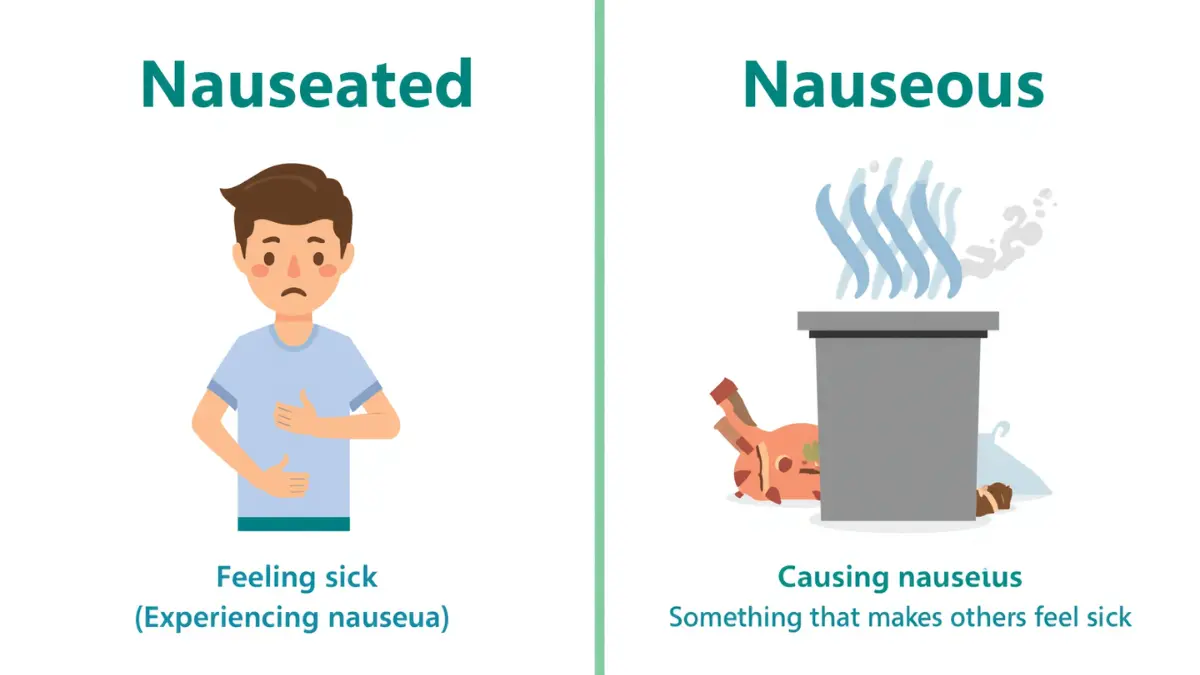
Understanding nauseated or nauseous helps you express symptoms more accurately. “Nauseated” usually means you feel sick, while “nauseous” traditionally means something causes nausea. But in modern English, especially in informal speech, people often mix both words.
In this guide, you will learn the correct meanings, origins, usage rules, common mistakes, real-life examples, FAQs, and expert writing advice for nauseated or nauseous so you can use them with confidence in both spoken and written English.
Nauseated or Nauseous – Quick Answer
Simple Rule
- Nauseated = feeling sick
- Nauseous = causing sickness (or commonly used to mean feeling sick in modern speech)
Examples
✅ I feel nauseated after the ride.
✅ The smell is nauseous (it causes sickness).
⚠️ I feel nauseous (common but technically debated in formal grammar).
Easy Memory Trick
- Nauseated = You feel it
- Nauseous = It causes it
Read more: Fewer or Less: What’s the Difference and Which One Is Correct?
The Origin of Nauseated or Nauseous
Both words come from Latin and have been used in English for centuries.
Origin of “Nauseous”
The word nauseous comes from Latin nausea, meaning “seasickness” or “feeling sick.” It originally described something that causes nausea.
Origin of “Nauseated”
The word nauseated comes from the verb “nauseate,” meaning “to make someone feel sick.”
Why Confusion Exists
Confusion happens because:
- Both relate to sickness
- Both are used in informal speech for “feeling sick”
- Modern English often ignores strict grammatical rules
- Medical vs casual usage differs
Read more: Which or That: What’s the Difference ?
British English vs American English Spelling
There is no spelling difference between British and American English for nauseated or nauseous, but usage differs slightly.
Comparison Table
| Feature | British English | American English |
| Nauseated | Preferred for “feeling sick” | Preferred in formal writing |
| Nauseous | Used for “causing sickness” | Often used informally for “feeling sick” |
| Medical usage | More strict | More flexible |
| Everyday speech | Mixed use | Very common mixed use |
Examples
British English
- I feel nauseated after the journey.
- The smell is nauseous.
American English
- I feel nauseous (common informal usage).
- That food is nauseous.
Which Spelling Should You Use?
Since spelling is the same, focus on meaning and audience.
Use “Nauseated” When:
- Describing your own feeling of sickness
- Writing formally or medically
- Wanting precise grammar
Examples
- I felt nauseated after the flight.
- She is nauseated by strong smells.
Use “Nauseous” When:
- Describing something that causes sickness
- Writing casually (modern usage)
- Speaking informally
Examples
- The garbage smell is nauseous.
- That spoiled food looks nauseous.
Global Writing Advice
For clear communication:
- Use nauseated for feelings
- Use nauseous for causes
Common Mistakes with Nauseated or Nauseous
Mistake 1
❌ I feel nauseous after eating too much.
✅ I feel nauseated after eating too much.
Mistake 2
❌ The patient is nauseous from travel sickness (formal context).
✅ The patient is nauseated from travel sickness.
Mistake 3
❌ The medicine made me nauseous (feeling).
✅ The medicine made me nauseated.
Mistake 4
❌ I am nauseated smell.
✅ The smell is nauseous.
Nauseated or Nauseous in Everyday Examples
In Emails
- I am feeling nauseated today and will take a rest.
- The strong chemical odor is nauseous.
In News Writing
- Passengers reported feeling nauseated during turbulence.
- Officials said the waste leak created a nauseous smell.
On Social Media
- That roller coaster made me feel so nauseated 😵
- That spoiled food looks nauseous 🤢
In Formal Writing
- The patient reported being nauseated after medication.
- The environment produced a nauseous odor.
Nauseated or Nauseous – Google Trends & Usage Data
Search interest for nauseated or nauseous remains steady because learners and writers want clarity in medical and everyday English.
Popular Countries
| Country | Search Interest |
| United States | Very High |
| United Kingdom | High |
| Canada | High |
| India | High |
| Australia | High |
Why People Search This Keyword
People look it up when:
- Writing medical reports
- Learning English grammar
- Writing essays or blogs
- Describing symptoms
- Preparing exams
Common Contexts
| Context | Usage |
| Medical writing | Nauseated |
| Everyday speech | Nauseous (mixed) |
| Academic writing | Nauseated preferred |
| Informal talk | Both used |
Comparison Table: Nauseated vs Nauseous
| Feature | Nauseated | Nauseous |
| Meaning | Feeling sick | Causing sickness |
| Usage | Personal symptom | External cause |
| Formality | High | Medium |
| Example | I am nauseated | The smell is nauseous |
| Common mistake | Using for cause | Using for feeling |
FAQs About Nauseated or Nauseous
What is the main difference between nauseated and nauseous?
Nauseated means you feel sick, while nauseous means something causes sickness.
Is it correct to say “I feel nauseous”?
Yes in modern English, but traditionally “I feel nauseated” is more correct.
Which word is more formal?
“Nauseated” is preferred in formal and medical writing.
Can nauseous mean feeling sick?
Yes in casual speech, but grammar experts often discourage it.
What causes confusion between the two words?
Both words relate to nausea and are used interchangeably in everyday language.
Is there a spelling difference in UK and US English?
No, both regions use the same spelling.
How can I remember the difference easily?
Nauseated = you feel it
Nauseous = it causes it
Conclusion
Understanding nauseated or nauseous helps you communicate symptoms clearly and correctly. While both words are related to sickness, they are not identical. “Nauseated” describes how a person feels, while “nauseous” describes something that causes that feeling. However, modern English often mixes these meanings, especially in casual speech.
For formal writing, medical reports, or professional communication, using “nauseated” is usually more accurate and preferred. In everyday conversation, both words are commonly understood, even if used loosely.
By learning the difference between nauseated or nauseous, you can avoid common grammar mistakes and improve clarity in both writing and speaking. This small distinction makes your English sound more precise, natural, and professional.

I am Arshman Ali, a professional content writer and the author behind tensestutor.com . I am passionate about making grammar simple and accessible for everyone. Through my writing, I aim to help learners and professionals communicate with clarity and confidence.