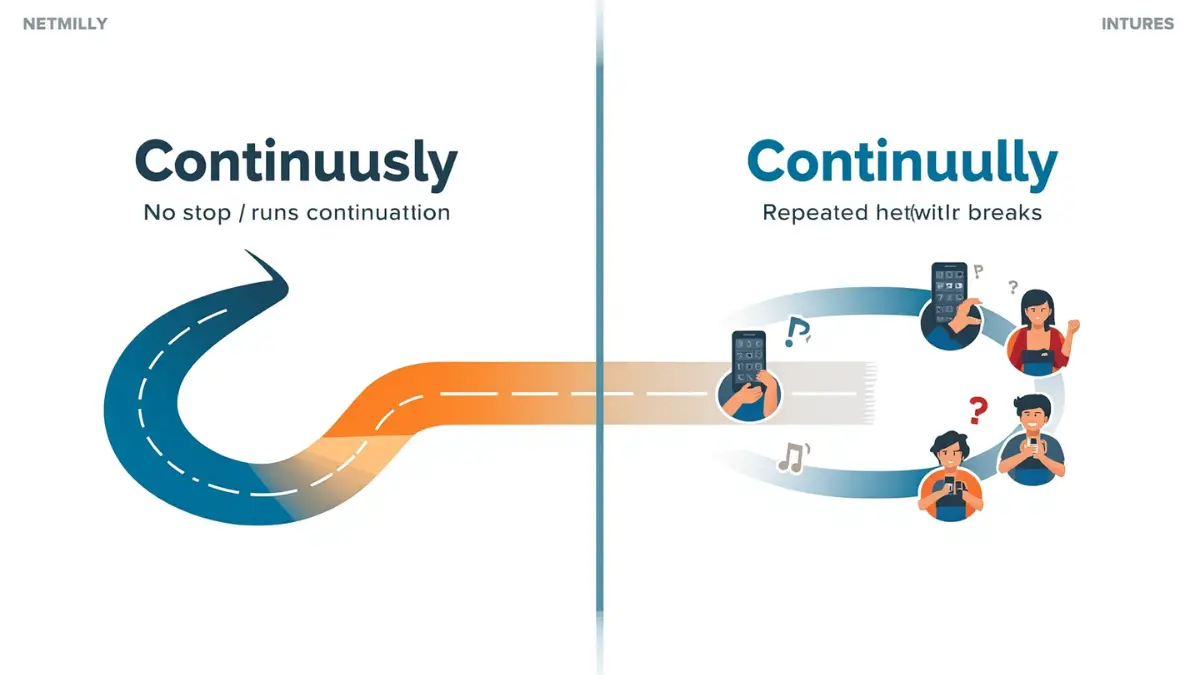
Many English learners get confused continuously or continually because both words look and sound similar. They are often used in schools, business writing, news reports, and exams. But their meanings are not the same.
People search for this topic when they want to avoid grammar mistakes and improve writing clarity. Using the wrong word can change the meaning of a sentence. For example, something can happen without stopping (continuously), or it can happen again and again with breaks (continually).
This confusion is very common in both British and American English. Even native speakers mix them up in emails, reports, and social media posts.
Understanding the difference helps you write more clearly and professionally. It also improves your grammar score in exams and makes your content sound more natural.
In this guide, you will learn the exact meaning of each word, their origin, usage rules, mistakes to avoid, and real-life examples. By the end, you will never confuse them again.
Continuously or Continually – Quick Answer
Continuously means without stopping.
Continually means repeatedly, with breaks in between.
Simple Examples
- It rained continuously for 5 hours. (no stop)
- He continually interrupts the class. (again and again)
Easy Rule
- Continuous = No break
- Continual = Repeated with breaks
Think like this:
- A machine running non-stop → continuously
- A phone ringing again and again → continually
Read more: Recognise or Recognize: Meaning and Correct Usage Guide
The Origin of Continuously or Continually
Both words come from Latin roots.
Continuously
From Latin continuus, meaning “uninterrupted” or “joined together.” It became part of English through Old French.
Continually
From Latin continualis, meaning “repeated often” or “happening again.” It entered English later with a slightly different meaning.
Why the Confusion Exists
Both words come from the idea of “continuing,” but English split their meanings:
- One focuses on no stop
- The other focuses on repetition
British English vs American English Spelling
There is no spelling difference between British and American English for these words. The difference is only in meaning and usage.
Read more : Organise or Organize: Meaning and Correct Usage in English
Comparison Table
| Word | Meaning | Usage Type | Example |
| Continuously | Without stopping | Time-based | The engine runs continuously |
| Continually | Repeatedly with breaks | Event-based | He continually asks questions |
Both British and American English follow the same rules.
Which Spelling Should You Use?
Since spelling is the same, focus on meaning instead of region.
Use “Continuously” when:
- Something never stops
- Machines or processes run non-stop
- Time flows without interruption
Use “Continually” when:
- Something happens again and again
- Actions repeat with pauses
- Behavior is repeated over time
Audience Tip:
- Academic writing → prefer clear distinction
- Business writing → use carefully for precision
- General writing → both are fine if correct
Common Mistakes with Continuously or Continually
Mistake 1
❌ The baby cried continuously every few minutes.
✔ The baby cried continually every few minutes.
Mistake 2
❌ The water flows continually without stopping.
✔ The water flows continuously without stopping.
Mistake 3
❌ He is continuously late to meetings (if it happens often with gaps).
✔ He is continually late to meetings.
Quick Fix Rule
| Wrong Usage | Correct Word |
| No stop | Continuously |
| Repeated action | Continually |
Continuously or Continually in Everyday Examples
Emails
- The system is continuously updated for security.
- We continually improve our customer service.
News Writing
- The river flowed continuously after heavy rain.
- The politician was continually criticized during debate.
Social Media
- I am continuously learning new skills.
- She is continually posting travel photos.
Formal Writing
- The machine operates continuously for 24 hours.
- The company is continually expanding its services.
Continuously or Continually – Google Trends & Usage Data
Both words are widely searched in English learning communities.
Observations:
- “Continuously” is more common in technical and scientific writing.
- “Continually” is more common in everyday speech and behavior descriptions.
- Students often search both together due to confusion in exams.
Country Usage Pattern
| Country | Continuously Usage | Continually Usage |
| USA | High | High |
| UK | High | High |
| India | Very High | Very High |
| Pakistan | High | High |
| Australia | High | High |
Both words are globally used with equal importance.
Continuously vs Continually Comparison Table
| Feature | Continuously | Continually |
| Meaning | No stop | Repeated actions |
| Breaks | No breaks | Has breaks |
| Focus | Time/process | Frequency |
| Example | Runs continuously | Calls continually |
| Usage style | Technical | General |
FAQs
1. What is the main difference between continuously and continually?
Continuously means without stopping. Continually means repeated actions with breaks.
2. Can I use continuously and continually interchangeably?
No. They have different meanings and should not be mixed.
3. Is continuously more formal than continually?
Both are formal, but continuously is more common in technical writing.
4. What is a simple trick to remember them?
No stop = continuously
Repeat = continually
5. Is there a British vs American spelling difference?
No. Both are spelled the same in all English varieties.
6. Which word is more common?
Continuously is slightly more common in scientific and technical contexts.
7. Can both be used in the same sentence?
Yes, if describing different actions:
“The machine runs continuously while workers continually monitor it.”
Conclusion
Understanding continuously or continually is important for clear and correct English writing. Although the words look similar, their meanings are very different. One describes something that never stops, while the other describes actions that happen again and again with breaks.
Many learners confuse these words because they both come from the idea of continuation. However, once you remember the simple rule continuous means no stop, continual means repeated the difference becomes easy.
In exams, business writing, and daily communication, using the correct word improves clarity and professionalism. It also helps avoid misunderstanding in technical and formal contexts.
Both British and American English use the same spelling, so the focus should always be on meaning, not region.
With practice and real-life examples, you can confidently use both words in the right situation and improve your English fluency.

I am Bahadar Ali, a professional content writer and the author behind Tensestutor.com I am passionate about making grammar simple and accessible for everyone. Through my writing, I aim to help learners and professionals communicate with clarity and confidence.