People often say things like “I’m literally dying of laughter” or “He figuratively climbed the ladder of success.” This is why many learners search for literally or figuratively because the two words seem similar but mean very different things.
The confusion happens because modern English often uses “literally” in an exaggerated way, even when something is not actually true. For example, “I literally exploded with anger” does not mean a real explosion. This creates misunderstanding for students, writers, and professionals who want to speak and write correctly.
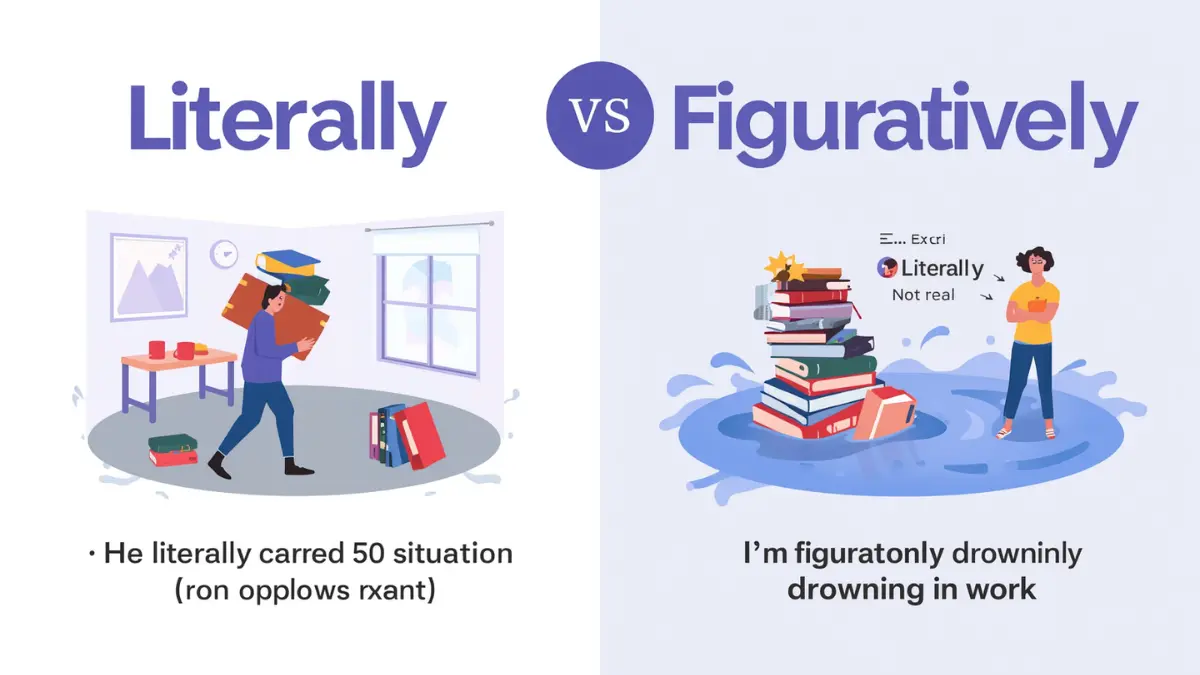
Understanding literally or figuratively helps you communicate clearly. “Literally” means something is 100% true in reality, while “figuratively” means something is symbolic or exaggerated for effect. Knowing the difference improves writing quality, avoids confusion, and makes your English sound more natural and precise.
In this guide, you will learn meanings, origins, usage rules, mistakes, examples, FAQs, and real-world writing tips for literally or figuratively so you can use both words confidently.
Literally or Figuratively – Quick Answer
Simple Rule
- Literally = true in real life, no exaggeration
- Figuratively = symbolic or exaggerated meaning
Examples
✅ I literally saw a lion in the zoo.
❌ I literally died laughing (not real).
✅ She is figuratively on top of the world after success.
❌ He literally has a heart of stone (not real).
Easy Memory Trick
- Literally = Real
- Figuratively = Symbolic
Read more ; Analyse or Analyze: Meaning, Spelling and Simple Usage Guide?
The Origin of Literally or Figuratively
Both words come from Latin roots and have been used for centuries.
Origin of “Literally”
The word literally comes from Latin littera, meaning “letter.” It originally meant “word for word” or “exactly as written.”
Origin of “Figuratively”
The word figuratively comes from Latin figura, meaning “shape or form.” It developed to describe language that uses symbols, images, or comparisons.
Why Confusion Exists
The confusion comes from:
- People using “literally” for emphasis
- Social media exaggeration
- Spoken English changing faster than grammar rules
- Overuse in casual speech
British English vs American English Spelling
There is no spelling difference between British and American English for literally or figuratively. However, usage style differs slightly.
Read more : Grey or Gray: Meaning and Correct Usage in English?
Comparison Table
| Feature | British English | American English |
| Literally | Used strictly in formal writing | Often used casually (sometimes incorrectly) |
| Figuratively | Used in academic writing | Used in literature and speech |
| Style preference | More traditional | More flexible in speech |
Examples
British English
- He literally arrived at 5 pm.
- The story is figuratively powerful.
American English
- I literally can’t believe it (casual speech).
- She is figuratively a rising star.
Which Spelling Should You Use?
Since spelling is identical, focus on meaning and audience.
Use “Literally” When:
- Describing real facts
- Reporting events accurately
- Writing formal or academic content
Examples
- I literally saw the accident happen.
- The machine literally stopped working.
Use “Figuratively” When:
- Using metaphors or symbols
- Writing creative content
- Expressing emotional or poetic meaning
Examples
- He is figuratively climbing the ladder of success.
- She is figuratively walking on air.
Global Advice
- Use literally for real events
- Use figuratively for symbolic meaning
- Avoid mixing them in formal writing
Common Mistakes with Literally or Figuratively
Mistake 1
❌ I literally died laughing.
✅ I was laughing a lot (figuratively speaking).
Mistake 2
❌ She is literally a shining star (if not famous).
✅ She is figuratively a shining star.
Mistake 3
❌ He figuratively broke the window (if it actually broke).
✅ He literally broke the window.
Mistake 4
❌ I literally understand the poem (if meaning is unclear).
✅ I figuratively understand the poem’s meaning.
Literally or Figuratively in Everyday Examples
In Emails
- We literally completed the project ahead of time.
- The feedback is figuratively a roadmap for improvement.
In News Writing
- The bridge literally collapsed after the storm.
- The leader is figuratively reshaping the economy.
On Social Media
- I literally can’t stop laughing 😂
- She is figuratively glowing after success ✨
In Formal Writing
- The device literally measures temperature changes.
- The theory is figuratively described as a “bridge” between ideas.
Literally or Figuratively – Google Trends & Usage Data
Searches for literally or figuratively are very high because modern usage often blurs the rules.
Popular Countries
| Country | Search Interest |
| United States | Very High |
| United Kingdom | High |
| India | Very High |
| Canada | High |
| Australia | High |
Why People Search This Keyword
People search this when:
- Writing essays or blogs
- Learning English grammar
- Confused by social media usage
- Preparing exams
- Improving professional writing
Common Contexts
| Context | Usage Type |
| Academic writing | Strict use |
| Social media | Casual / mixed |
| Literature | Figurative language |
| News reporting | Literal meaning |
Comparison Table: Literally vs Figuratively
| Feature | Literally | Figuratively |
| Meaning | Real, exact truth | Symbolic meaning |
| Usage | Facts, reality | Metaphors, imagination |
| Tone | Formal | Creative |
| Example | I literally ran 5 km | He is figuratively on fire |
| Risk of misuse | High in casual speech | Lower |
FAQs About Literally or Figuratively
What is the main difference between literally and figuratively?
Literally means real truth, while figuratively means symbolic or metaphorical meaning.
Can literally be used for exaggeration?
Yes, but it is considered informal or incorrect in strict grammar.
Is figuratively the opposite of literally?
Yes, figuratively represents non-literal or symbolic meaning.
Why do people misuse literally?
Because it is often used for emphasis in casual speech and social media.
Can both words be used in formal writing?
Yes, but they must be used correctly based on meaning.
Is there a spelling difference in UK and US English?
No, both regions use the same spelling.
How can I remember the difference easily?
Literally = real
Figuratively = imagination
Conclusion
Understanding literally or figuratively is important for clear and accurate communication. While both words are common in English, they have very different meanings. “Literally” refers to real events or facts, while “figuratively” refers to symbolic or imaginative expressions.
The confusion between these words has increased because modern speech and social media often use “literally” for exaggeration. However, in formal writing, it is important to use each word correctly to avoid misunderstanding.
If you are writing essays, emails, or professional content, always check whether you mean something real or symbolic. This simple step improves clarity and makes your writing more precise.
By mastering literally or figuratively, you strengthen your English skills, avoid common mistakes, and communicate more effectively in both spoken and written language.

I am Arshman Ali, a professional content writer and the author behind tensestutor.com . I am passionate about making grammar simple and accessible for everyone. Through my writing, I aim to help learners and professionals communicate with clarity and confidence.