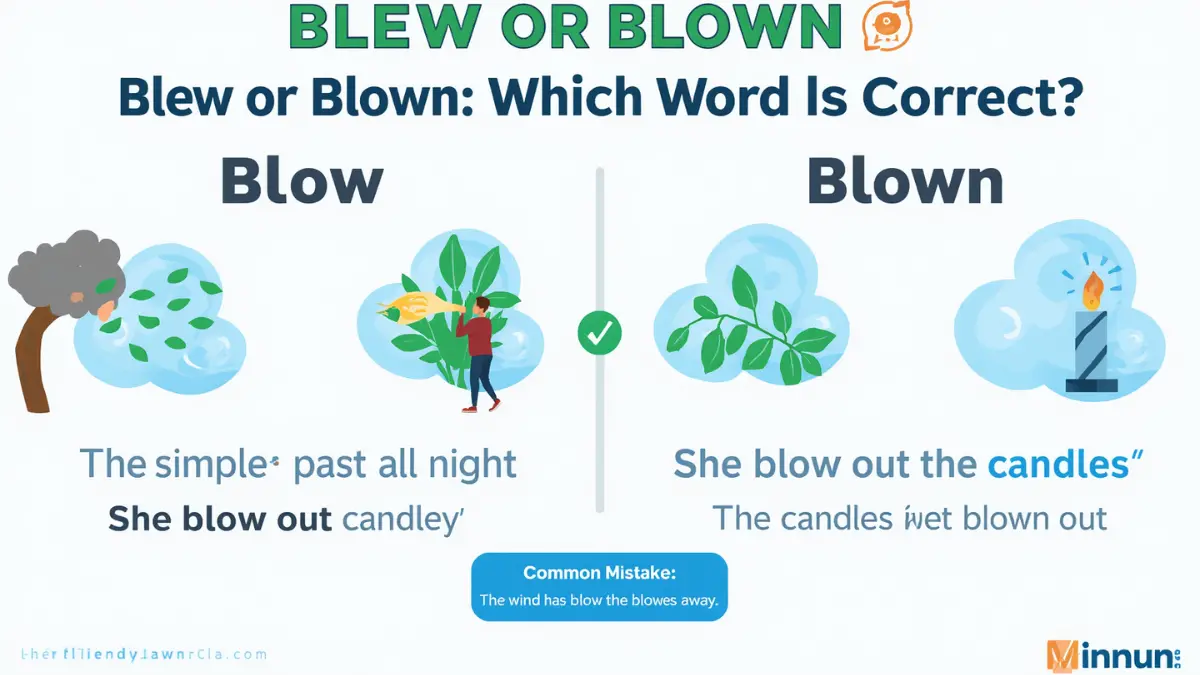
Many English learners and native speakers get confused by blew and blown. Both words come from the verb blow, but they are used in different ways. You may wonder whether to write “The wind blew hard” or “The wind has blown hard.” Since the words look similar and share the same meaning, it is easy to mix them up.
This confusion appears in emails, school assignments, business writing, and everyday conversations. Using the wrong form can make a sentence sound awkward or grammatically incorrect. The good news is that the rule is simple once you understand how English verb forms work.
In this guide, you’ll learn the difference between blew and blown, where these words came from, how they are used in British and American English, common mistakes to avoid, and examples from real-life situations. By the end, you’ll know exactly when to use each word and how to write with confidence.
Blew or Blown – Quick Answer
Blew is the simple past tense of the verb blow.
Blown is the past participle of blow and is usually used with helping verbs such as has, have, had, or been.
Examples
✅ The wind blew all night.
✅ She blew out the candles.
✅ The wind has blown the leaves away.
❌ The wind has blew all night.
❌ She has blew out the candles.
Read more: Dove or Dived: Which Past Tense Is Correct?
Quick Comparison
| Word | Grammar Form | Example |
| Blew | Simple past tense | The wind blew hard. |
| Blown | Past participle | The wind has blown hard. |
The Origin of Blew or Blown
Both blew and blown come from the verb blow, which dates back to Old English.
The word comes from the Old English blāwan, meaning “to breathe, puff, or move air.”
Over time, English developed different verb forms:
- Blow → Present tense
- Blew → Past tense
- Blown → Past participle
These are grammatical forms, not alternative spellings.
Read more: Proven or Proved: Which Word Is Correct ?
Verb Forms Table
| Base Form | Past Tense | Past Participle |
| Blow | Blew | Blown |
British English vs American English Spelling
There is no spelling difference between British English and American English for blew and blown.
Both countries use the same forms and follow the same grammar rules.
Examples
| British English | American English |
| The wind blew strongly. | The wind blew strongly. |
| The leaves have blown away. | The leaves have blown away. |
| The candle was blown out. | The candle was blown out. |
Comparison Table
| Feature | British English | American English |
| Blew | Blew | Blew |
| Blown | Blown | Blown |
| Meaning | Same | Same |
| Grammar Rules | Same | Same |
Which Spelling Should You Use?
The correct choice depends on grammar, not location.
Use Blew When:
- Talking about a completed action in the past.
- No helping verb is used.
Examples:
- The wind blew all day.
- He blew the whistle.
Use Blown When:
- Using has, have, or had.
- Using passive voice.
- Describing something affected by blowing.
Examples:
- The wind has blown the roof away.
- The whistle was blown loudly.
Audience Advice
| Audience | Recommended Usage |
| US Writers | Follow standard grammar rules |
| UK Writers | Follow standard grammar rules |
| Commonwealth Writers | Follow standard grammar rules |
| Global Audience | Use the grammatically correct form |
Common Mistakes with Blew or Blown
Mistake 1
❌ The wind has blew all night.
✅ The wind has blown all night.
Mistake 2
❌ She has blew out the candles.
✅ She has blown out the candles.
Mistake 3
❌ The whistle was blew.
✅ The whistle was blown.
Mistake 4
❌ They had blew away.
✅ They had blown away.
Easy Rule
If your sentence contains has, have, had, is, was, were, or been, you will usually need blown, not blew.
Blew or Blown in Everyday Examples
Emails
✅ The deadline blew past quickly.
✅ Our budget has blown up this quarter.
News Writing
✅ Strong winds blew across the region.
✅ Several trees have been blown down.
Social Media
✅ The wind blew my hat away!
✅ My mind has been blown by this movie.
Formal Writing
✅ The storm blew through the area overnight.
✅ Research findings have blown apart previous theories.
Blew or Blown – Google Trends & Usage Data
Searches for blew or blown remain popular because many people struggle with irregular verbs.
Common Search Intent
- Blew vs blown
- Has blew or has blown
- Past tense of blow
- When to use blown
- Blew and blown examples
Popular Countries
The keyword is frequently searched in:
- United States
- United Kingdom
- Canada
- Australia
- India
- Pakistan
Most searches come from students, writers, and English learners.
Blew vs Blown Comparison Table
| Feature | Blew | Blown |
| Verb Type | Past tense | Past participle |
| Used Alone | Yes | Usually no |
| Used with Have/Has/Had | No | Yes |
| Used in Passive Voice | No | Yes |
| Example | The wind blew hard. | The wind has blown hard. |
| Common Error | Used after helping verbs | Less commonly misused |
FAQs
Is it “has blew” or “has blown”?
Has blown is correct.
✅ The wind has blown all night.
❌ The wind has blew all night.
Is blew the past tense of blow?
Yes.
✅ The wind blew yesterday.
What is the past participle of blow?
The past participle is blown.
✅ The leaves have blown away.
Can I use blown without has, have, or had?
Yes, in passive constructions.
✅ The candle was blown out.
Why do people confuse blew and blown?
Both come from the verb blow, and their meanings are closely related.
Are blew and blown interchangeable?
No.
Each word has a different grammatical function.
How can I remember the difference?
Think of the pattern:
Blow → Blew → Blown
Conclusion
Understanding the difference between blew and blown is easier than many people think. Both words come from the verb blow, but they serve different grammatical purposes. Blew is the simple past tense and describes an action that happened in the past. Blown is the past participle and usually follows helping verbs such as has, have, and had, or appears in passive voice.
A simple way to remember the rule is to learn the sequence: blow, blew, blown. If your sentence talks about a completed past action, use blew. If the sentence includes a helping verb or passive construction, use blown.
Since British English and American English use the same forms, writers around the world can follow the same grammar rules. Whether you’re writing an email, report, article, or social media post, choosing the correct form will make your writing clearer and more professional. With a little practice, you’ll never confuse blew and blown again.

I am Bahadar Ali, a professional content writer and the author behind Tensestutor.com I am passionate about making grammar simple and accessible for everyone. Through my writing, I aim to help learners and professionals communicate with clarity and confidence.