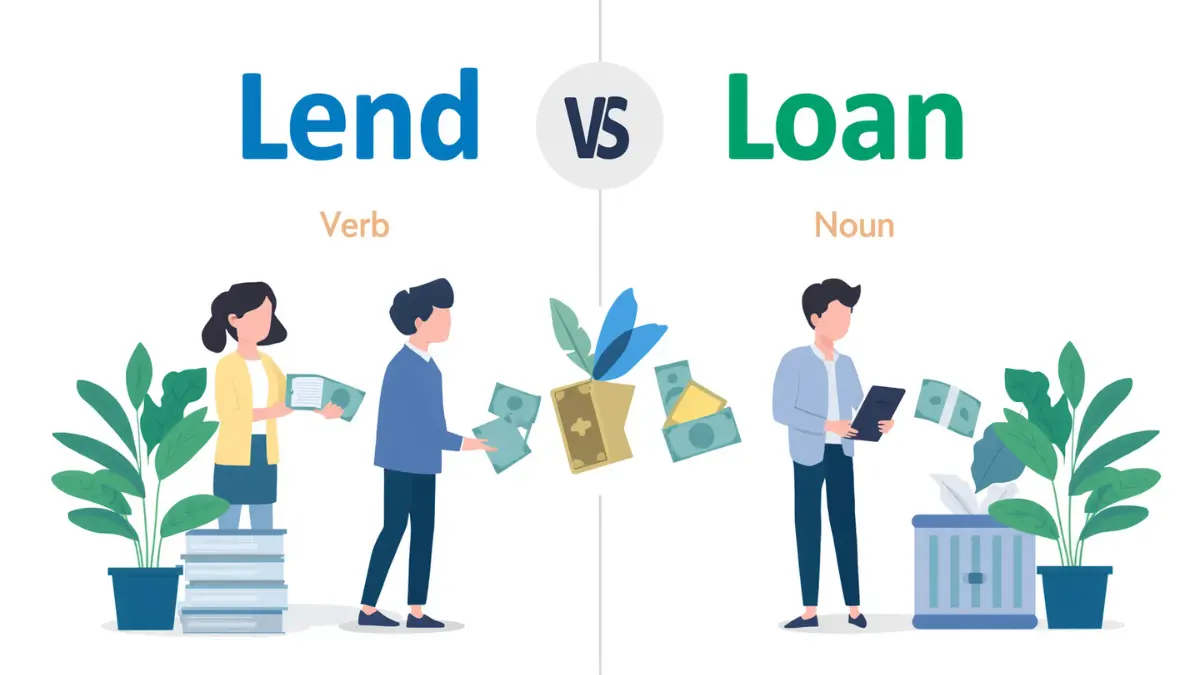
Have you ever wondered whether you should say lend or loan? Many English learners and native speakers get confused by these two words because they are closely related and often appear in similar situations. You might hear someone say, “Can you lend me some money?” while another person says, “The bank gave me a loan.” This can make it difficult to know which word is correct.
The confusion comes from the fact that both words involve giving something temporarily. However, they are not always used in the same way. In some cases, one word acts as a verb, while the other acts as a noun. Regional differences between British and American English can add even more confusion.
The good news is that the distinction is simple once you understand it. In this guide, you’ll learn the meaning of lend or loan, their origins, usage differences, common mistakes, and practical examples. By the end, you’ll know exactly when to use each word in everyday and professional writing.
Lend or Loan – Quick Answer
Lend is usually a verb that means to give something temporarily with the expectation that it will be returned.
Loan is usually a noun that refers to something that has been borrowed, especially money.
Examples
✅ Can you lend me your pen?
✅ She agreed to lend me her book.
✅ The bank approved my loan.
✅ He paid back the loan last year.
In American English, loan can sometimes be used as a verb:
✅ The bank will loan you the money.
However, lend is generally preferred in formal writing.
Read more: Since or Because: What’s the Difference
The Origin of Lend or Loan
The word lend comes from Old English lǣnan, meaning “to grant or allow someone to use something.”
The word loan comes from Old Norse lán, meaning “something borrowed.”
Over time, English developed a distinction:
- Lend became the standard verb.
- Loan became the standard noun.
This is why modern English usually uses:
- Lend = action
- Loan = thing
Word History Examples
| Word | Original Role |
| Lend | Verb |
| Loan | Noun |
Although American English sometimes uses loan as a verb, the traditional distinction remains common worldwide.
Read more: Comprise or Compose: What’s the Difference
British English vs American English Spelling
This topic is less about spelling and more about usage.
British English
British English strongly prefers lend as the verb.
✅ Can you lend me some money?
❌ Can you loan me some money? (less common)
American English
American English accepts both forms:
✅ Can you lend me some money?
✅ Can you loan me some money?
However, many style guides still prefer lend in formal contexts.
Comparison Table
| Usage | British English | American English |
| Verb meaning give temporarily | Lend | Lend or Loan |
| Noun meaning borrowed money | Loan | Loan |
| Formal writing | Lend | Usually Lend |
| Banking term | Loan | Loan |
Which Spelling Should You Use?
Choosing between lend and loan depends on your audience.
For US Audiences
- Lend is always correct.
- Loan as a verb is acceptable.
- Loan as a noun is standard.
For UK Audiences
- Use lend as the verb.
- Use loan as the noun.
For Canada, Australia, and New Zealand
- Follow the British pattern.
- Use lend for actions.
- Use loan for borrowed items or money.
For Global Audiences
The safest option is:
- Lend = verb
- Loan = noun
This avoids confusion and sounds professional.
Common Mistakes with Lend or Loan
Mistake 1: Using Loan as a Verb Everywhere
❌ Can you loan me your pencil?
✅ Can you lend me your pencil?
Mistake 2: Using Lend as a Noun
❌ I got a lend from the bank.
✅ I got a loan from the bank.
Mistake 3: Mixing the Terms
❌ The bank lent me a lend.
✅ The bank gave me a loan.
Mistake 4: Incorrect Business Writing
❌ We will loan assistance.
✅ We will lend assistance.
Lend or Loan in Everyday Examples
“Could you please lend me the report until tomorrow?”
News
“The bank announced a new loan program for small businesses.”
Social Media
“Can anyone lend me a charger for a few hours?”
Formal Writing
“The company secured a loan to expand operations.”
Banking
“The lender approved the loan after reviewing the application.”
School
“May I borrow your book, or could you lend it to me?”
Lend or Loan – Google Trends & Usage Data
Search and language usage show that both words remain popular, but they are used differently.
Most Common Contexts
| Word | Popular Contexts |
| Lend | Daily conversation, education, writing |
| Loan | Banking, finance, mortgages |
Country Usage
| Country | Preferred Verb |
| United States | Lend / Loan |
| United Kingdom | Lend |
| Canada | Lend |
| Australia | Lend |
| New Zealand | Lend |
Why Loan Is Popular
The word appears frequently in:
- Bank loans
- Student loans
- Mortgage loans
- Business loans
- Auto loans
Because of this, searches for loan often exceed searches for lend in financial contexts.
Lend vs Loan Comparison Table
| Feature | Lend | Loan |
| Part of Speech | Usually Verb | Usually Noun |
| Means Giving Temporarily | Yes | No |
| Means Borrowed Item or Money | No | Yes |
| Common in British English | Yes | Yes (noun only) |
| Common in American English | Yes | Yes |
| Formal Writing Preferred | Yes | As Noun |
| Banking Context | Less Common | Very Common |
Frequently Asked Questions (FAQs)
1. What is the difference between lend and loan?
Lend is usually a verb, while loan is usually a noun.
2. Is it correct to loan me money?
In American English, yes. In British English, lend me money is preferred.
3. Which is more formal, lend or loan?
As a verb, lend is generally considered more formal and widely accepted.
4. Is a bank loan or lend?
A bank gives a loan and may lend money.
5. Can loan be a verb?
Yes, especially in American English.
6. Why do people confuse lend and loan?
Both words relate to temporary giving and borrowing, so their meanings overlap.
7. Should I use lend or loan in business writing?
Use lend as a verb and loan as a noun for the clearest professional writing.
Conclusion
Understanding the difference between lend or loan is easier than many people think. The key rule is simple: lend is usually the action, while loan is usually the thing being given. If you are giving someone money, a book, or another item temporarily, you lend it. If you are talking about the money or item itself, especially in finance, it is a loan.
British English strongly follows this distinction, while American English allows loan as a verb in some situations. Even so, using lend as a verb and loan as a noun remains the safest and most professional choice for global audiences.
Whether you are writing emails, business documents, school assignments, or social media posts, knowing the correct usage will make your English clearer and more accurate. Remember the simple formula: people lend, banks provide loans, and good writing uses the right word for the right purpose.

I am Bahadar Ali, a professional content writer and the author behind Tensestutor.com I am passionate about making grammar simple and accessible for everyone. Through my writing, I aim to help learners and professionals communicate with clarity and confidence.