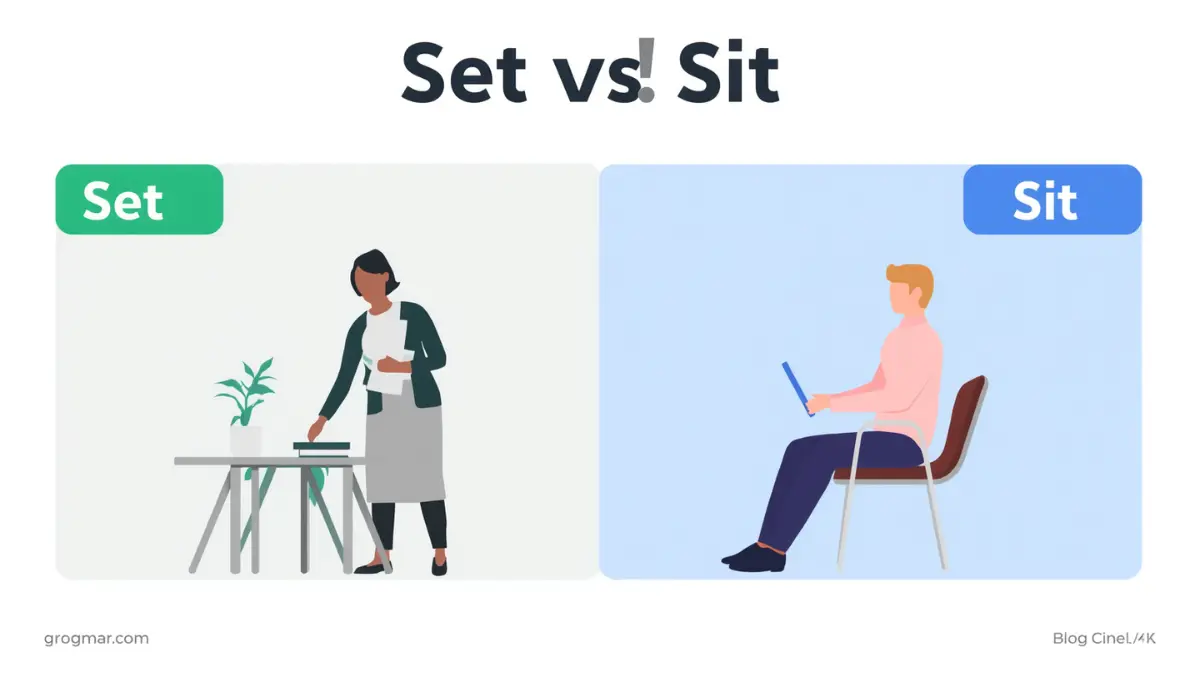
Do you say “set down” or “sit down”? Should you set a book on a table or sit a book on a table? These questions confuse many English learners and even native speakers. The words set and sit look simple, but they have different meanings and uses.
People often search for “set or sit” because the two words are related to position and placement. However, one word usually means placing something somewhere, while the other means being seated or moving into a seated position. Using the wrong word can make your writing sound awkward or incorrect.
The good news is that understanding the difference is easier than it seems. Once you learn a simple rule, you’ll know when to use each word in conversations, emails, social media posts, and professional writing.
In this guide, you’ll learn the meanings of set and sit, their origins, differences between British and American English, common mistakes, real-life examples, usage trends, and expert advice on choosing the correct word every time.
Set or Sit – Quick Answer
Set means to place or put something somewhere.
Sit means to rest in a seated position or move into a seated position.
Examples
✅ Please set the cup on the table.
✅ She set her phone beside the bed.
✅ Please sit in the front row.
✅ He sat quietly during the meeting.
Simple Rule
- If you are placing something → use set.
- If a person or animal is seated → use sit.
Read more: Anxious or Eager: What’s the Difference
The Origin of Set or Sit
The words set and sit come from Old English and have existed for hundreds of years.
Origin of Set
The word set comes from the Old English word settan, meaning “to place” or “to put.”
Examples:
- Set the table.
- Set the clock.
- Set the books on the shelf.
Origin of Sit
The word sit comes from the Old English word sittan, meaning “to occupy a seat” or “remain seated.”
Examples:
- Sit down.
- Sit quietly.
- Sit near the window.
Why the Confusion Exists
The confusion happens because both words relate to position and location. However, English grammar treats them differently:
- Set usually takes an object.
- Sit usually does not.
Example:
✅ Set the box here.
✅ Sit here.
❌ Sit the box here.
Read more: Disinterested or Uninterested: What’s the Difference
British English vs American English Spelling
Unlike words such as colour/color or centre/center, there is no spelling difference between British and American English.
Both countries use set and sit with the same spellings.
Comparison Table
| Meaning | British English | American English |
| Place something | Set | Set |
| Be seated | Sit | Sit |
| Past tense of sit | Sat | Sat |
| Past tense of set | Set | Set |
Examples
British English
- Please sit down.
- Set the kettle on the counter.
American English
- Please sit down.
- Set the laptop on the desk.
The spelling remains identical across English-speaking countries.
Which Spelling Should You Use?
The answer depends on the meaning, not the audience.
For US Audiences
Use a set when placing something and sit when being seated.
For UK Audiences
Follow the same rule.
For Commonwealth Countries
Canada, Australia, New Zealand, and South Africa use the same forms.
For Global Audiences
Use:
- Set = place something.
- Sit = be seated.
This rule works everywhere English is spoken.
Common Mistakes with Set or Sit
Many writers and speakers mix these words up.
Mistake 1: Using Sit for Objects
❌ Sit the book on the desk.
✅ Set the book on the desk.
Mistake 2: Using Set for Yourself
❌ Set here and wait.
✅ Sit here and wait.
Mistake 3: Confusing Past Tense
❌ Yesterday I set quietly in class.
✅ Yesterday I sat quietly in class.
Mistake 4: Forgetting the Object
Set usually needs something to be placed.
✅ Set the keys on the table.
Not:
❌ Set on the chair.
Set or Sit in Everyday Examples
“Please set the documents on my desk before leaving.”
News Report
“The audience sat silently during the speech.”
Social Media
“I’m going to sit outside and enjoy the sunset.”
Workplace Communication
“Please set the meeting materials in the conference room.”
School
“The students sat quietly while the teacher explained the lesson.”
Home
“Can you set the groceries on the kitchen counter?”
Set or Sit – Google Trends & Usage Data
Both words are extremely common because they serve different purposes.
Usage by Country
| Country | Common Usage |
| United States | Set and Sit |
| United Kingdom | Set and Sit |
| Canada | Set and Sit |
| Australia | Set and Sit |
| New Zealand | Set and Sit |
Why People Search “Set or Sit”
People often search this phrase because:
- The words sound related.
- Both involve position or placement.
- English learners find the grammar confusing.
- Past-tense forms create additional uncertainty.
Search interest often comes from grammar learners, students, and writers.
Set vs Sit Comparison Table
| Feature | Set | Sit |
| Main Meaning | Place something | Be seated |
| Needs an Object | Usually Yes | Usually No |
| Present Tense | Set | Sit |
| Past Tense | Set | Sat |
| Refers to Objects | Yes | No |
| Refers to People | Sometimes | Usually |
| Common in Formal Writing | Yes | Yes |
Frequently Asked Questions (FAQs)
1. What is the difference between set and sit?
Set means to place something. Sit means to be seated.
2. Is it sit the book down or set the book down?
The correct phrase is set the book down.
3. Can I say sit the box on the table?
Standard English prefers to set the box on the table.
4. What is the past tense of sit?
The past tense of sit is sat.
5. What is the past tense of set?
The past tense of set is set.
6. Do British and Americans use these words differently?
No. The meanings and spellings are essentially the same.
7. How can I remember the difference?
Remember: set something, sit yourself.
Conclusion
Understanding set or sit becomes simple when you remember their basic roles. Set means placing an object somewhere, while sit means being seated or moving into a seated position. Although the words are related to position, they are not interchangeable in standard English.
The confusion often happens because both words appear in everyday conversations. However, using the correct one improves clarity and professionalism in writing and speech. Whether you are writing an email, preparing a report, posting on social media, or learning English, knowing the difference helps you communicate more effectively.
A useful memory trick is this: you set things, but you sit yourself. If an object is being placed somewhere, choose set. If a person is taking a seat or remaining seated, choose sit. This simple rule works in American English, British English, and other forms of English worldwide. By practicing these examples, you’ll quickly become confident in using both words correctly.

I am Arshman Ali, a professional content writer and the author behind tensestutor.com . I am passionate about making grammar simple and accessible for everyone. Through my writing, I aim to help learners and professionals communicate with clarity and confidence.