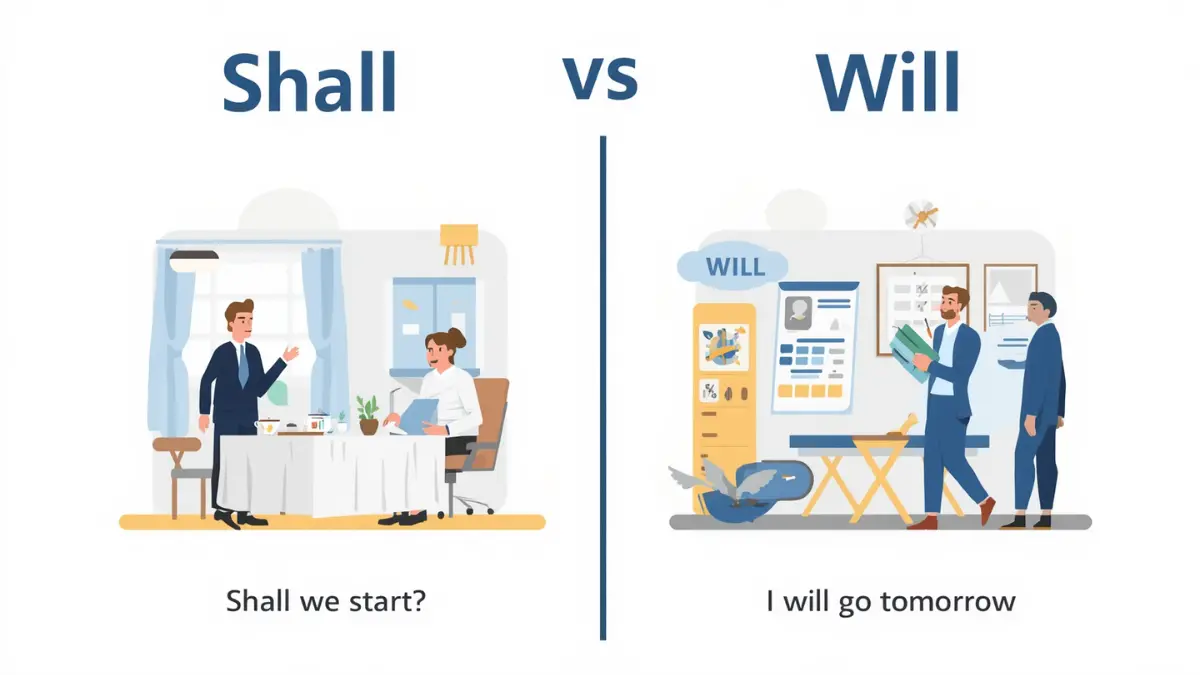
Many English learners get confused between shall and will. Both words are used to talk about the future, but their meanings and usage rules are not always the same. This creates uncertainty, especially when writing formal English, emails, exams, or professional content.
People often search for “shall or will” because they want a simple rule that tells them which one to use. In modern English, both words can show future actions, but they also carry different tones and levels of formality. For example, “I will go” and “I shall go” can sound similar, but they are not always interchangeable in every context.
This guide solves that confusion. You will learn the real difference between shall and will, their origin, usage in British and American English, common mistakes, and practical examples. By the end, you will know exactly when to use each word naturally and correctly.
Shall or Will – Quick Answer
Will is used for general future actions.
Shall is mostly used in formal English or suggestions (especially in British English).
Examples
- I will call you tomorrow. (simple future)
- We shall meet at 5 PM. (formal / polite suggestion)
- Shall I open the window? (offer)
- You will succeed if you try. (certainty)
Simple Rule
- Use will for normal future actions.
- Use shall for formal tone, offers, or suggestions.
Read more : Comprise or Compose: What’s the Difference
The Origin of Shall or Will
Shall
The word shall comes from Old English sceal, meaning “to owe” or “to be obliged.” Over time, it changed into a word used for duty, promise, and formal future statements.
Will
The word will comes from Old English willan, meaning “to want” or “to wish.” It became the standard word for expressing future actions.
Why Confusion Exists
Both words started as modal verbs but evolved into future markers. Today, will dominates modern English, while shall remains in formal and traditional usage.
British English vs American English Usage
There is no spelling difference, but there is a usage difference.
Key Difference
- British English: Uses shall in formal writing and suggestions.
- American English: Rarely uses shall, prefers will.
Read more : Fewer or Less: What’s the Difference and Which One Is Correct?
Comparison Table
| Meaning | British English | American English |
| Simple future | I shall go / I will go | I will go |
| Offer | Shall I help you? | Should I help you? |
| Suggestion | Shall we start? | Should we start? |
| Strong certainty | You shall succeed | You will succeed |
Which Should You Use?
For US English Users
Use will in almost all cases. Avoid shall except in legal or formal documents.
For UK/Commonwealth Users
You can use both:
- Will → everyday English
- Shall → formal tone, offers, polite suggestions
For Global English Users
The safest choice is will, because it is widely understood everywhere.
Common Mistakes with Shall or Will
Mistake 1
❌ I shall go to school tomorrow. (informal US usage)
✅ I will go to school tomorrow.
Mistake 2
❌ Will I open the door? (wrong tone)
✅ Shall I open the door?
Mistake 3
❌ We will meet at 5? (suggestion form)
✅ Shall we meet at 5?
Quick Fix Rule
| Wrong | Correct |
| Shall I go (casual US) | Should I go |
| Will we start? | Shall we start? |
| I shall call you (casual) | I will call you |
Shall or Will in Everyday Examples
Emails
- I will send the report today.
- Shall we schedule a meeting for Monday?
News Writing
- The government will announce new rules.
- The committee shall review the proposal (formal/legal tone).
Social Media
- I will try this recipe tonight!
- Shall we go out this weekend?
Formal Writing
- The company shall comply with regulations.
- The system will be updated next week.
Shall or Will – Google Trends & Usage Data
Observations
- Will is the most common globally.
- Shall appears mostly in UK English and legal writing.
- Search interest for “shall or will” is high among English learners.
Usage by Region
| Region | Will Usage | Shall Usage |
| USA | Very High | Low |
| UK | High | Medium |
| India | High | Medium |
| Pakistan | High | Medium |
| Global | Very High | Low |
Shall vs Will Comparison Table
| Feature | Shall | Will |
| Meaning | Formal future / suggestion | General future |
| Usage | British, formal | Global, everyday |
| Tone | Polite, formal | Neutral |
| Example | Shall we begin? | I will begin |
| Frequency | Low | Very High |
FAQs
1. What is the difference between shall and will?
Shall is formal and used for suggestions. Will is used for general future actions.
2. Can I use will instead of shall?
Yes. In modern English, will is widely accepted everywhere.
3. Is shall still used in English?
Yes, but mostly in British English, legal writing, and formal contexts.
4. Which is more correct: I shall or I will?
Both are correct, but I will is more natural in modern English.
5. When should I use shall?
Use shall for offers or suggestions like “Shall we start?”
6. Is shall old-fashioned?
Yes, in everyday speech it is considered formal or old-fashioned.
7. Do Americans use shall?
Rarely. Americans mostly use will or should instead.
Conclusion
Understanding shall and will help you write clearer and more natural English. Both words refer to future actions, but their usage depends on formality, region, and tone. In modern English, will is the most common and safest choice for everyday communication.
Shall still has value, especially in British English and formal writing. It is often used for polite offers, suggestions, and legal statements. However, in most global contexts, using will will make your English sound natural and easy to understand.
The key rule is simple: use will for normal future actions and reserve shall for formal or polite expressions. Once you follow this rule, you will avoid most mistakes.
With practice, choosing between these two words becomes automatic. Focus on context, not just grammar rules, and your English will improve quickly.

I am Bahadar Ali, a professional content writer and the author behind Tensestutor.com I am passionate about making grammar simple and accessible for everyone. Through my writing, I aim to help learners and professionals communicate with clarity and confidence.