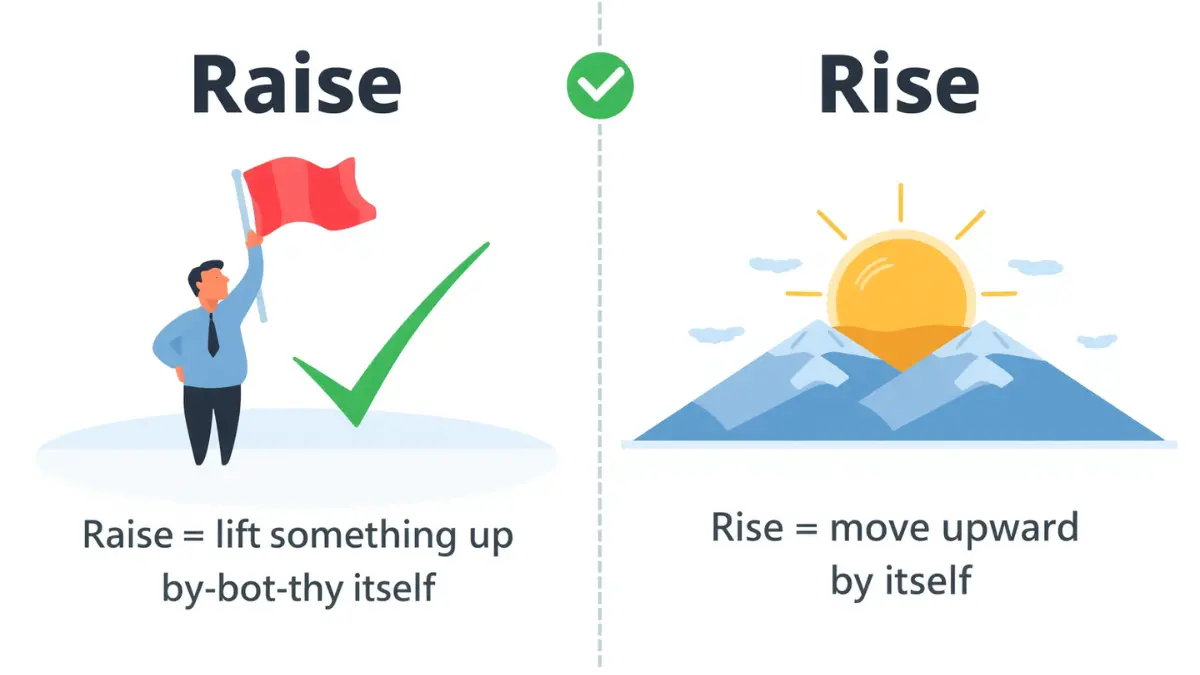
Have you ever written a sentence and paused to ask yourself, “Should I use raise or rise?” If so, you’re not alone. Many English learners and native speakers confuse these two words because they are closely related and both deal with movement upward. However, they are used in different ways, and choosing the wrong one can make a sentence sound incorrect.
People frequently search for raise or rise because these verbs appear in everyday conversations, business writing, news reports, and academic English. For example, should you say “The company raised prices” or “The company rose prices”? What about “The sun rises” versus “The sun raises”?
The key difference is simple: raise usually needs an object, while rise does not. Understanding this rule can instantly improve your grammar and confidence.
In this guide, you’ll learn the meanings, origins, differences, examples, common mistakes, and practical usage tips for raise or rise. By the end, you’ll know exactly when to use each word correctly.
Raise or Rise – Quick Answer
Simple Rule
- Raise = to lift or increase something.
- Rise = to move upward by itself.
Examples
✅ She raised her hand.
✅ The sun rises every morning.
✅ The company raised its prices.
✅ Temperatures rise during summer.
Easy Memory Trick
- Raise = Someone causes it to go up.
- Rise = It goes up on its own.
Read more: Due to or Because of: Simple Grammar Guide for English
The Origin of Raise or Rise
Origin of “Raise”
The word raise comes from Old Norse reisa, meaning “to lift up, build, or set upright.” It developed into the modern meaning of causing something to move upward.
Origin of “Rise”
The word rise comes from Old English rīsan, meaning “to get up, stand, or move upward.”
Why Confusion Exists
People confuse these words because:
- Both relate to upward movement.
- Their meanings are connected.
- Their past forms are irregular.
- They often appear in similar contexts.
British English vs American English Spelling
There is no spelling difference between British and American English.
Read more: Unique or Very Unique: Which One Is Correct
Comparison Table
| Word | British English | American English |
| Raise | Raise | Raise |
| Rise | Rise | Rise |
| Meaning | Same | Same |
| Usage | Same | Same |
Examples
British English
- Workers asked for a pay raise.
- House prices continue to rise.
American English
- The manager raised salaries.
- Costs are expected to rise.
Which Spelling Should You Use?
Since the spelling is identical worldwide, your choice depends on meaning.
Use “Raise” When:
You cause something to go up.
Examples
- Please raise your hand.
- They raised taxes last year.
- Parents raise children.
- The charity raised money.
Use “Rise” When:
Something goes up by itself.
Examples
- The moon rises at night.
- Prices continue to rise.
- The balloon rose into the sky.
- Water levels rise after heavy rain.
Global Advice
Whether writing for the US, UK, Canada, Australia, or other English-speaking countries, the rule remains the same:
Raise affects something. Rise happens naturally.
Common Mistakes with Raise or Rise
Mistake 1
❌ The company rose prices.
✅ The company raised prices.
Mistake 2
❌ She raised from her chair.
✅ She rose from her chair.
Mistake 3
❌ Temperatures raised quickly.
✅ Temperatures rose quickly.
Mistake 4
❌ The sun raises every morning.
✅ The sun rises every morning.
Mistake 5
❌ The water was raised naturally.
✅ The water rose naturally.
Raise or Rise in Everyday Examples
In Emails
- We plan to raise awareness about the campaign.
- Costs may rise next quarter.
In News Writing
- The government raised fuel taxes.
- Inflation continues to rise.
On Social Media
- Let’s raise money for charity!
- Temperatures are rising fast today.
In Formal Writing
- Researchers raised concerns about the results.
- Sea levels continue to rise globally.
Raise or Rise – Google Trends & Usage Data
Searches for raise or rise remain popular because these words are among the most commonly confused English verbs.
Popular Countries
| Country | Search Interest |
| United States | Very High |
| United Kingdom | High |
| India | High |
| Pakistan | High |
| Canada | Moderate |
Why People Search This Keyword
People search for raise or rise when:
- Studying grammar.
- Preparing for exams.
- Writing business documents.
- Learning English as a second language.
- Improving professional communication.
Common Contexts
| Context | Common Word |
| Salary increase | Raise |
| Sun movement | Rise |
| Prices increasing | Rise |
| Tax increase | Raise |
| Fundraising | Raise |
Comparison Table: Raise vs Rise
| Feature | Raise | Rise |
| Meaning | Cause to go up | Go up naturally |
| Needs Object? | Yes | No |
| Verb Type | Transitive | Intransitive |
| Example | Raise your hand | The sun rises |
| Past Tense | Raised | Rose |
| Past Participle | Raised | Risen |
FAQs About Raise or Rise
1. What is the main difference between raise and rise?
Raise means to make something go up. Rise means something goes up on its own.
2. Is it raise prices or rise prices?
The correct phrase is raise prices.
3. Is it raise from bed or rise from bed?
The correct phrase is rise from bed.
4. What is the past tense of raise?
The past tense of raise is raised.
5. What is the past tense of rise?
The past tense of rise is rose.
6. Can raise and rise be used interchangeably?
No. They have different grammatical functions and meanings.
7. How can I remember the difference?
If someone or something causes the action, use raise. If the action happens naturally, use rise.
Conclusion
Understanding raise or rise is essential for clear and accurate English. Although the two words are closely related, they serve different grammatical purposes. Raise means to lift, increase, or move something upward and always requires an object. Rise, on the other hand, means to move upward naturally and does not require an object.
This distinction appears in many common situations, from discussing salaries and taxes to describing the sun, water levels, and prices. Because both words involve upward movement, confusion is common among English learners and even experienced writers.
A simple rule can help: if someone causes the action, use raise; if the action happens by itself, use rise. Practicing real-world examples will make the difference easier to remember.
By mastering raise or rise, you can improve your writing, speaking, and overall confidence in English communication.

I am Bahadar Ali, a professional content writer and the author behind Tensestutor.com I am passionate about making grammar simple and accessible for everyone. Through my writing, I aim to help learners and professionals communicate with clarity and confidence.