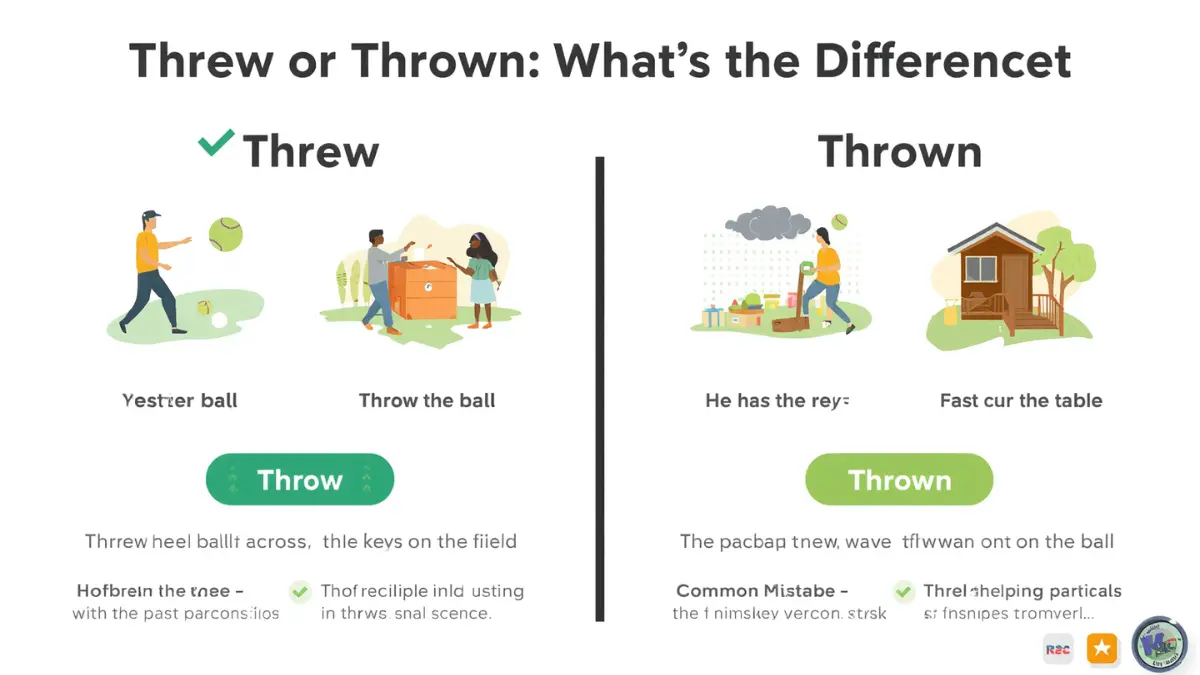
Have you ever wondered whether to write “threw” or “thrown”? Many English learners and native speakers mix up these two words because they both come from the verb “throw.” While they look similar and relate to the same action, they are used in different ways.
This confusion often appears in emails, school assignments, business writing, social media posts, and everyday conversations. Using the wrong form can make a sentence sound incorrect and may affect the clarity of your writing.
The good news is that the difference between threw and thrown is simple once you understand how English verb tenses work. One is used as the simple past tense, while the other is a past participle that requires a helping verb.
In this guide, you’ll learn the meaning of each word, their origins, how to use them correctly, common mistakes to avoid, and examples from everyday writing. By the end, you’ll know exactly when to use threw and when to use thrown.
Threw or Thrown – Quick Answer
Threw is the simple past tense of throw.
Thrown is the past participle of throw and must be used with a helping verb such as has, have, had, was, were, or been.
Examples
✅ I threw the ball yesterday.
✅ She threw the letter into the trash.
Quick Rule
- Throw → Threw → Thrown
- Use threw for past actions.
- Use thrown with helping verbs.
Read more: Set or Sit: Understanding the Difference and Using Each Word
The Origin of Threw or Thrown
Both threw and thrown come from the Old English verb þrāwan, which meant “to twist, turn, or throw.”
Over time, English developed different verb forms to show tense. The base verb throw evolved into:
- Present: throw
- Past: threw
- Past participle: thrown
Unlike spelling variations such as “color” and “colour,” threw and thrown are not alternative spellings. They are different grammatical forms of the same verb.
Read more: Lend or Loan : Understanding the Difference
British English vs American English Spelling
There is no spelling difference between British English and American English for threw and thrown.
Both countries use the same forms because they represent different verb tenses rather than regional spellings.
Comparison Table
| Form | British English | American English | Usage |
| Throw | Throw | Throw | Present tense |
| Threw | Threw | Threw | Simple past tense |
| Thrown | Thrown | Thrown | Past participle |
Examples
| Sentence | Correct Form |
| She threw the ball. | Threw |
| He has thrown the ball. | Thrown |
| The keys were thrown away. | Thrown |
Which Spelling Should You Use?
Since both words are correct, your choice depends on grammar rather than location.
Use “Threw” If:
- The action happened in the past.
- No helping verb is present.
Examples:
- I threw the paper away.
- They threw stones into the river.
Use “Thrown” If:
- A helping verb appears.
- You are using perfect or passive constructions.
Examples:
- She has thrown the letter away.
- The ball was thrown over the fence.
Audience-Based Advice
| Audience | Recommended Usage |
| United States | Follow grammar rules |
| United Kingdom | Follow grammar rules |
| Australia | Follow grammar rules |
| Canada | Follow grammar rules |
| Global audience | Use the correct verb form |
Common Mistakes with Threw or Thrown
Many writers accidentally use threw when thrown is required.
Incorrect vs Correct
❌ I have threw the ball.
✅ I have thrown the ball.
❌ The package was threw onto the porch.
✅ The package was thrown onto the porch.
❌ She had threw away the receipt.
✅ She had thrown away the receipt.
Easy Trick
If you see has, have, had, was, were, or been, you usually need thrown.
Threw or Thrown in Everyday Examples
Emails
✅ I threw away the duplicate document.
✅ The file has been thrown into the archive folder.
News Writing
✅ Protesters threw objects toward the building.
✅ Several items were thrown from the vehicle.
Social Media
✅ Someone threw my hat into the pool!
✅ My phone has been thrown across the room too many times.
Formal Writing
✅ The witness stated that the suspect threw the object.
✅ Evidence had been thrown into the river.
Threw or Thrown – Google Trends & Usage Data
Search interest for “threw or thrown” remains strong because learners frequently struggle with irregular verbs.
Usage Patterns
- Threw is common in storytelling and past-event descriptions.
- Thrown appears often in formal writing and passive voice constructions.
- English learners search for this phrase to understand verb tense differences.
Countries Showing Interest
- United States
- United Kingdom
- Canada
- Australia
- India
Educational websites, grammar blogs, and language-learning platforms regularly discuss the distinction because it is a common writing error.
Comparison Table: Threw vs Thrown
| Feature | Threw | Thrown |
| Part of speech | Past tense verb | Past participle |
| Requires helping verb | No | Yes |
| Indicates completed past action | Yes | Sometimes |
| Used in passive voice | No | Yes |
| Example | She threw the ball. | She has thrown the ball. |
Frequently Asked Questions
Is threw or thrown correct?
Both are correct. The right choice depends on grammar.
When should I use threw?
Use threw as the simple past tense.
Example: I threw the keys on the table.
When should I use thrown?
Use thrown with helping verbs.
Example: I have thrown the keys on the table.
Is “I have threw” correct?
No.
The correct phrase is “I have thrown.”
Is “was threw” correct?
No.
The correct form is “was thrown.”
Why do people confuse threw and thrown?
Both words come from the verb throw, but they serve different grammatical functions.
Are threw and thrown different in British English?
No. British and American English use the same forms.
Conclusion
Understanding the difference between threw and thrown is an important step toward writing correct English. Although both words come from the verb throw, they have different jobs in a sentence. Threw is the simple past tense and describes an action that happened in the past. Thrown is the past participle and works with helping verbs such as has, have, had, was, and were.
Many mistakes happen because writers use threw after a helping verb. Remember the simple pattern: throw, threw, thrown. If a helping verb appears in the sentence, thrown is usually the correct choice. If you are simply describing a past action, use threw.
The good news is that there is no British-versus-American spelling difference to worry about. Both English varieties use the same forms. By following the examples and rules in this guide, you can confidently choose the correct word every time and avoid one of the most common grammar mistakes in English.

I am Arshman Ali, a professional content writer and the author behind tensestutor.com . I am passionate about making grammar simple and accessible for everyone. Through my writing, I aim to help learners and professionals communicate with clarity and confidence.