Many English learners and native speakers alike get confused by grew and grown. Since both words come from the verb grow, they seem similar at first glance. However, they serve different grammatical purposes and cannot always be used interchangeably.
People often search for “grew or grown” when writing emails, school assignments, business documents, social media posts, or everyday conversations. A sentence like “The company has grew quickly” may look correct, but it contains a grammar mistake. Understanding when to use grew and when to use grown helps you communicate more clearly and professionally.
The confusion happens because English verbs often have different forms for the present tense, past tense, and past participle. The verb grow follows this pattern: grow – grew – grown. Knowing which form belongs in which sentence is the key to using them correctly.
This guide explains the difference between grew and grown, their origins, common mistakes, examples, and practical advice for writers around the world.
Grew or Grown – Quick Answer
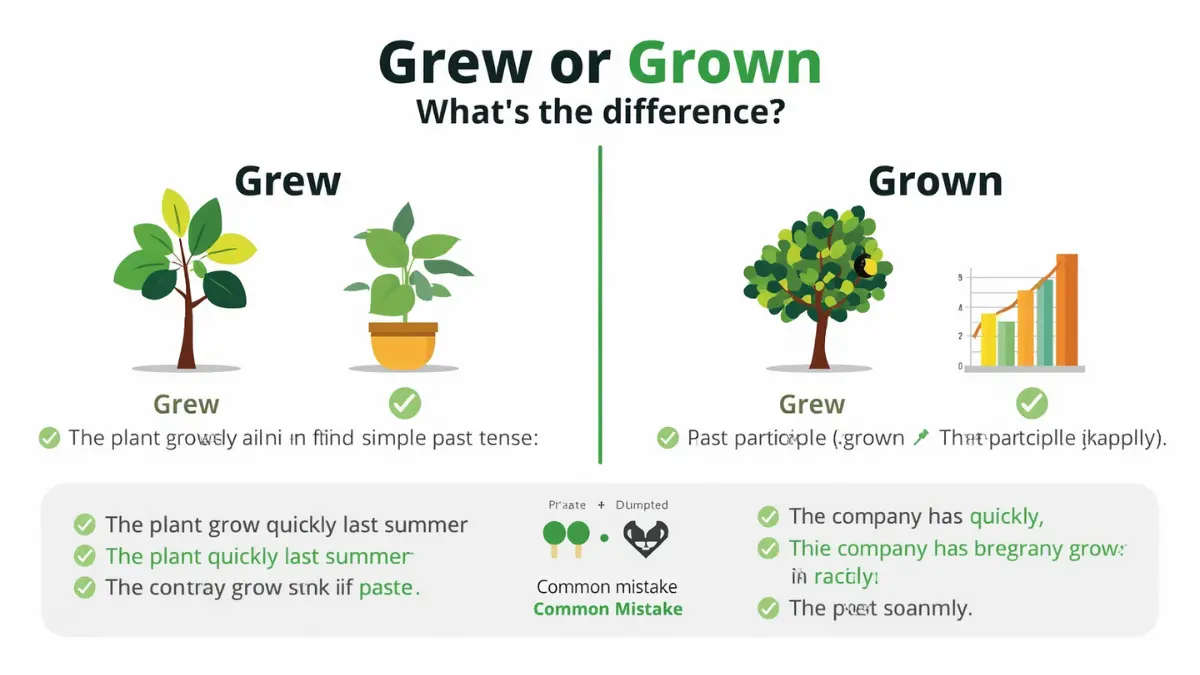
The simple answer is:
- Grew = simple past tense of grow
- Grown = past participle of grow
Examples
✅ She grew tomatoes last summer.
✅ The tree has grown taller over the years.
❌ The tree has grew taller over the years.
✅ The tree has grown taller over the years.
Read more: Raise or Rise: What’s the Difference and How to Use Them
Remember:
- Use grew when talking about a completed action in the past.
- Use grown with helping verbs such as has, have, or had.
The Origin of Grew or Grown
Both words come from the Old English verb growan, which meant “to flourish,” “increase,” or “develop.”
Over time, English adopted different verb forms:
| Verb Form | Word |
| Base Form | Grow |
| Past Tense | Grew |
| Past Participle | Grown |
Unlike spelling variations such as color and colour, grew and grown are not regional spellings. They are different grammatical forms of the same verb.
The distinction has existed for centuries and remains consistent across modern English.
Read more: Set or Sit: Understanding the Difference and Using Each Word
British English vs American English Spelling
Unlike many English words, grew and grown are spelled the same in both British and American English.
There are no regional spelling differences.
Comparison Table
| Usage | British English | American English |
| Past tense | Grew | Grew |
| Past participle | Grown | Grown |
| Formal writing | Grew/Grown | Grew/Grown |
| Informal writing | Grew/Grown | Grew/Grown |
Examples
British English
- The garden grew rapidly.
- The garden has grown rapidly.
American English
- The business grew last year.
- The business has grown significantly.
Which Spelling Should You Use?
Since there is no spelling difference, the choice depends on grammar.
Use Grew When:
- Referring to a completed past action
- No helping verb is present
Examples:
- The child grew quickly.
- Sales grew by 20% last year.
Use Grown When:
- Using has, have, or had
- Forming perfect tenses
Examples:
- The child has grown quickly.
- Sales have grown by 20%.
Audience-Based Advice
| Audience | Recommended Usage |
| United States | Follow standard grammar rules |
| United Kingdom | Follow standard grammar rules |
| Australia | Follow standard grammar rules |
| Canada | Follow standard grammar rules |
| Global audience | Use the correct verb form for clarity |
Common Mistakes with Grew or Grown
Many writers confuse the past tense with the past participle.
Mistake 1
❌ The company has grew rapidly.
✅ The company has grown rapidly.
Mistake 2
❌ The plant grown fast last year.
✅ The plant grew fast last year.
Mistake 3
❌ They had grew vegetables before.
✅ They had grown vegetables before.
Mistake 4
❌ My son has grew taller.
✅ My son has grown taller.
Grew or Grown in Everyday Examples
Emails
✅ Our customer base grew significantly last quarter.
✅ Our customer base has grown significantly this year.
News Articles
✅ The city’s population grew by 10%.
✅ The city’s population has grown steadily.
Social Media
✅ My followers grew fast this month!
✅ My audience has grown beyond expectations.
Formal Writing
✅ Revenue grew during the reporting period.
✅ Revenue has grown consistently over five years.
Grew or Grown – Google Trends & Usage Data
Search data shows that “grew or grown” is a common grammar-related query worldwide.
The confusion is especially common among:
- English learners
- Students
- Content writers
- Business professionals
- Job applicants
Popular Countries Searching the Term
| Country | Interest Level |
| United States | High |
| United Kingdom | High |
| Canada | Medium |
| Australia | Medium |
| India | High |
Most searches occur when people want to verify grammar before publishing or submitting written work.
Grew vs Grown Comparison Table
| Feature | Grew | Grown |
| Verb Type | Past tense | Past participle |
| Base Verb | Grow | Grow |
| Used Alone | Yes | Usually No |
| Used with Has/Have/Had | No | Yes |
| Example | She grew flowers. | She has grown flowers. |
| Formal Writing | Yes | Yes |
| Informal Writing | Yes | Yes |
FAQs
Is grew correct English?
Yes. Grew is the simple past tense form of grow.
Is grown correct English?
Yes. Grown is the past participle form of grow.
Which is correct: has grew or has grown?
Has grown is correct.
Can I use grown without has or have?
Sometimes, such as an adjective:
- A grown man.
But in verb phrases, it usually needs a helping verb.
Is grew present tense?
No. It is the simple past tense.
Why do people confuse grew and grown?
Because both come from the same verb and refer to growth, but they serve different grammatical functions.
What is the correct verb sequence?
Grow → Grew → Grown
Conclusion
Understanding the difference between grew and grown is easier than many people think. Both words come from the verb grow, but they have different grammatical jobs. Grew is the simple past tense and describes something that happened in the past. Grown is the past participle and is typically used with helping verbs such as has, have, and had.
The good news is that there are no British-versus-American spelling differences to worry about. Writers everywhere use the same forms. The key is simply choosing the correct verb form for the sentence structure.
When speaking or writing, remember this simple rule: if there is a helping verb, use grown; if there is no helping verb and the action happened in the past, use grew. Following this guideline will help you avoid common grammar mistakes and make your writing clearer, more professional, and easier to understand.

I am Arshman Ali, a professional content writer and the author behind tensestutor.com . I am passionate about making grammar simple and accessible for everyone. Through my writing, I aim to help learners and professionals communicate with clarity and confidence.