Do you ever stop and wonder whether you should use lay or lie in a sentence? If so, you’re not alone. This is one of the most common grammar questions in English. Many native speakers and English learners mix up these two words because they are closely related and have confusing verb forms.
You may have heard sentences like, “I’m going to lay down” or “I need to lie down.” Both sound familiar, but only one is correct in certain situations. The confusion becomes even greater when past tense forms such as lay, laid, and lain enter the picture.
Understanding the difference between lay and lie can improve your writing, speaking, and professional communication. Whether you’re writing an email, posting on social media, or preparing a business report, using the correct word helps you sound more confident and accurate.
This guide explains the meaning, history, usage rules, common mistakes, and real-world examples of lay or lie. By the end, you’ll know exactly which word to use and when.
Lay or Lie – Quick Answer
The basic rule is simple:
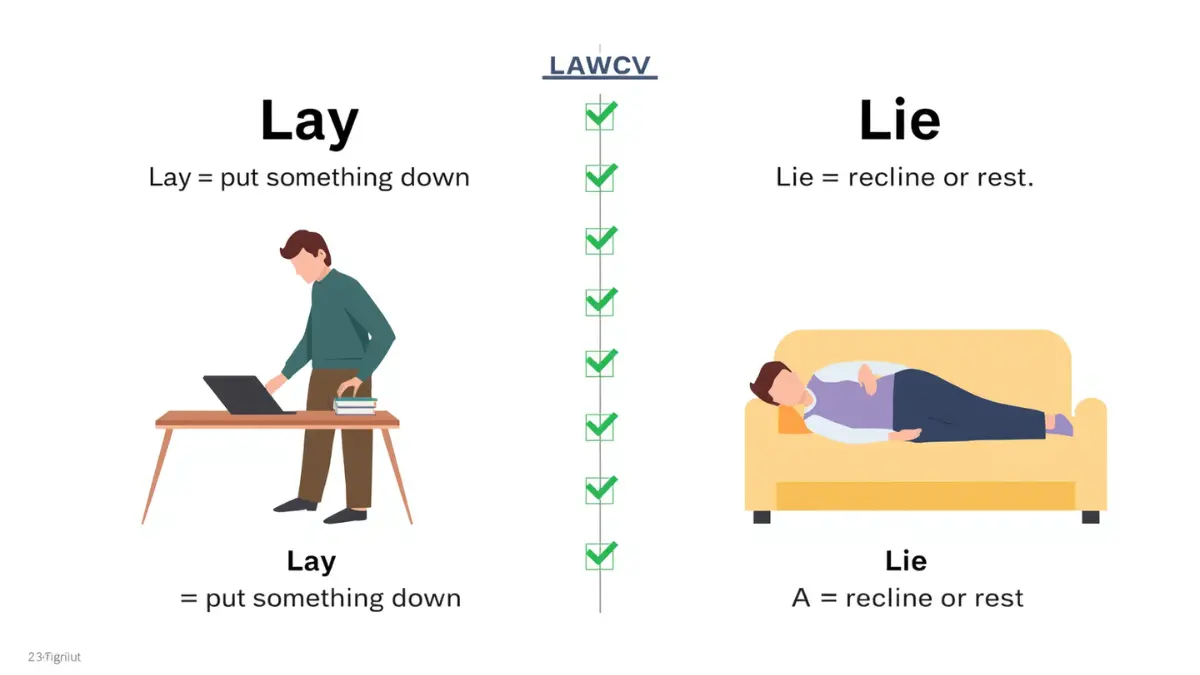
- Lay means to put or place something down.
- Lie means to recline or rest.
Examples
✅ I will lay the book on the table.
✅ Please lay the blanket on the bed.
✅ I need to lie down for a few minutes.
✅ The cat likes to lie in the sun.
A helpful trick:
- Lay requires an object.
- Lie does not require an object.
Read more: Due to or Because of: Simple Grammar Guide for
Quick Comparison
| Word | Meaning | Needs an Object? |
| Lay | Put something down | Yes |
| Lie | Rest or recline | No |
The Origin of Lay or Lie
The confusion between lay and lie goes back hundreds of years.
Origin of Lay
The word lay comes from the Old English word lecgan, meaning “to place” or “put down.”
Over time, it evolved into the modern verb lay, which still means to place something somewhere.
Origin of Lie
The word lie comes from the Old English word licgan, meaning “to rest” or “recline.”
Its meaning has remained largely unchanged throughout English history.
Read more: Unique or Very Unique: Which One Is Correct
Why the Confusion Exists
The confusion happens because the past tense of lie is lay.
Example:
- Today: I lie down.
- Yesterday: I lay down.
This overlap causes many speakers to mix up the two verbs.
British English vs American English Spelling
Unlike words such as “colour” and “color,” there is no spelling difference between British English and American English for lay and lie.
Both countries use the same spellings and grammar rules.
Comparison Table
| Meaning | British English | American English |
| Put something down | Lay | Lay |
| Recline or rest | Lie | Lie |
| Past tense of lie | Lay | Lay |
| Past tense of lay | Laid | Laid |
Examples
British English:
- Please lay the newspaper on the desk.
- I need to lie down.
American English:
- Lay the keys on the counter.
- I’m going to lie down.
The rules are identical on both sides of the Atlantic.
Which Spelling Should You Use?
The answer depends on what you want to say.
Use “Lay” When
You are placing something somewhere.
Examples:
- Lay the phone on the table.
- Lay the baby in the crib.
- Lay the documents on my desk.
Use “Lie” When
You are resting or reclining.
Examples:
- I want to lie down.
- The dog likes to lie near the fireplace.
- She lay on the beach yesterday.
For US Audiences
Follow standard grammar rules.
For UK Audiences
Follow the same standard grammar rules.
For Global Audiences
Use the same distinction between lay and lie.
There is no regional preference.
Common Mistakes with Lay or Lie
Many writers use these words incorrectly.
Mistake 1: Using Lay Instead of Lie
❌ I’m going to lay down for a nap.
✅ I’m going to lie down for a nap.
Mistake 2: Using Lie Instead of Lay
❌ Please lie the papers on my desk.
✅ Please lay the papers on my desk.
Mistake 3: Confusing Past Tenses
❌ Yesterday I laid on the couch all day.
✅ Yesterday I lay on the couch all day.
Mistake 4: Forgetting the Object
❌ Lay down and relax.
✅ Lie down and relax.
Unless something is being placed, use lie.
Lay or Lie in Everyday Examples
“Please lay the contract on my desk before lunch.”
News Article
“The injured player was forced to lie on the field while receiving treatment.”
Social Media
“I just want to lie on the beach all weekend.”
Formal Writing
“The researcher laid the documents in chronological order.”
Workplace Communication
“Lay the files in the storage cabinet.”
Casual Conversation
“I’m tired. I need to lie down.”
Lay or Lie – Google Trends & Usage Data
Search interest for lay or lie remains high because it is one of the most confusing grammar topics in English.
Popular Countries Searching This Topic
| Country | Interest Level |
| United States | Very High |
| United Kingdom | High |
| Canada | High |
| Australia | High |
| New Zealand | Moderate |
Why People Search for It
- Confusing verb forms.
- Similar pronunciation.
- Common everyday use.
- Grammar tests and exams.
- Professional writing concerns.
Teachers, students, writers, and business professionals frequently look up the difference.
Lay vs Lie Comparison Table
| Feature | Lay | Lie |
| Meaning | Put something down | Rest or recline |
| Requires Object | Yes | No |
| Present Tense | Lay | Lie |
| Past Tense | Laid | Lay |
| Past Participle | Laid | Lain |
| Example | Lay the book down | Lie on the bed |
| Professional Use | Yes | Yes |
Frequently Asked Questions (FAQs)
1. What is the difference between lay and lie?
Lay means to place something down. Lie means to recline or rest.
2. Is it correct to say “lay down”?
Only if you are placing something down. If you are resting, say “lie down.”
3. Why is lay the past tense of lie?
English inherited these verb forms from Old English, creating overlap between the two verbs.
4. What is the past tense of lay?
The past tense of lay is laid.
Example: I laid the book on the shelf.
5. What is the past tense of lie?
The past tense of lie is lay.
Example: Yesterday I lay on the couch.
6. Is “I’m going to lay down” wrong?
In standard grammar, yes. The correct form is “I’m going to lie down.”
7. Do British and American English use different rules?
No. Both follow the same grammar rules for lay and lie.
Conclusion
The difference between lay and lie can seem confusing at first, but the rule becomes simple once you understand it. Lay means to put or place something somewhere, while lie means to rest or recline. The easiest way to remember the difference is to check If there is an object in the sentence. If something is being placed, use lay. If a person or animal is simply resting, use lie.
Many grammar mistakes happen because the past tense of lie is lay, which overlaps with the present tense of lay. This can make sentences look unusual even when they are correct. However, with practice, these forms become easier to recognize.
Whether you are writing emails, articles, reports, or social media posts, using lay and lie correctly improves clarity and professionalism. Remember the simple rule: lay puts something down; lie rests down. Following this guideline will help you avoid one of the most common grammar mistakes in English.

I am Arshman Ali, a professional content writer and the author behind tensestutor.com . I am passionate about making grammar simple and accessible for everyone. Through my writing, I aim to help learners and professionals communicate with clarity and confidence.