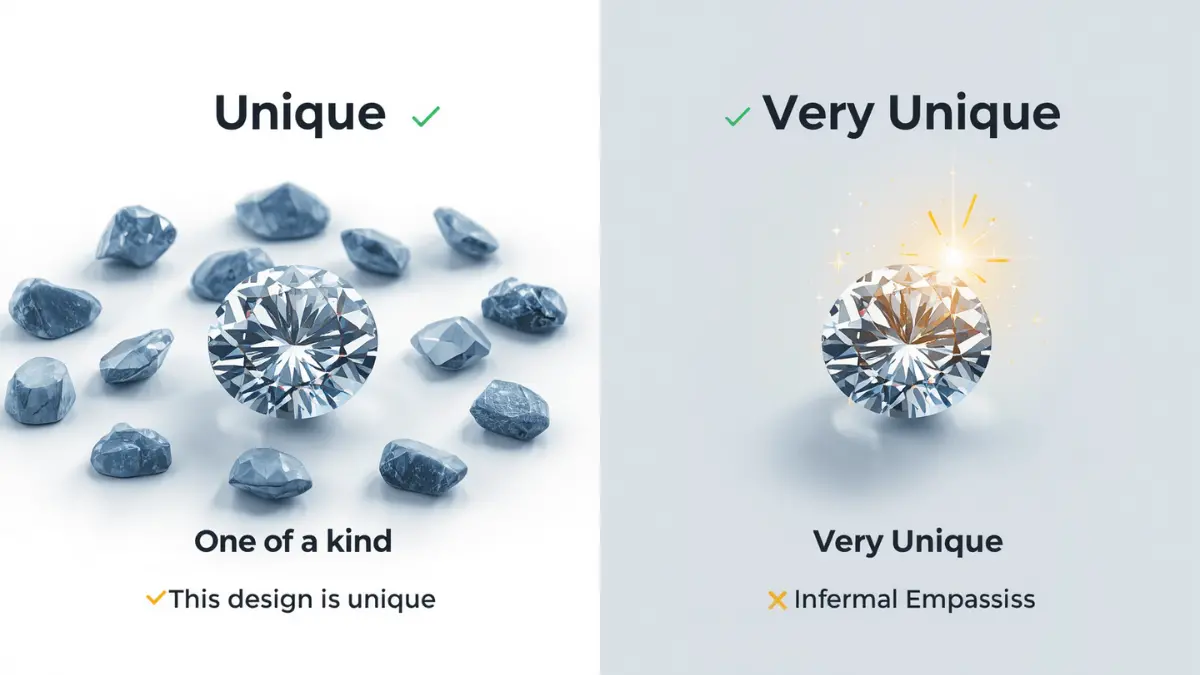
Many English learners and native speakers wonder If they should write something unique or very unique. You may have seen both forms in books, advertisements, blogs, and everyday conversations. This creates confusion because some grammar experts say very unique is wrong, while others believe it is acceptable in informal speech.
People search for something unique or very unique because they want to sound professional and avoid grammar mistakes. The confusion comes from the meaning of the word unique itself. Traditionally, unique means “one of a kind” or “unlike anything else.” If something is already one of a kind, can it be “very” one of a kind?
The answer depends on context, style, and audience. In formal writing, many editors prefer simply unique. In casual speech and marketing, very unique is often used for emphasis.
This guide explains the difference between unique and very unique, their history, usage rules, common mistakes, examples, and professional writing advice so you can choose the right form with confidence.
Unique or Very Unique – Quick Answer
Short Answer
Unique is traditionally the preferred and grammatically precise choice.
Very unique is commonly used in everyday English but is often avoided in formal writing.
Examples
✅ This design is unique.
✅ Her approach is unique.
⚠️ This design is very unique.
⚠️ Her approach is very unique.
Easy Rule
- Formal writing → Unique
- Casual speech or marketing → Very unique may be acceptable
Read more: Which or That: What’s the Difference ?
The Origin of Unique or Very Unique
Unique
The word unique comes from the French word unique and the Latin word unicus, meaning “only one” or “single.”
It entered English in the 17th century and originally meant:
- One of a kind
- Unlike anything else
- Sole or singular
Very Unique
As language evolved, people began using very unique words to emphasize how unusual or special something seemed.
This created debate among grammarians because something that is one of a kind cannot logically be “more one of a kind.”
Why the Confusion Exists
The confusion exists because modern English often uses words emotionally rather than literally.
Examples:
- Very perfect
- Very complete
- Very unique
While these forms appear in everyday speech, traditional grammar often rejects them.
Read more: Recognise or Recognize: Meaning and Correct Usage Guide
British English vs American English Spelling
There is no spelling difference between British and American English.
Comparison Table
| Expression | British English | American English |
| Unique | Unique | Unique |
| Very Unique | Very Unique | Very Unique |
Examples
| British Usage | American Usage |
| The building is unique. | The building is unique. |
| It has a very unique design. | It has a very unique design. |
The debate is about style and grammar, not spelling.
Which Spelling Should You Use?
Since there is no spelling difference, your choice depends on audience and purpose.
For US Audiences
Professional writing:
✅ Unique
Informal content:
✅ Unique
⚠️ Very unique (acceptable for emphasis)
For UK Audiences
Editors generally prefer:
✅ Unique
For Global Audiences
The safest choice is:
✅ Unique
It sounds professional and avoids criticism from grammar purists.
Common Mistakes with Unique or Very Unique
Mistake 1
❌ This artwork is very unique.
✅ This artwork is unique.
Mistake 2
❌ The company offers the most unique solution.
✅ The company offers a unique solution.
Mistake 3
❌ This product is extremely unique.
✅ This product is unique.
Better Alternatives
Instead of saying very unique, try:
- Highly unusual
- Remarkably distinctive
- Exceptionally rare
- Truly original
- One of a kind
Correction Table
| Less Preferred | Better Choice |
| Very unique | Unique |
| Extremely unique | Unique |
| Most unique | Unique |
Unique or Very Unique in Everyday Examples
Emails
Professional:
“The proposal offers a unique solution.”
News Writing
“The artist developed a unique style.”
Social Media
“This is a very unique café!”
Marketing
“Our brand provides a very unique customer experience.”
Academic Writing
“The study presents a unique perspective.”
In formal settings, unique is usually preferred.
Unique or Very Unique – Google Trends & Usage Data
Both phrases are commonly searched online.
Unique
- More common in dictionaries
- Preferred in academic writing
- Frequently used in professional communication
Very Unique
- Common in blogs and advertising
- Frequently used in social media
- Popular in conversational English
Country Usage
| Country | Unique | Very Unique |
| United States | Very High | High |
| United Kingdom | Very High | Medium |
| Canada | High | Medium |
| Australia | High | Medium |
| India | High | High |
Search interest shows that many people want clarification about whether very unique is correct.
Unique vs Very Unique Comparison Table
| Feature | Unique | Very Unique |
| Traditional Grammar | Correct | Debated |
| Formal Writing | Recommended | Usually avoided |
| Informal Speech | Common | Common |
| Marketing Content | Common | Common |
| Academic Writing | Preferred | Not preferred |
| Professional Tone | Strong | Less formal |
FAQs
1. Is “very unique” grammatically correct?
Many style guides discourage it because unique already means one of a kind.
2. Can I use “very unique” in everyday conversation?
Yes. Many native speakers use it informally.
3. Why do grammar experts dislike “very unique”?
Because unique is traditionally considered an absolute quality.
4. Is “unique” better for professional writing?
Yes. It is the safest and most widely accepted option.
5. Is there a British vs American difference?
No. Both varieties use the same spelling and grammar rules.
6. What can I use instead of “very unique”?
Try:
- Remarkably distinctive
- Highly unusual
- Truly original
- Exceptionally rare
7. Which form should students use in essays?
Use unique because it is preferred by teachers, editors, and style guides.
Conclusion
The debate over unique or very unique has existed for many years. Traditionally, unique means one of a kind, which is why many grammar experts argue that adding very is unnecessary. From a strict grammatical viewpoint, something cannot be more unique than unique.
However, language changes over time. In modern conversation, advertising, and social media, many people use very unique words simply to add emphasis. Most readers understand the intended meaning, even if some editors dislike the phrase.
If your goal is professional, academic, or formal writing, choose unique. It is clear, concise, and accepted by virtually all style guides. If you are writing casual content or marketing copy, very unique may be acceptable depending on your audience and tone.
The safest rule is simple: when in doubt, use unique. It communicates originality without raising grammar concerns and works well in every type of writing.

I am Arshman Ali, a professional content writer and the author behind tensestutor.com . I am passionate about making grammar simple and accessible for everyone. Through my writing, I aim to help learners and professionals communicate with clarity and confidence.