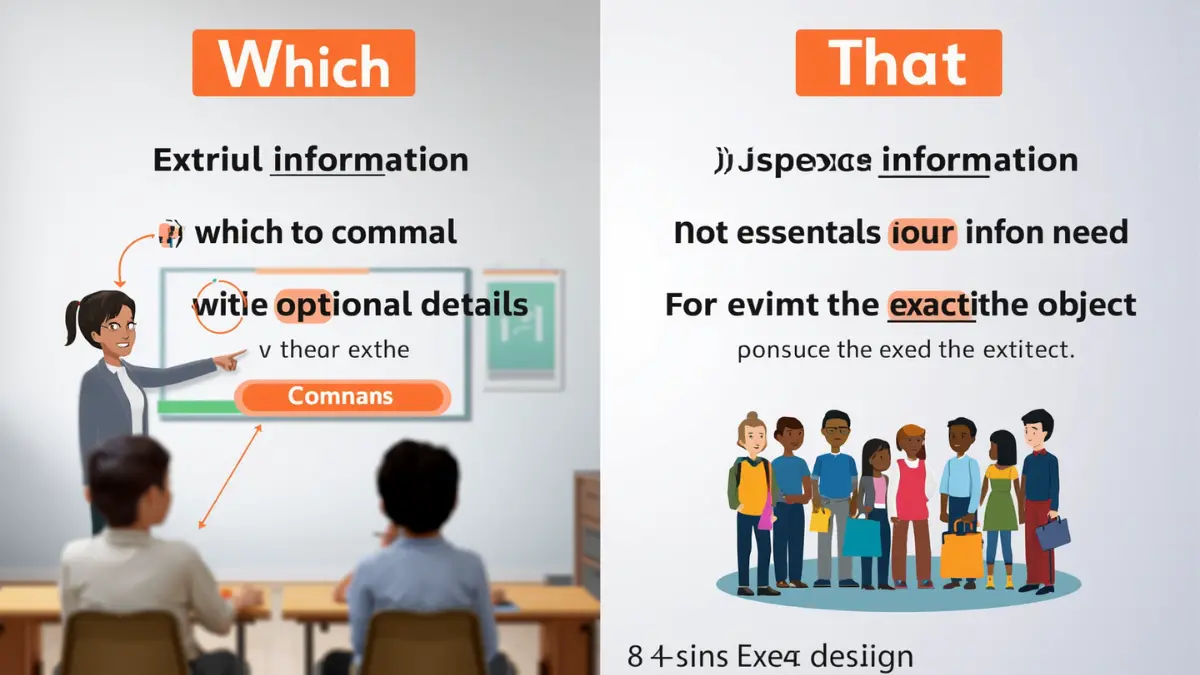
Many writers struggle with which or that because both words introduce extra information in a sentence. At first glance, they seem almost identical. However, choosing the wrong one can make writing unclear or grammatically incorrect, especially in formal English.
For example:
- “The car that is parked outside is mine.”
- “The car, which is parked outside, is mine.”
These sentences look similar, but they do not mean the same thing. People search for which or that because they want to improve grammar, punctuation, and sentence clarity. Students, bloggers, professionals, and even native speakers often confuse these words in essays, emails, and articles.
The good news is that the rule becomes easy once you understand restrictive and nonrestrictive clauses. In simple terms, “that” gives essential information, while “which” adds extra details. This guide explains which or that with simple examples, comparison tables, grammar tips, and common mistakes so you can write clearly and confidently.
Which or That – Quick Answer
Quick Rule
- That = essential information
- Which = extra information
Examples
| Word | Example |
| That | The book that I borrowed is excellent. |
| Which | The book, which I borrowed yesterday, is excellent. |
Easy Tip
- If the information is necessary → use that
- If the information is extra → use which
Read more: Analyse or Analyze: Meaning, Spelling and Simple Usage Guide?
The Origin of Which or That
Both words come from Old English and Germanic language roots.
- That originally pointed to specific things.
- Which was used when choosing between options.
Over time, English grammar developed clearer roles:
- “That” became common for defining clauses.
- “Which” became linked with descriptive or additional clauses.
Historical Meaning
| Word | Early Meaning |
| That | Specific object or idea |
| Which | Choice or selection |
Modern grammar guides later created stricter rules, especially in formal American English.
Read more: Grey or Gray: Meaning and Correct Usage in English?
British English vs American English Spelling
The difference between which or that is more about grammar style than spelling.
American English
American grammar guides strongly prefer:
- that for essential clauses
- which for nonessential clauses
British English
British English is more flexible. Writers sometimes use “which” where Americans would use “that.”
Comparison Table
| Usage | American English | British English |
| Essential clause | that | that/which |
| Extra information | which | which |
Examples
| Type | Example |
| Essential | The phone that broke was expensive. |
| Extra | The phone, which broke yesterday, was expensive. |
Which Spelling Should You Use?
Use “That” When:
- The information is necessary
- The sentence meaning changes without it
Examples
- The dog that barked all night is tired.
- The cake that she baked was delicious.
Use “Which” When:
- The information is extra
- The sentence still works without it
Examples
- My laptop, which is new, works well.
- Paris, which is in France, attracts tourists.
Best Choice for Global Writing
For professional and international writing:
- Use that for essential details
- Use which for extra details with commas
Common Mistakes with Which or That
These grammar errors are very common.
| Incorrect | Correct |
| The car which I bought is fast. | The car that I bought is fast. |
| My bike was stolen. | My bike, which is red, was stolen. |
| The movie that we watched was funny. | The movie that we watched was funny. |
Mistake 1: Forgetting commas with “which”
Correct:
- My phone, which is broken, needs repair.
Mistake 2: Using “which” for essential information
In formal US English, “that” is preferred.
Mistake 3: Mixing grammar styles
Stay consistent throughout your writing.
Which or That in Everyday Examples
In Emails
- “The report that you requested is attached.”
- “The meeting, which starts at noon, may run late.”
In News Writing
- “The law that passed yesterday affects taxes.”
- “The storm, which caused flooding, has ended.”
On Social Media
- “The song that I love is trending.”
- “My cat, which hates rain, stayed inside.”
In Formal Writing
- “The study that examined climate change showed new results.”
- “The experiment, which lasted six months, was successful.”
Which or That – Google Trends & Usage Data
Search trends show that which or that is a popular grammar topic worldwide.
Why People Search It
| Reason | Explanation |
| Grammar confusion | Similar sentence structures |
| Punctuation rules | Comma usage problems |
| Formal writing | Academic and business English |
Popular Search Queries
- which vs that
- when to use which
- when to use that
- that or which grammar rule
Country Usage
| Country | Common Preference |
| United States | Strong “that” rule |
| United Kingdom | Flexible usage |
| Canada | Mixed style |
| Australia | Similar to British usage |
Which vs That Comparison Table
| Feature | Which | That |
| Adds extra information | Yes | No |
| Gives essential information | No | Yes |
| Usually uses commas | Yes | No |
| Common in formal US English | Nonessential clauses | Essential clauses |
| Example | My car, which is blue | The car that I bought |
FAQs About Which or That
1. What is the difference between which and that?
“That” gives essential information. “Which” adds extra information.
2. Do I use commas with which?
Yes, usually.
3. Do I use commas with that?
No, usually not.
4. Is “which” wrong in essential clauses?
Not always, but American English prefers “that.”
5. Which is more formal?
Both are formal when used correctly.
6. Why do people confuse which and that?
Because both connect parts of sentences.
7. Can British English use “which” more freely?
Yes. British English grammar is more flexible.
Conclusion
Understanding which or that helps improve grammar, punctuation, and sentence clarity. Although the words look similar, they serve different purposes in English writing. “That” introduces essential information that a sentence needs, while “which” adds extra information that can usually be removed without changing the main meaning.
This small grammar difference is especially important in formal writing, business communication, and academic work. American English follows stricter rules, while British English allows more flexibility. Still, using the standard rule makes your writing easier to understand worldwide.
A simple way to remember the difference is this:
- Use that when the information is necessary.
- Use which when the information is additional and separated by commas.
With practice, choosing between which or that becomes much easier. Correct usage makes your writing look more professional, polished, and grammatically accurate.

I am Bahadar Ali, a professional content writer and the author behind Tensestutor.com I am passionate about making grammar simple and accessible for everyone. Through my writing, I aim to help learners and professionals communicate with clarity and confidence.