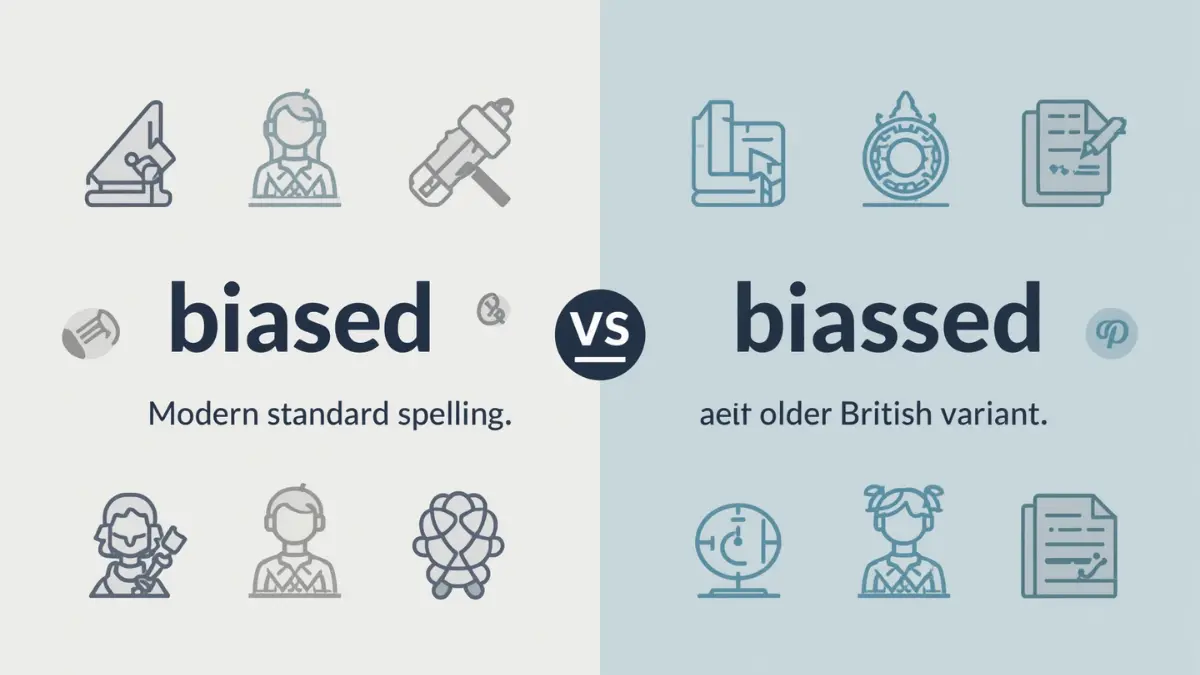
Have you ever written the word biased or biassed and stopped to wonder which spelling is correct? You are not alone. Many students, writers, bloggers, and professionals search for biased or biassed because both forms appear online, in books, and even in news articles. The confusion becomes stronger when people switch between British and American English.
Imagine reading two articles on the same topic. One says a reporter was “biased,” while another says the reporter was “biassed.” Naturally, readers start asking: Which spelling should I use? Is one wrong? This is exactly why people search for biased or biassed every day.
The good news is simple: both spellings exist, but one is far more common today. Understanding the difference helps improve your writing, avoid spelling mistakes, and communicate clearly with international audiences. In this guide, you will learn the quick answer, spelling history, British vs American usage, common mistakes, real-life examples, and professional advice about biased or biassed.
Biased or Biassed – Quick Answer
The quick answer is:
- Biased → Modern and most common spelling worldwide
- Biassed → Older British variant, now rarely used
Examples:
- The judge seemed biased during the case.
- Some newspapers are accused of being biased.
Today, “biased” is accepted in both American and modern British English.
The Origin of Biased or Biassed
The word comes from bias, which originally meant a slant or inclination. The term entered English from the French word biais, meaning “slanting” or “oblique.”
Over time, English speakers created adjective forms:
- Biased
- Biassed
The spelling difference happened because older British English often doubled consonants before adding suffixes like “-ed.” Similar spelling patterns appeared in words like:
- traveller/traveler
- cancelled/canceled
As English evolved, spelling became simpler. The form biased became more popular because it matched modern spelling rules and was easier to write.
Today:
- Biased = standard modern spelling
- Biassed = old-fashioned variant
Lose or Loose: What’s the Difference and How to Use It Correctly?
British English vs American English Spelling
In American English, biased has always been the preferred form. Modern British English also mostly uses biased today.
American English
- Correct: biased
- Rare/Wrong: biassed
British English
- Common today: biased
- Older variant: biassed
Examples
| Sentence | Preferred Spelling |
| The article looked unfair and biased. | US & UK |
| Some older British texts use biassed. | Historical UK |
Comparison Table
| Feature | Biased | Biassed |
| Modern Usage | Very common | Rare |
| American English | Standard | Uncommon |
| British English | Standard today | Older variant |
| Easy for SEO | Yes | Less common |
| Seen in modern media | Frequently | Rarely |
| Recommended today | Yes | Usually no |
Which Spelling Should You Use?
For American Audiences
Use biased. It is the only widely accepted spelling in the United States.
Example:
- The report was biased against small businesses.
For British or Commonwealth Audiences
You should still usually use biased because it is now standard in modern British English.
Example:
- Critics said the newspaper was biased.
For Global or Online Writing
Use biased. It is clearer, easier to recognize, and better for SEO because more people search for it online.
Professional advice:
If you want your writing to look modern, clean, and internationally understood, choose biased.
Choosed or Chose: Which Is Correct ?
Common Mistakes with Biased or Biassed
Many learners make small spelling mistakes with these words. Here are common errors and corrections.
| Incorrect | Correct |
| The media is biassed. | The media is biased. |
| She gave a bias opinion. | She gave a biased opinion. |
| He is bias toward his team. | He is biased toward his team. |
| The article sounded biase. | The article sounded biased. |
Mistake 1: Using “bias” instead of “biased”
Wrong:
- The teacher was bias.
Correct:
- The teacher was biased.
Mistake 2: Mixing British and American spelling styles
Wrong:
- The company used modern American spelling but wrote “biassed.”
Correct:
- Stay consistent with “biased.”
Mistake 3: Overusing “biased”
Sometimes people use “biased” when they really mean:
- unfair
- emotional
- opinionated
Choose words carefully depending on context.
Biased or Biassed in Everyday Examples
In Emails
- Your feedback seems slightly biased toward one department.
In News Writing
- Critics called the interview biased.
In Social Media
- That review feels biased because the creator was sponsored.
In School Essays
- A good researcher avoids biased language.
In Formal Writing
- The survey produced biased results due to limited participants.
These examples show that biased works naturally in all forms of modern communication.
Biased or Biassed – Google Trends & Usage Data
Search trends clearly show that biased is far more popular than biassed worldwide.
Countries Using “Biased” Most
- United States
- Canada
- Australia
- United Kingdom
- India
Why “Biased” Dominates
- Simpler spelling
- Modern dictionary preference
- Strong online usage
- Better readability
- More common in journalism and education
Where “Biassed” Appears
- Older British books
- Historical newspapers
- Archived academic texts
Today, search engines strongly favor “biased” because users type it more often.
Comparison Table: Biased vs Biassed
| Category | Biased | Biassed |
| Meaning | Unfair or prejudiced | Same meaning |
| Spelling Style | Modern | Older |
| Popularity | Very high | Very low |
| SEO Value | Better | Lower |
| Recommended for students | Yes | No |
| Found in modern dictionaries | Yes | Limited |
| Best for global readers | Yes | No |
FAQs About Biased or Biassed
1. Is “biassed” wrong?
Not exactly. It is an older spelling, mainly from historical British English, but it is rare today.
2. Which spelling is correct today?
“Biased” is the modern standard spelling worldwide.
3. Do British people still use “biassed”?
Very rarely. Most modern British writers use “biased.”
4. Is “biased” American English only?
No. It is now standard in both American and modern British English.
5. Which spelling is better for SEO?
“Biased” is much better because more users search for it online.
6. Why are people confused about biased or biassed?
Because older books and websites still contain the older spelling “biassed.”
7. Can I use biassed in academic writing?
It is not recommended unless you are quoting historical material.
Conclusion
The confusion between biased or biassed comes from historical spelling differences between older British English and modern English usage. While both spellings technically exist, biased is now the clear standard across the world. It is widely accepted in American English, British English, education, journalism, business communication, and online writing.
If you want your writing to appear modern, professional, and easy to understand, use biased in almost every situation. The spelling “biassed” mainly survives in older texts and historical references. For students, bloggers, SEO writers, and professionals, choosing “biased” helps avoid confusion and improves readability.
Language changes over time, and spelling often becomes simpler. The shift from “biassed” to “biased” is a perfect example of how English evolves for clarity and convenience. By understanding this difference, you can write with more confidence and accuracy in every context.

I am Arshman Ali, a professional content writer and the author behind tensestutor.com . I am passionate about making grammar simple and accessible for everyone. Through my writing, I aim to help learners and professionals communicate with clarity and confidence.