Many people get confused between “lose” and “loose.” They look similar, sound a bit alike, and are often used in everyday writing. Because of this, people frequently search for the difference between them. Some common questions include: “Did I spell it right?” “Why does autocorrect keep changing my word?” or “Which one means not tight?”
This confusion matters because using the wrong word can completely change your meaning. For example, “I will lose weight” is correct, but “I will loose weight” is wrong and confusing. Similarly, “My shirt is loose” is correct, but “My shirt is lose” is incorrect.
This article will clearly explain the difference between lose and loose in simple terms. You will learn their meanings, origins, spelling rules, and real-life usage. You will also see common mistakes and easy examples so you never mix them up again.
By the end, you will confidently know when to use lose and when to use loose in writing, speaking, and exams.
Lose or Loose – Quick Answer
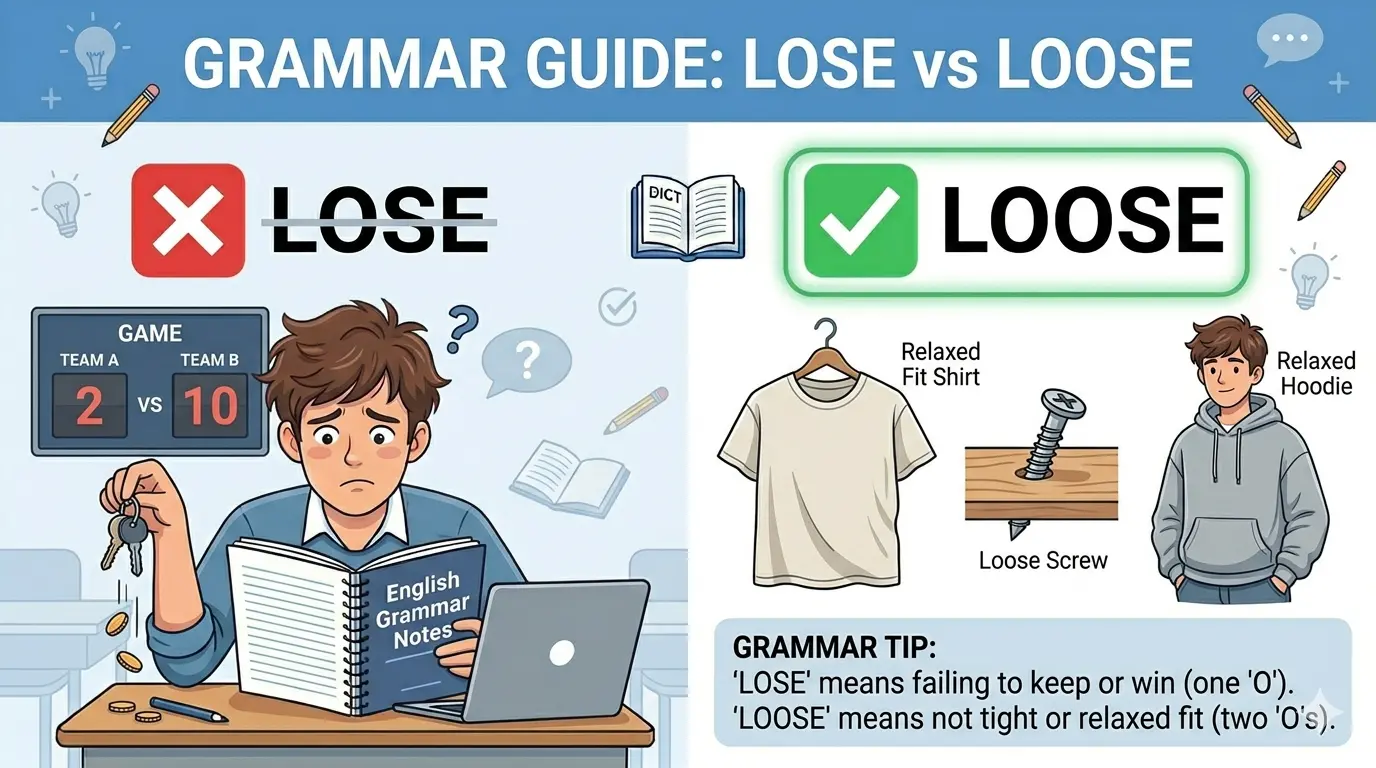
Lose → means to fail to keep something, or misplace something.
- Example: I don’t want to lose my phone.
Loose → means not tight, free, or not fixed.
- Example: My shirt is loose on me.
Simple trick:
- Lose = Loss (something goes away)
- Loose = Not tight (extra “o” = extra space)
Onsite or On-Site: Which Spelling Is Correct?
The Origin of Lose and Loose
Both words come from Old English.
- Lose comes from Old English “losian” meaning “to be lost or destroyed.”
- Loose comes from Old Norse “lauss” meaning “free or released.”
Over time, English kept both words but changed their spelling slightly. That is why they look similar today but have different meanings and pronunciations.
British English vs American English Spelling
Unlike many words, lose and loose do NOT change between British and American English.
They are spelled the same in both.
The confusion is not regional—it is grammar-based, not spelling-based.
Comparison Table
| Word | Meaning | Example (US/UK same) |
| Lose | To misplace or fail | I will lose my keys. |
| Loose | Not tight | The screw is loose. |
Which Spelling Should You Use?
There is no choice between US or UK spelling here. Instead:
- Use lose when talking about loss or failure.
- Use loose when talking about something not tight.
Simple rule:
- If you can replace it with “lost,” use lose
- If you mean “not tight,” use loose
Onsite or On-Site: Which Spelling Is Correct?
Common Mistakes with Lose and Loose
Here are the most common errors:
❌ I don’t want to loose the game
✔ I don’t want to lose the game
❌ My bag is lose
✔ My bag is loose
❌ Don’t loose your phone
✔ Don’t lose your phone
Why this happens:
- Spelling looks similar
- Fast typing errors
- Lack of grammar practice
Lose and Loose in Everyday Examples
Emails:
- We cannot lose this important client.
- The handle is loose and needs repair.
Social Media:
- Don’t lose hope 💪
- My hoodie is so loose today 😄
News Writing:
- The company may lose revenue this quarter.
- Safety rules were ignored due to a loose connection.
Formal Writing:
- Students must not lose focus during exams.
- A loose policy can cause security risks.
Lose or Loose – Google Trends & Usage Data
Search data shows that “lose vs loose” is heavily searched worldwide, especially in:
- India 🇮🇳
- Pakistan 🇵🇰
- United States 🇺🇸
- United Kingdom 🇬🇧
Why?
- Students preparing for exams
- ESL learners (English as a second language)
- Social media grammar confusion
- Auto-correct mistakes in typing
“Lose” is more commonly used in daily language, but “loose” causes more spelling errors online.
Comparison Table: Lose vs Loose
| Feature | Lose | Loose |
| Part of speech | Verb | Adjective |
| Meaning | Misplace or fail | Not tight |
| Pronunciation | /luːz/ | /luːs/ |
| Example | I might lose my job | My shirt is loose |
| Common error | Loose instead of lose | Lose instead of loose |
FAQs
1. What is the main difference between lose and loose?
Lose means to misplace or fail, while loose means not tight.
2. Why do people confuse lose and loose?
Because they look similar and are typed quickly in casual writing.
3. Is “loose weight” correct?
No. The correct phrase is lose weight.
4. Can “lose” be used as an adjective?
No. Lose is always a verb.
5. What is the easiest way to remember the difference?
“Lose = lost something.”
“Loose = extra space or not tight.”
6. Do British and American English spell them differently?
No, both use the same spelling.
7. Which one is more commonly used?
“Lose” is more common in daily communication.
Conclusion
Understanding the difference between lose and loose is simple once you break it down. These two words are often confused because they look and sound similar, but their meanings are completely different. Lose is a verb that means to misplace something, fail, or no longer have something. On the other hand, loose is an adjective that describes something not tight, relaxed, or free.
This difference is important in both casual and professional writing. A small spelling mistake can change the meaning of a sentence and create confusion. That is why learners, students, and writers often search for this topic.
The easiest way to remember is simple: lose is about loss, and loose is about space or tightness. With practice, you will naturally stop mixing them up. Always double-check your writing, especially in emails, exams, and social media posts.
Now you can confidently use both words correctly without hesitation. This small grammar rule will instantly improve your English clarity and writing accuracy.

I am Arshman Ali, a professional content writer and the author behind tensestutor.com . I am passionate about making grammar simple and accessible for everyone. Through my writing, I aim to help learners and professionals communicate with clarity and confidence.