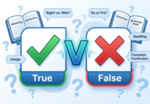
Many people search for “true or false v” because they see it online, in quizzes, legal documents, games, or educational content and wonder what it means. Is the letter V an abbreviation? Does it mean versus? Is it a spelling mistake?
This confusion happens because different contexts use the letter V in different ways. In some places, v means versus, while in others it may appear by mistake or as part of a title. People often want a quick answer before using the term in writing, social media, or professional documents.
This guide explains everything about true or false v, including its meaning, origin, spelling differences, common mistakes, and how people use it in everyday writing. You will also find examples, comparison tables, and answers to frequently asked questions so you can use the term correctly and avoid confusion.
True or False V – Quick Answer
True or false v is not a standard English phrase.
Usually, the letter v means versus. Therefore, “true or false v” may be:
- A typo or incomplete phrase.
- A title ending with the letter “v”.
- A reference where v stands for versus.
Examples
| Phrase | Meaning |
| True or False | A statement that must be judged correct or incorrect |
| A v B | A versus B |
| Smith v Jones | Legal case between Smith and Jones |
| True or False v | Usually incomplete or incorrect |
The Origin of True or False V
The phrase true or false comes from logic and education. It has been used for centuries to describe statements that are either correct or incorrect.
The letter v comes from the Latin word versus, meaning “against.” It became common in:
- Legal cases.
- Sports competitions.
- Debates.
- Academic references.
Because “true or false” and “v” belong to different contexts, combining them often creates confusion. In many cases, true or false v appears because of typing errors or unfinished text.
British English vs American English Spelling
The phrase true or false has the same spelling in British and American English. The difference appears in how v or vs. is written.
British English
- v
- versus
American English
- vs.
- versus
Comparison Table
| Context | British English | American English |
| Legal case | Brown v Green | Brown v Green |
| Informal writing | Liverpool v Chelsea | Liverpool vs. Chelsea |
| Full word | Versus | Versus |
| True or false | Same spelling | Same spelling |
Which Spelling Should You Use?
The best choice depends on your audience.
For US Readers
Use vs.
Example:
- Apple vs. Samsung
For UK Readers
Use v
Example:
- Arsenal v Chelsea
For Global Readers
Write the full word versus when possible.
Example:
- True versus false statements
This makes the meaning clear to everyone.
Common Mistakes with True or False V
People often make these mistakes.
| Incorrect | Correct |
| True or False V | True or False |
| True or false vs | True versus False |
| True V False | True versus False |
| True or Falsev | True or False |
| True or False versus | True versus False |
Corrections
✅ True or False
✅ True vs. False
❌ True or False V
True or False V in Everyday Examples
Emails
Correct
“Please answer the true or false questions before Friday.”
News
“Experts discussed true versus false claims about climate change.”
Social Media
“Can you tell if these statements are true or false?”
Formal Writing
“The survey contained twenty true-or-false questions.”
Education
“Students completed a true or false quiz.”
True or False V – Google Trends & Usage Data
The phrase true or false is widely used around the world because of:
- School quizzes.
- Educational websites.
- Online games.
- Fact-checking articles.
- Social media posts.
Countries where the term is popular include:
- United States
- United Kingdom
- Canada
- Australia
- India
The exact phrase true or false v is much less common and often appears because of incomplete searches or typing errors.
Keyword Variations Comparison Table
| Variation | Correct? | Common Use |
| True or False | Yes | Education and quizzes |
| True vs. False | Yes | American English |
| True v False | Yes | British English |
| True versus False | Yes | Formal writing |
| True or False V | No | Typing error or incomplete phrase |
| True False | Sometimes | Informal writing |
FAQs
What does true or false v mean?
It usually has no standard meaning and is often an incomplete phrase or typo.
Is “true or false v” grammatically correct?
No. The standard phrase is true or false.
Does v mean versus?
Yes. In British English, v is short for versus.
Is “vs.” American English?
Yes. Americans commonly use vs., while British English often uses v.
Should I write “true versus false”?
Yes. It is correct and clear.
Is “true or false” used worldwide?
Yes. It is common in schools, quizzes, and fact-checking.
Can I use “v” in legal writing?
Yes. Legal cases commonly use v, such as Brown v Board of Education.
Conclusion
The phrase true or false v causes confusion because it mixes two different ideas. The expression true or false is a common way to test whether a statement is correct or incorrect. The letter v, on the other hand, is a short form of versus and is mainly used in legal cases, sports, and comparisons.
For most situations, the correct phrase is simply true or false. If you want to compare two ideas, use true versus false, true vs. false, or true v false, depending on your audience. American readers usually prefer vs., while British readers often use v. Writing out versus is the clearest choice for international audiences.
Understanding these differences helps you avoid mistakes and communicate clearly. When in doubt, keep your writing simple and choose the version that best fits your readers and the purpose of your content.

I am Bahadar Ali, a professional content writer and the author behind Tensestutor.com I am passionate about making grammar simple and accessible for everyone. Through my writing, I aim to help learners and professionals communicate with clarity and confidence.