Have you ever heard someone say “I could care less” and wondered if it makes sense? Many English learners and native speakers search for “could care less or couldn’t care less” because the two phrases seem similar, but they have very different meanings.
This confusion is common in everyday conversations, social media posts, news articles, and even professional writing. One phrase is considered logically correct, while the other has become popular through common usage, especially in American English.
Understanding the difference helps you avoid mistakes and communicate more clearly. Whether you’re writing an email, preparing a report, posting on social media, or simply improving your English skills, knowing which phrase to use can make your message stronger.
In this guide, you’ll learn the correct meaning of both expressions, their history, differences between British and American usage, common mistakes, and practical examples. By the end, you’ll know exactly when to use each phrase and which version is best for your audience.
Could Care Less or Couldn’t Care Less – Quick Answer
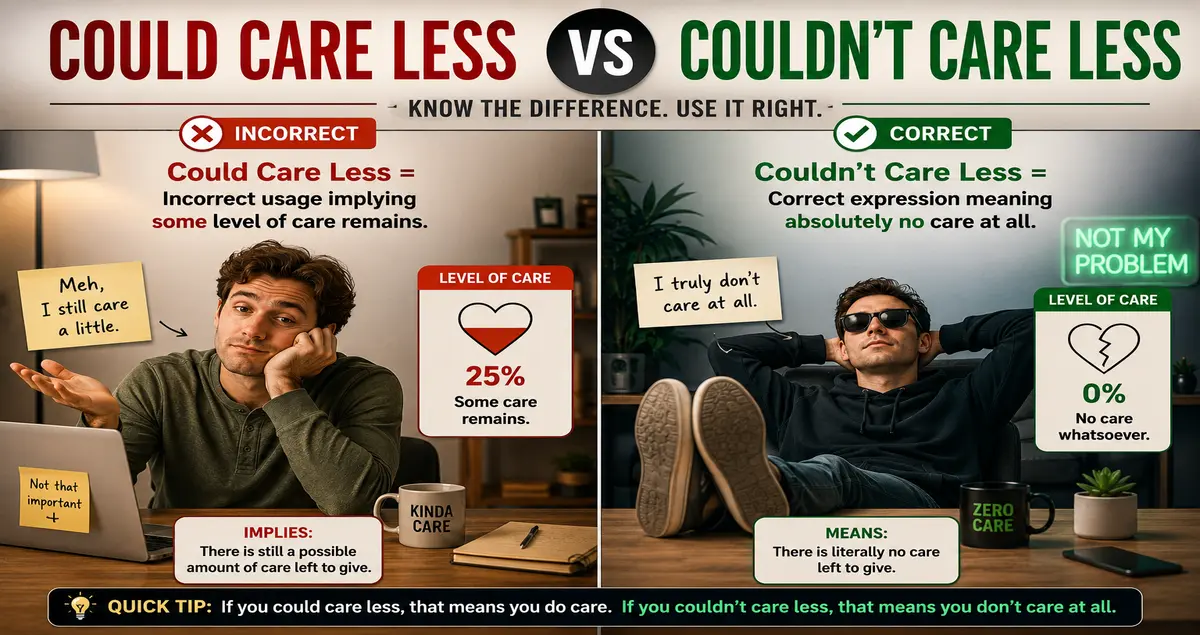
Quick answer: “Couldn’t care less” is the correct phrase.
It means:
“I care so little that it is impossible for me to care any less.”
Examples
✅ I couldn’t care less about celebrity gossip.
✅ She couldn’t care less what others think.
The phrase “I could care less” literally means:
“I still care at least a little.”
Because of this, many grammar experts consider it incorrect.
Examples
❌ I could care less about the movie.
✅ I couldn’t care less about the movie.
However, “I could care less” is widely used in the United States as an idiomatic expression.
Read more:Had Went or Had Gone? The Correct Grammar Explained
The Origin of Could Care Less or Couldn’t Care Less
The phrase “couldn’t care less” appeared first in British English during the mid-20th century. It was used to show complete lack of interest or concern.
Example:
“I couldn’t care less.”
The phrase is logical because it expresses the lowest possible level of caring.
Later, the American version “could care less” became popular. Linguists believe it developed as a sarcastic or ironic shortening of the original phrase.
Over time, many Americans began using it naturally, even though the literal meaning appears opposite to the intended message.
Why Do Different Versions Exist?
- British English kept the original phrase.
- American English popularized the shortened version.
- Both are understood by most English speakers today.
- Grammar experts generally prefer “couldn’t care less.”
Read more:I Have Ate or I Have Eaten? Which One Is Correct?
British English vs American English Spelling and Usage
While this difference is more about usage than spelling, regional preferences are important.
| Feature | Couldn’t Care Less | Could Care Less |
| Literal meaning | Correct and logical | Opposite meaning |
| British English | Very common | Rare |
| American English | Common | Also common |
| Formal writing | Preferred | Usually avoided |
| Academic writing | Recommended | Not recommended |
| Grammar experts | Approve | Often criticize |
Examples
British English
- I couldn’t care less about football.
American English
- I could care less about football.
- I couldn’t care less about football.
Both may be understood in the US, but the second version is considered more accurate.
Which Spelling Should You Use?
The best choice depends on your audience.
For US Audiences
- Both phrases may be understood.
- Couldn’t care less is clearer and more logical.
- Use it in professional writing.
For UK Audiences
- We couldn’t care less.
- It is the standard expression.
For Commonwealth Countries
Countries such as Canada, Australia, New Zealand, and South Africa generally prefer:
- Couldn’t care less
For Global Audiences
Choose:
✅ Couldn’t care less
It avoids confusion and is accepted worldwide.
Common Mistakes with Could Care Less or Couldn’t Care Less
Mistake 1: Using the Opposite Meaning
❌ I could care less about the problem.
✅ I couldn’t care less about the problem.
Mistake 2: Using “Could Care Less” in Formal Writing
❌ The company could care less about customer feedback.
✅ The company couldn’t care less about customer feedback.
Mistake 3: Assuming Both Are Equally Correct
While both are common, only “couldn’t care less” is logically correct.
Mistake 4: Mixing Tenses
❌ I couldn’t cared less.
✅ I couldn’t care less.
Could Care Less or Couldn’t Care Less in Everyday Examples
Emails
Professional
We couldn’t care less about personal preferences when making safety decisions.
News Writing
Citizens couldn’t care less about the political dispute.
Social Media
Honestly, I couldn’t care less about that trend.
Workplace Communication
Management couldn’t care less about office rumors.
Academic Writing
Researchers couldn’t care less about speculation without evidence.
Everyday Conversation
I couldn’t care less which restaurant we choose.
Could Care Less or Couldn’t Care Less – Google Trends & Usage Data
Search interest for “could care less or couldn’t care less” remains high because many people are unsure which version is correct.
Usage by Region
| Region | More Common Version |
| United Kingdom | Couldn’t care less |
| Australia | Couldn’t care less |
| Canada | Couldn’t care less |
| New Zealand | Couldn’t care less |
| United States | Both versions appear frequently |
Common Search Intent
People search this phrase to:
- Learn which version is correct.
- Improve grammar.
- Write professionally.
- Understand regional differences.
- Avoid common English mistakes.
The debate continues because the American version remains popular despite criticism from grammar experts.
Comparison Table: Keyword Variations
| Phrase | Meaning | Correct Literal Meaning? | Recommended? |
| Couldn’t care less | No concern at all | Yes | Yes |
| Could care less | Suggests some concern remains | No | Usually No |
| Could not care less | Same as couldn’t care less | Yes | Yes |
| I couldn’t care less | Complete lack of interest | Yes | Yes |
| I could care less | Common American idiom | No | Use cautiously |
FAQs
1. Which is correct: could care less or couldn’t care less?
Couldn’t care less is the grammatically and logically correct phrase.
2. Why do Americans say “could care less”?
Many people use it as an idiomatic or sarcastic expression that became popular over time.
3. Is “could care less” wrong?
Literally, yes. However, it is widely understood in American English.
4. Which phrase should I use in professional writing?
Use couldn’t care less.
5. Do British people use “could care less”?
Rarely. British English strongly prefers couldn’t care less.
6. Is “could not care less” also correct?
Yes. It has the same meaning as couldn’t care less.
7. Which version is best for international audiences?
Use couldn’t care less because it is clear and widely accepted.
Conclusion
The debate over “could care less or couldn’t care less” has existed fordecades, but the answer is simple. The phrase “couldn’t care less” is the original and logically correct expression.
It means you have absolutely no interest or concern about something. Because it accurately expresses complete indifference, it is the preferred choice in formal writing, academic work, business communication, and international English.
The phrase “could care less” is common in American English and is usually understood by native speakers. However, its literal meaning suggests that some level of caring still exists. For this reason, many grammar experts advise avoiding it, especially when clarity matters.
If your goal is to communicate clearly and professionally, choose “couldn’t care less.” It is accepted across the English-speaking world, avoids confusion, and reflects standard grammar rules. Whether you’re writing emails, reports, articles, or social media posts, using the correct phrase will help your message sound more accurate and polished.

I am Bahadar Ali, a professional content writer and the author behind Tensestutor.com I am passionate about making grammar simple and accessible for everyone. Through my writing, I aim to help learners and professionals communicate with clarity and confidence.