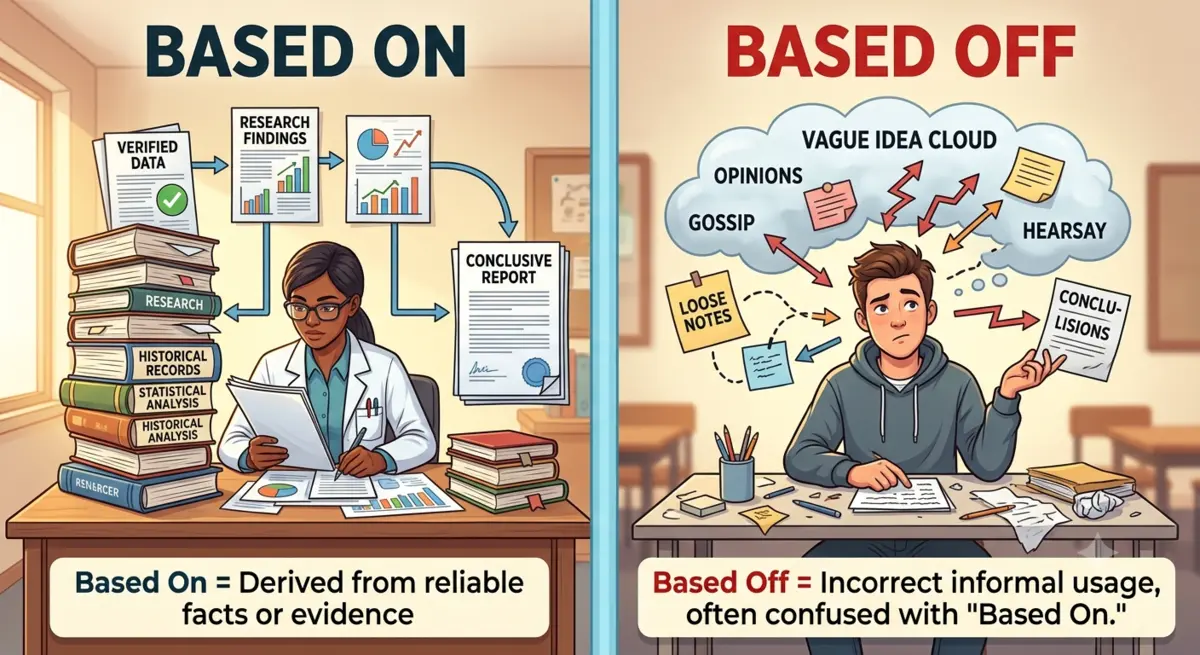
Have you ever wondered whether you should write “based on” or “based off”? Many English learners, writers, students, and professionals search for this question because both phrases appear often in books, websites, news articles, and social media posts.
The confusion comes from the fact that both expressions are used by native speakers. However, some grammar experts consider one form more standard than the other. If you are writing an email, academic paper, business report, or online content, choosing the right phrase can improve clarity and professionalism.
In this guide, you will learn the difference between based on and based off, where these phrases came from, how they are used in British and American English, and which version is best for your audience. You will also see common mistakes, real-life examples, comparison tables, and answers to frequently asked questions.
By the end, you will know exactly when to use based on and when based off may be acceptable.
Based On or Based Off – Quick Answer
Quick answer: “Based on” is the standard and widely accepted form in English.
Examples
✅ The movie is based on a true story.
✅ Our decision was based on customer feedback.
✅ The report is based on recent research.
“Based off” is common in informal American English, but many editors and style guides still prefer “based on.”
⚠️ Informal: The game is based off a popular TV show.
✅ Preferred: The game is based on a popular TV show.
Read more:Have Went or Have Gone:The Correct Grammar Explained?
The Origin of Based On or Based Off
The phrase “based on” comes from the noun base, meaning a foundation or support.
Historically, something that is “based on” another thing rests upon it as its foundation.
Example
A theory is based on evidence.
The story is based on real events.
The phrase “based off” appeared much later, mainly in North American speech. Some linguists believe it developed from expressions like:
- Built off
- Worked off
- Modeled off
Because of this influence, many speakers began saying based off instead of based on.
Today, both forms are understood, but based on remains the traditional and more widely accepted expression.
Read more:To Too Two Difference: Easy Guide to Use Them Correctly
British English vs American English Spelling
The difference is not really a spelling issue. It is mainly a usage difference.
British English strongly prefers based on.
American English also prefers based on, but based off appears more often in casual speech and online writing.
Comparison Table
| English Variety | Preferred Form | Accepted? | Common Context |
| British English | Based on | Yes | Formal and informal |
| American English | Based on | Yes | Formal and informal |
| American English | Based off | Sometimes | Informal speech |
| Australian English | Based on | Yes | Standard usage |
| Canadian English | Based on | Yes | Standard usage |
Examples
British English
✅ The documentary is based on historical records.
American English
✅ The documentary is based on historical records.
⚠️ Informal: The documentary is based off historical records.
Which Spelling Should You Use?
If Your Audience Is in the United States
Use based on professional, academic, and business writing.
You may hear based off in casual conversations.
If Your Audience Is in the UK or Commonwealth Countries
Use based on almost exclusively.
If Your Audience Is Global
Choose based on because it is understood and accepted everywhere.
Professional Advice
For websites, blogs, reports, academic papers, resumes, and marketing content, based on is the safest choice.
Common Mistakes with Based On or Based Off
Mistake 1: Using Based Off in Formal Writing
❌ The study is based off previous research.
✅ The study is based on previous research.
Mistake 2: Mixing the Phrases
❌ Our findings are based off of data.
✅ Our findings are based on data.
Mistake 3: Assuming Both Are Equal Everywhere
❌ Based off is always correct.
✅ Based on is the standard form in all major English varieties.
Mistake 4: Using the Wrong Preposition
❌ The movie is based from a book.
✅ The movie is based on a book.
Based On or Based Off in Everyday Examples
✅ This proposal is based on the client’s requirements.
News Article
✅ The report is based on official government statistics.
Social Media
✅ My artwork is based on my favorite video game.
⚠️ Informal: My artwork is based off my favorite video game.
Academic Writing
✅ The conclusion is based on data collected during the study.
Business Writing
✅ The strategy is based on market research.
Based On or Based Off – Google Trends & Usage Data
Search interest shows that based on is far more common than based off.
Popularity by Country
| Country | More Common Form |
| United States | Based on |
| United Kingdom | Based on |
| Canada | Based on |
| Australia | Based on |
| New Zealand | Based on |
Usage Context
| Context | Preferred Form |
| Academic Writing | Based on |
| Business Writing | Based on |
| Journalism | Based on |
| Books | Based on |
| Casual Conversation | Based on / Based off |
| Social Media | Based on / Based off |
Overall, based on dominant search results, published writing, and professional communication.
Comparison Table: Based On vs Based Off
| Feature | Based On | Based Off |
| Grammatically Standard | Yes | Less standard |
| Formal Writing | Recommended | Usually avoided |
| Academic Writing | Recommended | Avoid |
| Business Writing | Recommended | Avoid |
| Casual Speech | Common | Common in some regions |
| Global Acceptance | Very high | Lower |
| British English | Preferred | Rare |
| American English | Preferred | Informal use exists |
FAQs
1. Is “based on” correct?
Yes. Based on is the standard and widely accepted form in English.
2. Is “based off” grammatically wrong?
Not completely. It is common in informal American English, but many editors prefer based on.
3. Which phrase should I use in professional writing?
Use based on for professional, academic, and business communication.
4. Do Americans say “based off”?
Yes. Some Americans use based off in casual speech, although based on remains more common.
5. Which phrase is better for SEO content?
Use based on because it is the standard form and is preferred by most readers.
6. Is “based off of” correct?
It is understood, but many style guides recommend replacing it with based on.
7. Can I use “based off” in conversation?
Yes. Native speakers may use it casually, but based on is still the safer choice.
Conclusion
The debate between based on and based off is mostly about usage rather than grammar. While both expressions are understood by English speakers, based on remains the standard, traditional, and widely accepted form. It appears in academic writing, journalism, business communication, books, and professional content across the English-speaking world.
The phrase based off has become more common in informal American English, especially in speech and social media. However, many editors, teachers, and style guides still prefer based on because it clearly expresses the idea of a foundation or source.
If your goal is clarity, professionalism, and global understanding, choose based on. It works well for readers in the United States, the United Kingdom, Canada, Australia, and other English-speaking countries. Using the standard form helps your writing look polished and trustworthy.
When in doubt, remember this simple rule: formal writing = based on; casual speech = based on or based off. Following this guideline will help you communicate clearly and confidently in any situation.

I am Bahadar Ali, a professional content writer and the author behind Tensestutor.com I am passionate about making grammar simple and accessible for everyone. Through my writing, I aim to help learners and professionals communicate with clarity and confidence.