Have you ever stopped while writing and wondered, “Do I need a comma before because?” You are not alone. This is one of the most common punctuation questions in English.
Many writers add a comma before because every time they use it. Others never use one. Both approaches can lead to mistakes. The truth is that the comma before because depends on the meaning of the sentence.
People search for comma before because because they want clear writing. They want to avoid confusion in emails, school assignments, business documents, and social media posts. A small comma can sometimes change the meaning of a sentence completely.
In this guide, you will learn when to use a comma before because, when to leave it out, common mistakes to avoid, and real-life examples. By the end, you’ll know exactly how to handle this punctuation rule with confidence.
Comma Before Because – Quick Answer
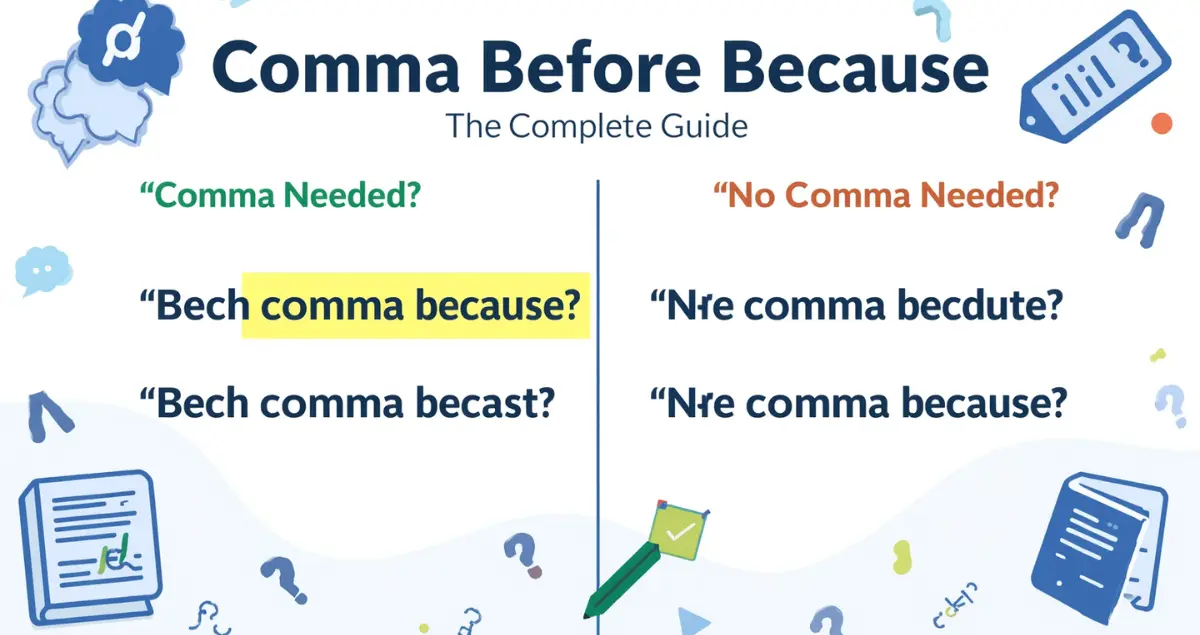
Usually, you do not use a comma before because.
Correct:
- I stayed home because it was raining.
- She smiled because she was happy.
However, a comma may be needed when it helps prevent confusion or changes the meaning.
Example:
- He didn’t leave because he was tired.
This means he did not leave for the reason of being tired.
- He didn’t leave, because he was tired.
This means he stayed because he was tired.
Quick Rule: Leave out the comma before because unless it improves clarity.
Read more: Anxious or Eager: What’s the Difference
The Origin of Comma Before Because
The word because comes from Middle English and originally developed from the phrase “by cause.” Over time, it became a conjunction used to introduce reasons or explanations.
English punctuation rules evolved separately from the word itself. Early English writing used fewer punctuation marks than modern English.
Today, style guides generally agree that because does not normally require a comma before it. Writers add a comma only when the sentence could be misunderstood without one.
Unlike spelling differences between words, the question of comma before because is mostly about punctuation style and sentence meaning rather than regional language changes.
British English vs American English Spelling
There is no spelling difference because in British English and American English. The word is spelled the same in both forms of English.
However, punctuation preferences can vary slightly between style guides.
Read more: Unique or Very Unique: Which One Is Correct
| Feature | British English | American English |
| Spelling of because | because | because |
| Standard rule | Usually no comma | Usually no comma |
| Clarity comma allowed | Yes | Yes |
| Formal writing style | Similar | Similar |
| Academic recommendations | Context-based | Context-based |
Examples
| British English Example | American English Example |
| I stayed inside because it was cold. | I stayed inside because it was cold. |
| She was late because of traffic. | She was late because of traffic. |
Which Spelling Should You Use?
Because it has the same spelling worldwide, you do not need to choose between British and American spelling.
Instead, focus on punctuation.
If Your Audience Is in the United States
Follow standard American punctuation rules. Avoid a comma before because unless clarity requires it.
If Your Audience Is in the United Kingdom
The same rule applies. Most British style guides recommend avoiding unnecessary commas.
If Your Audience Is Global
Use the simplest approach:
- No comma before because in most sentences.
- Add a comma only when it prevents confusion.
This approach works well for international readers.
Common Mistakes with Comma Before Because
Many writers misuse commas with because.
Mistake 1: Adding a Comma Every Time
❌ I stayed home, because it was raining.
✅ I stayed home because it was raining.
Mistake 2: Creating Unnecessary Pauses
❌ She studied hard, because she wanted good grades.
✅ She studied hard because she wanted good grades.
Mistake 3: Removing a Needed Comma
❌ He didn’t quit because he was unhappy.
This can be unclear.
✅ He didn’t quit, because he was unhappy.
Mistake 4: Following Speech Patterns
People often pause before because when speaking. That pause does not always need a comma in writing.
Comma Before Because in Everyday Examples
- I missed your message because I was traveling.
- I couldn’t attend the meeting, because I was feeling unwell.
News Writing
- The road was closed because of severe weather.
- The event was postponed because organizers needed more time.
Social Media
- I’m smiling because it’s finally Friday.
- I stayed offline because I needed a break.
Formal Writing
- The project succeeded because the team planned carefully.
- The application was rejected because it lacked required documents.
Comma Before Because – Google Trends & Usage Data
Search interest for comma before because remains strong because punctuation questions are common among students, writers, teachers, and professionals.
The topic is especially popular in:
- United States
- United Kingdom
- Canada
- Australia
- India
People typically search for:
- Do you put a comma before because?
- Is there a comma before because?
- Grammar rules for because
- Comma before because examples
Most searches occur in educational, professional writing, and grammar-learning contexts.
Comma Before Because Comparison Table
| Sentence Type | Comma Needed? | Example |
| Simple reason | No | I left because it was late. |
| Cause and effect | No | She smiled because she was happy. |
| Clarification needed | Sometimes | He didn’t leave, because he was tired. |
| Formal business writing | Usually no | We canceled because demand was low. |
| Academic writing | Usually no | The results changed because conditions changed. |
Frequently Asked Questions
1. Do you always put a comma before because?
No. Most sentences do not need a comma before because.
2. When should I use a comma before because?
Use it only when it helps clarify meaning or prevents misunderstanding.
3. Is it wrong to put a comma before because?
Not always. It is correct when needed for clarity, but often unnecessary.
4. Does British English use a comma before because?
British English follows the same general rule as American English.
5. Does American English require a comma before because?
No. Most American style guides recommend omitting it unless clarity requires one.
6. Can a comma change the meaning of a sentence?
Yes. In some cases, adding or removing a comma changes the interpretation.
7. Is a comma before because formal or informal?
Neither. It is a punctuation choice based on meaning and clarity.
Conclusion
Understanding the rule for comma before because can make your writing clearer and more professional. The good news is that the rule is simple. In most situations, you should not place a comma before because. The word naturally connects a reason to the main part of the sentence without needing extra punctuation.
However, there are exceptions. A comma can be useful when a sentence might be misunderstood or when the writer wants to emphasize a particular meaning. In these cases, the comma acts as a tool for clarity rather than a strict grammar requirement.
Whether you are writing emails, reports, essays, articles, or social media posts, the best approach is to read your sentences carefully. If the meaning is already clear, leave the comma out. If readers could interpret the sentence in more than one way, adding a comma may help.
Remember this simple guideline: No comma before because in most cases, but use one when clarity demands it. Following this rule will help you write with confidence and accuracy.

I am Bahadar Ali, a professional content writer and the author behind Tensestutor.com I am passionate about making grammar simple and accessible for everyone. Through my writing, I aim to help learners and professionals communicate with clarity and confidence.