Have you ever written a sentence and paused to wonder If you should use proven or proved? You are not alone. Many English speakers, writers, students, and professionals get confused about these two words because both seem correct.
The confusion comes from the fact that proven and proved are forms of the same verb, prove. In some situations, they can be used interchangeably. In others, one form sounds more natural or follows traditional grammar rules. This creates uncertainty, especially in formal writing, business communication, academic work, and online content.
Understanding the difference between proven or proved can help you write more clearly and confidently. It also prevents common grammar mistakes that may make your writing look less professional.
In this guide, you’ll learn the meaning of each word, their origins, differences between British and American English, when to use each form, common mistakes, real-life examples, and usage trends around the world.
Proven or Proved – Quick Answer
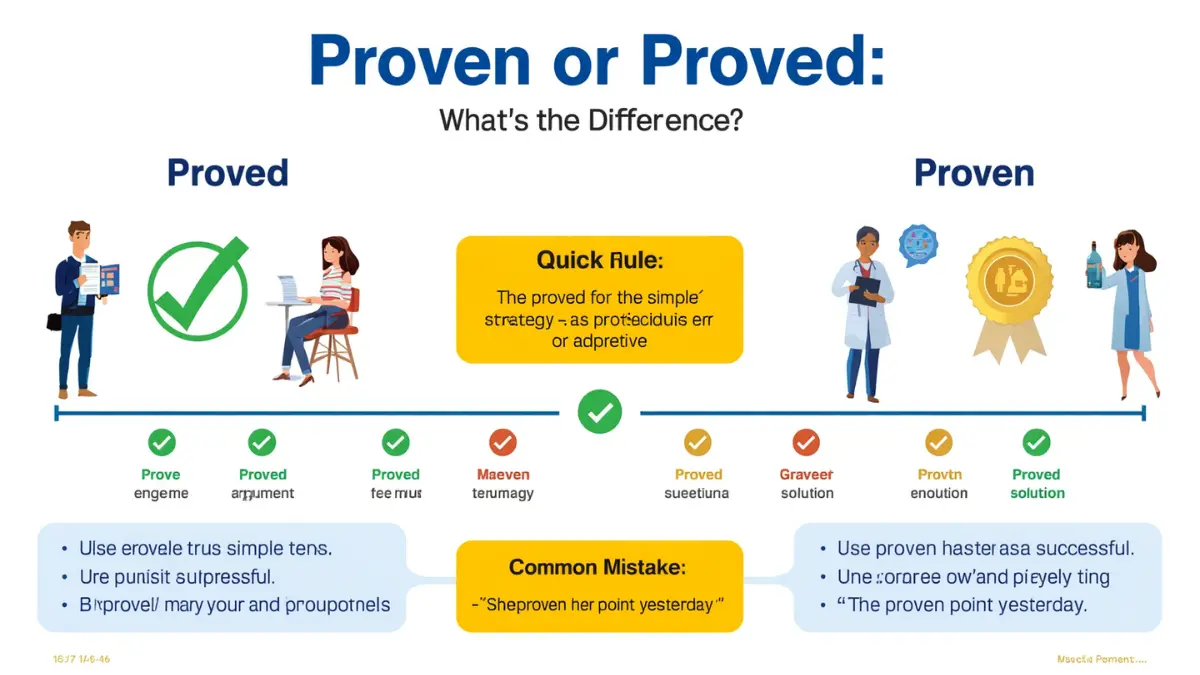
Both proven and proved are correct, but they are used differently.
- Proved is the traditional past tense and past participle of prove.
- Proven is commonly used as a past participle, especially before a noun.
Examples
✅ She proved her point during the meeting.
✅ The scientist has proved the theory.
Read more: Laid or Lain: What’s the Difference
Quick Rule
| Form | Usage |
| Proved | Past tense and traditional past participle |
| Proven | Common past participle, especially before nouns |
The Origin of Proven or Proved
The verb prove comes from the Old French word prover, which originated from the Latin word probare, meaning “to test” or “to demonstrate.”
Historically, proved was the only accepted past tense and past participle form.
Historical Development
- Old English: prove
- Past tense: proved
- Past participle: proved
Read more; Lay or Lie: Understanding the Difference and Using Each Correctly
Over time, English speakers began using proven as an alternative past participle. This pattern is similar to other verbs such as:
| Base Verb | Past Tense | Past Participle |
| show | showed | shown |
| prove | proved | proven |
| wake | woke | woken |
By the 19th and 20th centuries, proven became widely accepted, especially in American English.
British English vs American English Spelling
The difference between proven and proved is more about usage preference than spelling.
American English
American English often prefers proven as a past participle.
Examples:
- The strategy has proven effective.
- A proven solution is available.
British English
British English traditionally favors proved, especially after helping verbs.
Examples:
- The method has proved successful.
- The evidence has proved useful.
However, modern British English also accepts proven, particularly before nouns.
Comparison Table
| Situation | American English | British English |
| Past tense | Proved | Proved |
| Past participle | Proven often preferred | Proved often preferred |
| Before nouns | Proven | Proven |
| Formal writing | Proven common | Proved slightly more common |
| Everyday use | Proven | Both accepted |
Which Spelling Should You Use?
The best choice depends on your audience.
For American Audiences
Use proven when writing:
- Business content
- Marketing materials
- Blogs
- News articles
Example:
Our company offers a proven system for growth.
For British Audiences
Use proved in formal writing.
Example:
The study has proved the hypothesis.
For Global Audiences
Either form is acceptable, but proven is often easier for international readers because it is very common online.
Recommended Usage
| Audience | Best Choice |
| United States | Proven |
| United Kingdom | Proved or Proven |
| Australia | Proved or Proven |
| Canada | Both accepted |
| Global readers | Proven |
Common Mistakes with Proven or Proved
Many writers misuse these forms because they assume they are always interchangeable.
Mistake 1: Using Proven as a Simple Past Tense
❌ She proven her point.
✅ She proved her point.
Mistake 2: Thinking Proven Is Incorrect
❌ This is wrong because proven is not a real word.
✅ Proven is a fully accepted English word.
Mistake 3: Mixing Styles
❌ The theory has proved effective and is a proven solution. (Not wrong, but style may feel inconsistent.)
✅ Choose one style and stay consistent.
Mistake 4: Using Proved Before Nouns
Less natural:
⚠️ A proved method
More natural:
✅ A proven method
Proven or Proved in Everyday Examples
Here is how these words appear in daily communication.
In Emails
✅ We have proved that the system works.
✅ We use a proven process to improve efficiency.
In News Articles
✅ Researchers have proved a link between the two events.
✅ The company relies on proven technology.
On Social Media
✅ This is a proven way to save money.
✅ The experiment proved successful.
In Academic Writing
✅ The findings have proved significant.
In Business Writing
✅ Our team uses proven strategies to increase sales.
Proven or Proved – Google Trends & Usage Data
Search interest for proven or proved remains steady because many writers want to know which form is correct.
Usage Patterns by Country
| Country | More Common Form |
| United States | Proven |
| Canada | Proven |
| United Kingdom | Proved |
| Australia | Both |
| New Zealand | Both |
Context-Based Popularity
| Context | Preferred Form |
| Marketing | Proven |
| Advertising | Proven |
| Academic Writing | Proved |
| Journalism | Both |
| Everyday Writing | Proven |
The phrase “proven method” is particularly popular because it sounds natural and persuasive in business and marketing content.
Proven vs Proved Comparison Table
| Feature | Proven | Proved |
| Part of Speech | Past participle | Past tense and past participle |
| Traditional Form | No | Yes |
| Common in American English | Yes | Yes |
| Common in British English | Yes | Yes |
| Used Before Nouns | Very common | Rare |
| Formal Writing | Accepted | Accepted |
| Example | A proven strategy | The strategy proved effective |
FAQs
Is proven grammatically correct?
Yes. Proven is a widely accepted past participle of the verb prove.
Is proved grammatically correct?
Yes. Proved is the traditional past tense and past participle form.
Which is more common, proven or proved?
Proven is generally more common in modern American English.
Can I say “has proven”?
Yes. Many style guides accept phrases like:
The method has proven successful.
Can I say “has proved”?
Yes. This form is especially common in British English.
Is “proven method” correct?
Yes. In fact, proven method is one of the most common uses of the word proven.
Should I use proven or proved in academic writing?
Many academic and formal British publications prefer proved, but both forms are generally accepted.
Conclusion
The debate over proven or proved is less about right and wrong and more about usage and style. Both words come from the verb prove, and both are accepted in modern English. Traditionally, proved served as both the past tense and past participle. Over time, proven gained popularity, particularly in American English, where it is now widely used in business, marketing, journalism, and everyday communication.
If you are writing for a British audience or following a formal style guide, proved may be the safer choice. If you are writing for American readers or a global audience, proven often sounds more natural and familiar. When used before nouns, such as proven method, proven solution, or proven strategy, the word proven is generally preferred.
The most important rule is consistency. Choose the form that matches your audience and writing style, then use it throughout your content. By understanding the difference between proven and proved, you can write with greater accuracy, confidence, and professionalism.

I am Bahadar Ali, a professional content writer and the author behind Tensestutor.com I am passionate about making grammar simple and accessible for everyone. Through my writing, I aim to help learners and professionals communicate with clarity and confidence.