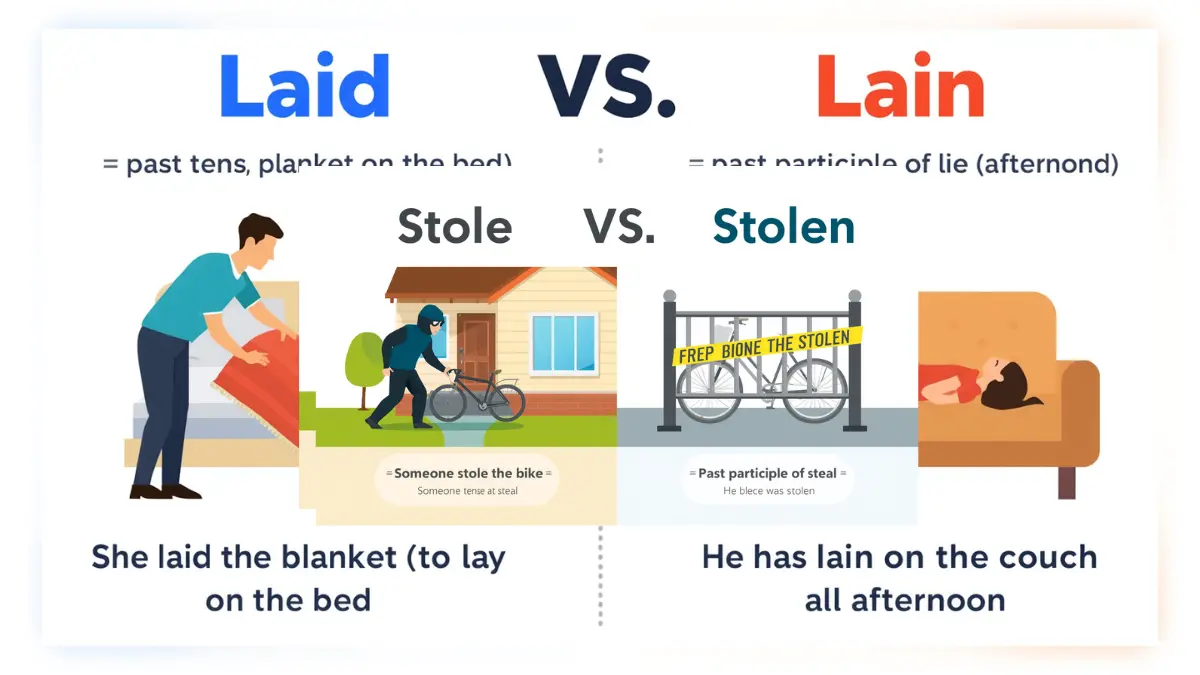
Many English learners and native speakers get confused by “laid” and “lain.” The words look similar, sound alike, and both relate to the verb “lie” or “lay.” Because of this, people often search for “laid or lain” to understand which word is correct.
This confusion happens because English verbs can change form in unusual ways. One word needs an object, while the other does not. Even experienced writers mix them up in emails, school papers, social media posts, and business writing.
If you have ever asked questions like:
- “Should I say I have laid down or lain down?”
- “Is laid grammatically correct here?”
- “What is the difference between laid and lain?”
then this guide will help you.
In this article, you will learn the quick answer, the history behind the words, British vs American usage, common mistakes, and real-life examples. By the end, you will know exactly when to use laid and when to use lain with confidence.
Laid or Lain – Quick Answer
The difference is simple:
- Laid = past tense or past participle of lay
- Lain = past participle of lie
Read more: Raise or Rise: What’s the Difference and How to Use Them
Quick Examples
| Word | Meaning | Example |
| Laid | Put something down | She laid the book on the table. |
| Lain | Rested or reclined | He had lain on the couch all day. |
Easy Rule
- Use laid when there is an object.
- Use lain when there is no object.
Compare These
- Correct: She laid the baby in the crib.
- Correct: The baby had lain quietly for hours.
Read more: Set or Sit: Understanding the Difference and Using Each Word
The Origin of Laid or Lain
The confusion between “laid” and “lain” comes from old English grammar.
The verb lay comes from Old English lecgan, which meant “to place something down.” Over time, the past form became laid.
The verb lie comes from Old English licgan, meaning “to rest” or “recline.” Its past participle later became lain.
Because both verbs changed over hundreds of years, their forms now look very similar:
| Base Verb | Past Tense | Past Participle |
| Lay | Laid | Laid |
| Lie | Lay | Lain |
This creates confusion because lay is both:
- a present tense verb, and
- the past tense of “lie.”
English spelling and grammar evolved differently across regions, which also added to the confusion.
British English vs American English Spelling
Both British English and American English use laid and lain the same way grammatically. The difference is usually in writing style and frequency of use.
American English often prefers simpler sentence structures. Because of this, many Americans avoid “lain” in casual writing.
British English tends to keep traditional grammar forms more often.
Comparison Table
| Context | American English | British English |
| Casual speech | “I’ve laid down.” | “I’ve lain down.” |
| Formal writing | “He had lain there.” | “He had lain there.” |
| Everyday use | “laid” used more often | “lain” used more correctly |
| Grammar teaching | Simplified in schools | Traditional forms taught |
Example Sentences
American English
- I laid the phone on the desk.
- He had lain awake all night.
British English
- She laid the coat on the chair.
- The dog had lain by the fire.
Which Spelling Should You Use?
The correct choice depends on your audience and writing style.
Use “Laid” When:
- You place something somewhere.
- There is an object in the sentence.
- Writing casual American English.
Example:
- She laid the keys on the counter.
Use “Lain” When:
- Someone or something rests.
- There is no object.
- Writing formal or professional English.
Example:
- He had lain in bed for hours.
Audience-Based Advice
| Audience | Best Choice |
| US readers | Simple wording, often “laid” |
| UK readers | Traditional grammar with “lain” |
| Academic writing | Use correct grammatical form |
| Global audience | Keep sentences simple and clear |
If you are unsure, rewrite the sentence to avoid confusion.
Common Mistakes with Laid or Lain
Many writers use these words incorrectly.
Mistake 1: Using “laid” without an object
❌ He has laid on the sofa all day.
✅ He has lain on the sofa all day.
Mistake 2: Using “lain” with an object
❌ She had lain the bag on the floor.
✅ She had laid the bag on the floor.
Mistake 3: Confusing “lay” and “lie”
❌ I will lie the papers there.
✅ I will lay the papers there.
Quick Trick
Ask:
- “What was placed?” → use laid
- “Who rested?” → use lain
Laid or Lain in Everyday Examples
Here are real-world examples of how people use these words.
In Emails
- I have laid the documents on your desk.
- The files had lain untouched for weeks.
In News Writing
- The evidence was laid before the court.
- The town had lain silent after the storm.
On Social Media
- I’ve just lain in bed all weekend.
- She laid everything out perfectly.
In Formal Writing
- The foundation was laid in 1995.
- The manuscript had lain hidden for years.
Laid or Lain – Google Trends & Usage Data
Search interest for “laid or lain” stays strong because English learners and writers regularly struggle with verb forms.
Usage by Region
| Country | More Common Search |
| United States | “laid” |
| United Kingdom | “lain” |
| Canada | Both |
| Australia | “lain” in formal writing |
| India | High searches for grammar explanations |
Why People Search This Keyword
People usually search for:
- grammar help
- school assignments
- professional writing
- English learning
- proofreading support
In online writing, “laid” appears more often because many people incorrectly replace “lain” with it.
Comparison Table: Laid vs Lain
| Feature | Laid | Lain |
| Verb Origin | Lay | Lie |
| Meaning | Put something down | Rested/reclined |
| Need an Object? | Yes | No |
| Common Usage | Very common | Less common |
| Formal Writing | Correct in context | Correct in context |
| Example | She laid the phone down. | He had lain there all day. |
FAQs About Laid or Lain
1. Is it “have laid” or “have lain”?
Use:
- have laid when something was placed
- have lain when someone rested
Example:
- I have laid the papers down.
- I have lain awake all night.
2. Why is “lain” rarely used?
Many speakers simplify grammar in casual English. “Laid” is often incorrectly used instead.
3. Is “laid down” always wrong?
No. It is correct when something is being placed down.
Example:
- She laid down the book.
4. Can “lain” be used in modern English?
Yes. It is still correct and common in formal writing.
5. What is the past tense of “lie”?
The past tense of “lie” is lay.
Example:
- Yesterday, he lay on the couch.
6. Is “laid” more common in American English?
Yes. American English often favors simpler grammar in casual speech.
7. How can I remember the difference?
- Laid = placed something
- Lain = rested somewhere
Conclusion
Understanding the difference between laid and lain becomes much easier once you know the basic grammar rule. Use laid when an object is involved and something is being placed somewhere. Use lain when someone or something is resting without an object.
The confusion exists because English verb forms changed over time, and the verbs “lay” and “lie” developed similar spellings. American English often uses simpler forms in casual speech, while British English keeps traditional grammar more often.
If you write for school, business, or professional audiences, using the correct form matters. It improves clarity and makes your writing look polished. In casual conversation, many people mix the words up, but understanding the proper usage helps you communicate more clearly.
A simple memory trick can help:
- If something is placed → laid
- If someone rests → lain
With practice, choosing between “laid” and “lain” will soon feel natural.

I am Bahadar Ali, a professional content writer and the author behind Tensestutor.com I am passionate about making grammar simple and accessible for everyone. Through my writing, I aim to help learners and professionals communicate with clarity and confidence.