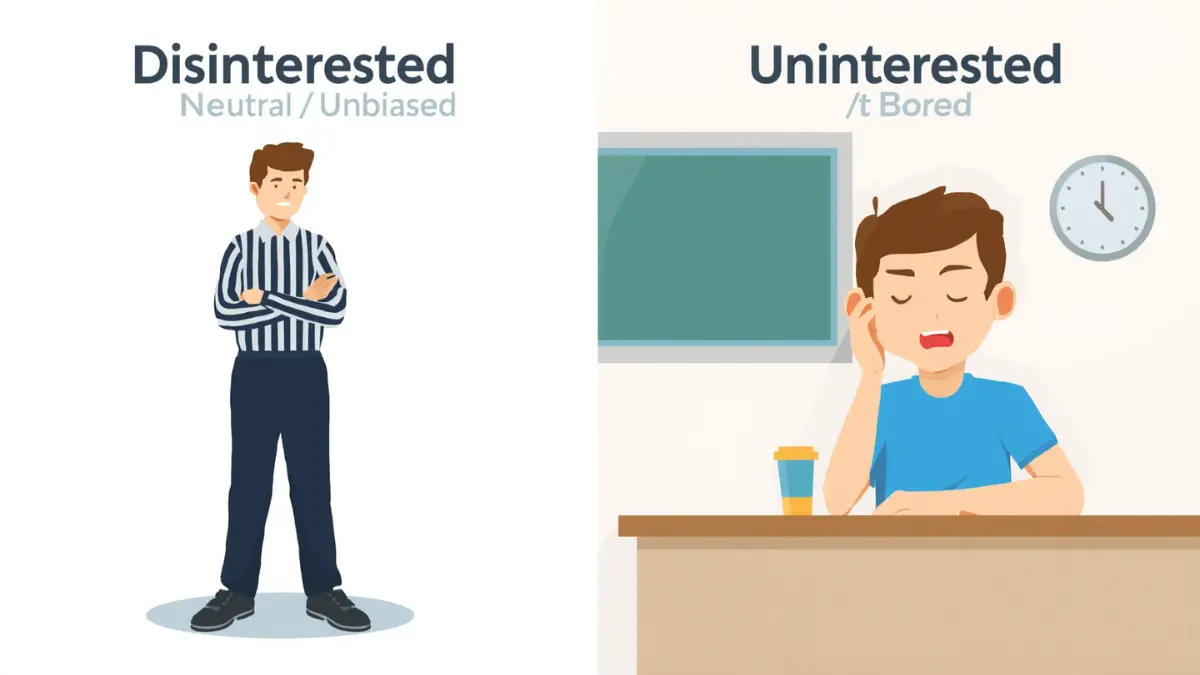
Many English speakers struggle with disinterested or uninterested people because the two words look similar and are often used incorrectly. At first glance, they seem to mean the same thing. However, they have different meanings and should be used in different situations.
People commonly search for disinterested or uninterested people when writing emails, academic papers, business reports, or professional content. Choosing the wrong word can change the meaning of a sentence and make your writing less accurate.
The confusion exists because both words describe a lack of connection to something. However, disinterested refers to being impartial or unbiased, while uninterested means not interested or bored. Understanding this distinction can improve your grammar and help you communicate more clearly.
In this guide, you’ll learn the meanings of both words, their origins, common mistakes, real-world examples, and usage tips. By the end, you’ll know exactly when to use disinterested and when to use uninterested.
Disinterested or Uninterested – Quick Answer
Disinterested means neutral, unbiased, or having no personal stake in a matter.
Uninterested means not interested, bored, or lacking curiosity.
Examples
✅ The judge remained disinterested throughout the case.
✅ She seemed uninterested in the movie.
Easy Rule
- Disinterested = Unbiased
- Uninterested = Not interested
Read more: Which or That: What’s the Difference ?
Quick Memory Trick
If someone is fair and neutral, they are disinterested.
If someone does not care, they are uninterested.
The Origin of Disinterested or Uninterested
Both words come from the word interest, but they developed different meanings.
Disinterested
The word disinterested appeared in English during the 17th century. It originally meant “free from personal interest” or “impartial.”
It was mainly used in legal, political, and ethical discussions.
Uninterested
The word uninterested developed later and simply meant “not interested.”
It describes a lack of curiosity, enthusiasm, or concern.
Why the Confusion Exists
Many people mistakenly use disinterested when they mean uninterested because both words suggest some form of detachment.
However, modern grammar guides still recommend keeping the meanings separate.
Read more: Recognise or Recognize: Meaning and Correct Usage Guide
British English vs American English Spelling
There is no spelling difference between British English and American English.
Both countries use:
- Disinterested
- Uninterested
Comparison Table
| Meaning | British English | American English |
| Neutral or unbiased | Disinterested | Disinterested |
| Not interested | Uninterested | Uninterested |
Examples
| British English | American English |
| The referee remained disinterested. | The referee remained disinterested. |
| The audience appeared uninterested. | The audience appeared uninterested. |
The spelling remains the same worldwide.
Which Spelling Should You Use?
Since the spelling does not change by region, the key is choosing the correct meaning.
For US Audiences
Use:
- Disinterested for impartiality
- Uninterested for lack of interest
For UK Audiences
The same distinction applies.
For Global Audiences
Following the traditional meanings helps avoid confusion.
Professional Writing Advice
In business, academic, and legal writing, it is best to preserve the difference between the two words.
Common Mistakes with Disinterested or Uninterested
Mistake 1
❌ She was disinterested in the lecture.
✅ She was uninterested in the lecture.
Mistake 2
❌ The mediator remained uninterested during negotiations.
✅ The mediator remained disinterested during negotiations.
Mistake 3
❌ The students looked disinterested because the lesson was boring.
✅ The students looked uninterested because the lesson was boring.
Quick Correction Table
| Incorrect | Correct |
| Disinterested in the movie | Uninterested in the movie |
| Uninterested judge | Disinterested judge |
| Disinterested audience | Uninterested audience |
Disinterested or Uninterested in Everyday Examples
Emails
Disinterested
“We need a disinterested third party to review the issue.”
Uninterested
“The client seemed uninterested in the proposal.”
News Writing
“The panel selected a disinterested expert.”
“Voters appeared uninterested in the debate.”
Social Media
“I’m completely uninterested in reality TV.”
Formal Writing
“The study was reviewed by a disinterested committee member.”
“The participants appeared uninterested in the training session.”
Disinterested or Uninterested – Google Trends & Usage Data
Both words are frequently searched because of their similar appearance.
Disinterested
Often used in:
- Law
- Ethics
- Journalism
- Academic writing
Uninterested
Common in:
- Everyday conversation
- Social media
- Entertainment reviews
- Personal communication
Usage by Country
| Country | Disinterested Usage | Uninterested Usage |
| United States | High | Very High |
| United Kingdom | High | Very High |
| Canada | High | High |
| Australia | High | High |
| India | High | High |
Generally, uninterested appears more frequently because it is used in everyday situations.
Disinterested vs Uninterested Comparison Table
| Feature | Disinterested | Uninterested |
| Meaning | Neutral, unbiased | Not interested |
| Emotion | No personal stake | Lack of enthusiasm |
| Formality | Often formal | Common everyday use |
| Legal Context | Very common | Rare |
| Example | A disinterested judge | An uninterested student |
FAQs
1. What is the main difference between disinterested and uninterested?
Disinterested means impartial. Uninterested means not interested.
2. Can disinterested mean bored?
Traditionally, no. The correct word for bored is uninterested.
3. Which word should I use in professional writing?
Use disinterested when referring to fairness or neutrality and uninterested when referring to lack of interest.
4. Are disinterested and uninterested interchangeable?
No. They have different meanings.
5. Is there a British and American spelling difference?
No. Both varieties use the same spelling.
6. Why do people confuse these words?
Because they look similar and both suggest distance from a subject.
7. Which word is more common?
Uninterested is generally more common in everyday conversation.
Conclusion
Understanding the difference between disinterested or uninterested can make your writing more accurate and professional. Although the words look alike, they serve different purposes. Disinterested refers to being neutral, objective, and free from personal bias. Uninterested refers to a lack of interest, enthusiasm, or curiosity.
A simple way to remember the distinction is that a judge, referee, or mediator should be disinterested, while a bored student or viewer is uninterested. This rule works in academic writing, business communication, journalism, and everyday conversation.
There are no spelling differences between British and American English, so the decision depends entirely on meaning. Using the correct word helps prevent confusion and improves clarity.
By mastering this commonly confused word pair, you can communicate more effectively and confidently in both formal and informal situations. Whenever you are unsure, ask yourself whether you mean “fair and unbiased” or “not interested.” The answer will guide you to the correct choice.

I am Bahadar Ali, a professional content writer and the author behind Tensestutor.com I am passionate about making grammar simple and accessible for everyone. Through my writing, I aim to help learners and professionals communicate with clarity and confidence.