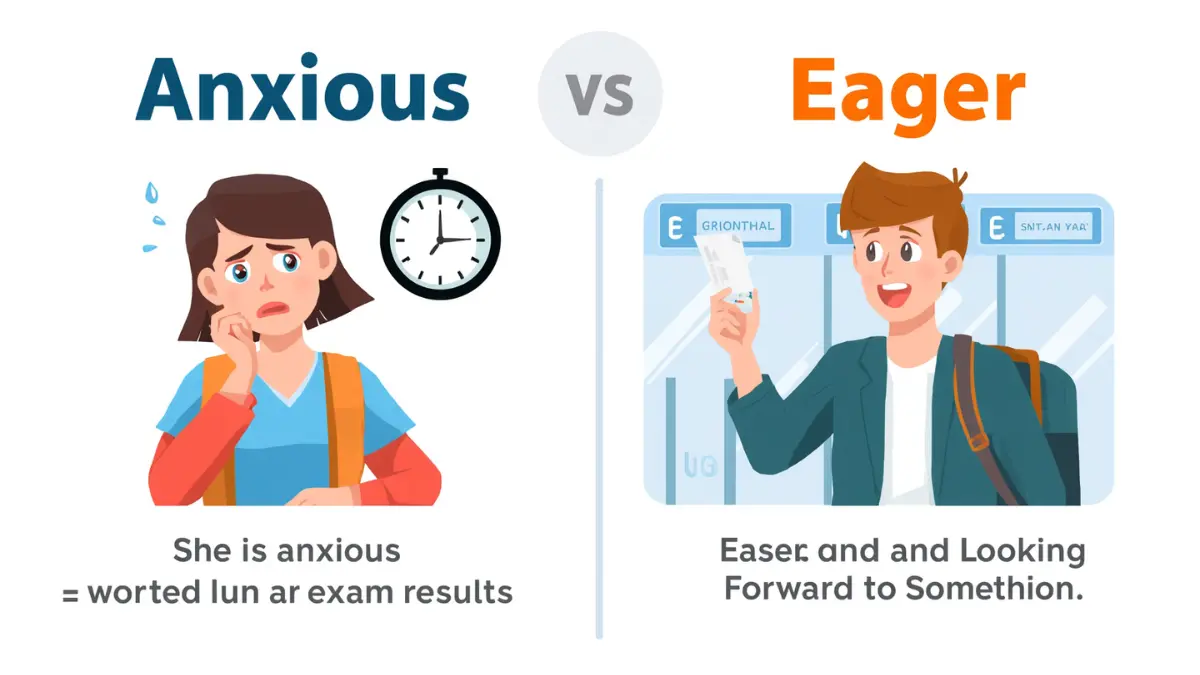
Have you ever wondered whether you should say, “I am anxious to start my new job” or “I am eager to start my new job”? Many English learners and native speakers alike struggle with anxious or eager because both words describe anticipation about something that will happen in the future.
The confusion comes from the fact that both words can express strong feelings about an upcoming event. However, the emotions behind them are different. Eager usually shows excitement and enthusiasm, while anxious often suggests worry, nervousness, or concern.
In some situations, especially in informal English, people use “anxious” when they actually mean “eager,” which creates further confusion.
Understanding the difference between anxious or eager helps you communicate more clearly in emails, conversations, academic writing, and professional settings. Using the correct word ensures your audience understands whether you are excited about something or worried about it.
This guide explains the meanings, origins, usage rules, common mistakes, examples, and FAQs related to anxious or eager, helping you choose the right word with confidence.
Anxious or Eager – Quick Answer
Simple Rule
- Anxious = worried, nervous, or concerned about something.
- Eager = excited and enthusiastic about something.
Examples
✅ I am eager to begin my vacation.
✅ She was anxious about her exam results.
Read more: Grey or Gray: Meaning and Correct Usage in English?
Easy Memory Trick
- Eager = Excited
- Anxious = Nervous
More Examples
| Word | Example |
| Eager | The children were eager to open their gifts. |
| Anxious | He felt anxious before the interview. |
| Eager | We are eager to hear the news. |
| Anxious | She was anxious about the upcoming surgery. |
The Origin of Anxious or Eager
Both words have interesting histories that explain their meanings today.
Origin of “Anxious”
The word anxious comes from the Latin word anxius, meaning troubled, worried, or distressed.
Historically, it has been associated with concern, uncertainty, and fear.
Origin of “Eager”
The word eager comes from the Old French word eigre, meaning keen, enthusiastic, or strongly desirous.
It has always carried a positive sense of excitement and anticipation.
Why the Confusion Exists
The confusion occurs because:
- Both words involve anticipation.
- Some speakers use “anxious” to mean “excited.”
- Informal speech often ignores traditional distinctions.
- Context can affect interpretation.
Read more: Draught or Draft: Meaning, Difference, and Simple Usage Guide
British English vs American English Spelling
There is no spelling difference between British English and American English for anxious and eager.
However, usage preferences may vary slightly.
Comparison Table
| Feature | British English | American English |
| Anxious | Commonly means worried | Sometimes used for excited anticipation |
| Eager | Preferred for excitement | Preferred for excitement |
| Formal writing | Maintains distinction | Maintains distinction |
Examples
British English
- She was anxious about the outcome.
- They were eager to begin.
American English
- I am anxious to see the results. (sometimes meaning excited)
- I am eager to see the results.
Which Spelling Should You Use?
Since the spelling remains the same worldwide, focus on the intended meaning.
Use “Anxious” When:
- You feel worried.
- You are nervous about uncertainty.
- You feel concerned about an outcome.
Examples
- He was anxious about the medical test.
- We are anxious about the delay.
Use “Eager” When:
- You feel excited.
- You look forward to something.
- You are enthusiastic about an opportunity.
Examples
- She is eager to learn.
- They are eager to travel.
Global Writing Advice
For professional and international audiences:
- Use eager for positive anticipation.
- Use anxious for worry or concern.
Common Mistakes with Anxious or Eager
Mistake 1
❌ I am anxious to start my dream vacation.
✅ I am eager to start my dream vacation.
Mistake 2
❌ She was eager about failing the exam.
✅ She was anxious about failing the exam.
Mistake 3
❌ We are anxious to celebrate the holiday.
✅ We are eager to celebrate the holiday.
Mistake 4
❌ He was eager about his surgery results.
✅ He was anxious about his surgery results.
Anxious or Eager in Everyday Examples
In Emails
- We are eager to discuss your proposal.
- We are anxious about the project deadline.
In News Writing
- Investors were anxious about market changes.
- Fans were eager for the championship match.
On Social Media
- I’m eager for the weekend!
- Feeling anxious before tomorrow’s presentation.
In Formal Writing
- Researchers were eager to analyze the findings.
- Participants expressed anxiety about future changes.
Anxious or Eager – Google Trends & Usage Data
The keyword anxious or eager remains popular because many English learners encounter both words frequently.
Countries with High Search Interest
| Country | Popularity |
| United States | Very High |
| United Kingdom | High |
| India | High |
| Canada | High |
| Australia | High |
Why People Search This Keyword
People commonly search for anxious or eager when:
- Learning English grammar.
- Preparing for exams.
- Improving business communication.
- Writing essays and reports.
- Understanding subtle vocabulary differences.
Common Usage Contexts
| Context | Preferred Word |
| Positive anticipation | Eager |
| Nervous anticipation | Anxious |
| Academic writing | Both, depending on meaning |
| Business communication | Both, depending on context |
Comparison Table: Anxious vs Eager
| Feature | Anxious | Eager |
| Emotion | Worry or concern | Excitement |
| Tone | Negative or uncertain | Positive |
| Anticipation | Nervous | Enthusiastic |
| Formal Usage | Common | Common |
| Example | Anxious about results | Eager to begin |
FAQs About Anxious or Eager
What is the main difference between anxious and eager?
Anxious suggests worry, while eager suggests excitement.
Can anxious mean excited?
In some informal American English contexts, yes. However, eager is usually clearer.
Which word is better for professional writing?
Use eager for enthusiasm and anxious for concern.
Is eager always positive?
Generally, yes. It reflects excitement and willingness.
Is anxious always negative?
Usually, although it can sometimes mean strongly anticipating something.
Why do people confuse anxious and eager?
Both involve anticipation of future events.
Are the words interchangeable?
Not always. Their emotional meanings are different.
Conclusion
Understanding anxious or eager can greatly improve your English communication. While both words involve anticipation, they express different emotions. Eager shows excitement, enthusiasm, and positive expectation. Anxious reflects worry, concern, or nervousness about what may happen next.
The distinction is important in professional writing, academic work, and everyday conversations. Choosing the wrong word can change the meaning of your message and confuse readers. If you feel excited about an upcoming event, use eager. If you feel worried or uncertain, use anxious.
There are no spelling differences between British and American English, making the rule simple to follow worldwide. By practicing these meanings and reviewing real-life examples, you can confidently choose the correct word every time.
Mastering the difference between anxious or eager will make your writing clearer, more precise, and more professional.

I am Bahadar Ali, a professional content writer and the author behind Tensestutor.com I am passionate about making grammar simple and accessible for everyone. Through my writing, I aim to help learners and professionals communicate with clarity and confidence.