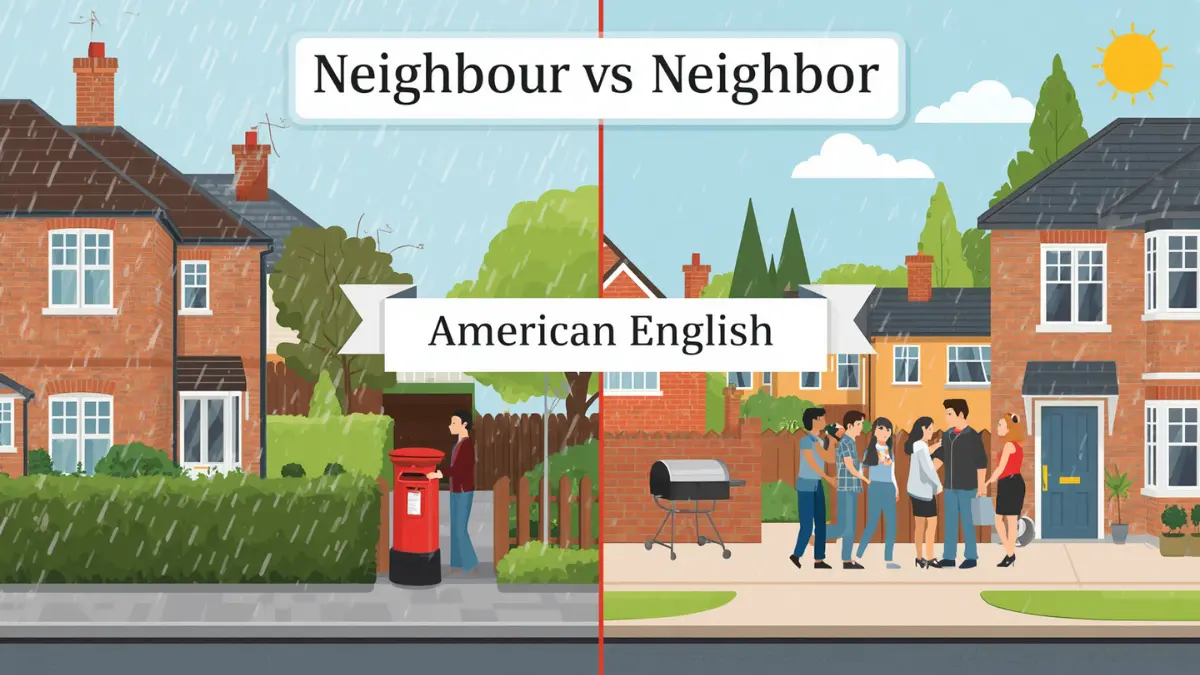
Many English learners get confused between neighbour or neighbor. Both words look almost the same, but the spelling changes depending on the country. You may see “neighbour” in books from the UK, while “neighbor” appears in American texts.
This small difference often creates doubt for students, writers, and professionals. People search for neighbour or neighbor to know which spelling is correct and when to use each one.
Imagine writing an email to your local community group. If you write “My neighbor is helpful,” it may look normal in the US. But in the UK, it would be written as “My neighbour is helpful.” This is why understanding neighbour or neighbor is important.
It helps avoid spelling mistakes in exams, business writing, and social media posts. In this guide, we will explain neighbour or neighbor, their origin, usage rules, and simple examples so you can use both correctly with confidence.
Neighbour or Neighbor – Quick Answer
The quick answer is simple:
- Neighbour → British English spelling
- Neighbor → American English spelling
Both words mean the same thing: a person who lives near you.
Examples
- UK: My neighbour helped me carry groceries.
- US: My neighbor helped me carry groceries.
Honour or Honor: What’s the Difference?
The Origin of Neighbour or Neighbor
The word comes from Old English “neahgebur”, meaning “near dweller.” It combined two parts:
- “neah” → near
- “gebur” → farmer or dweller
Over time, the word evolved into “neighbour” in British English. Later, American English simplified many spellings, removing extra letters like “u” in words such as “colour/color” and “neighbour/neighbor.”
The difference is not about meaning. It is only about spelling style based on history and regional language changes.
British English vs American English Spelling
The main difference between neighbour or neighbor is spelling style.
| British English | American English | Meaning |
| Neighbour | Neighbor | A person living near you |
| Neighbourhood | Neighborhood | Area where people live |
| Neighbourly | Neighborly | Friendly behavior toward neighbors |
Examples
- UK: She is my kind neighbour.
- US: She is my kind neighbor.
Travelling or Traveling: Which Spelling Is Correct?
Which Spelling Should You Use?
Use depends on your audience:
- UK / Commonwealth countries → Use neighbour
- USA → Use neighbor
- Global writing (blogs, SEO, apps) → Choose one style and stay consistent
If you are writing for school or exams, follow the system used in your curriculum.
Common Mistakes with Neighbour or Neighbor
1. Mixing both spellings in one text
❌ Wrong: My neighbour and neighbor are kind.
✅ Correct: My neighbor is kind (US) OR My neighbour is kind (UK)
2. Using wrong style for audience
❌ Wrong: Writing “neighbor” in British school exam
✅ Correct: Use “neighbour” in UK writing
3. Confusing meaning
❌ Wrong: Thinking they are different meanings
✅ Correct: Both mean the same person living nearby
4. Inconsistent spelling in blogs
❌ Wrong: Switching between neighbour/neighbor in same article
✅ Correct: Use one spelling style only
5. Incorrect plural form confusion
❌ Wrong: neighboors / neibours
✅ Correct: neighbours (UK) / neighbors (US)
Neighbour or Neighbor in Everyday Examples
In Emails
- “Dear neighbor, thank you for your support.”
- “Dear neighbour, please join the meeting.”
In News
- “The neighbor called emergency services quickly.”
- “A neighbour helped during the flood.”
On Social Media
- “Love my neighbor vibes ❤️”
- “Helping my neighbour today!”
In Formal Writing
- “Community programs improve neighbour relations.”
- “Good neighbor policies strengthen trust.”
Neighbour or Neighbor – Google Trends & Usage Data
Search data shows:
- “neighbor” is more popular in the United States.
- “neighbour” is more common in the United Kingdom, India, Pakistan, Australia, and other Commonwealth countries.
People usually search this keyword for:
- School grammar questions
- English writing exams
- Blogging and SEO writing
- Job applications and formal writing
Both spellings are widely used, but geography decides preference.
Comparison Table: Neighbour vs Neighbor
| Feature | Neighbour | Neighbor |
| Region | UK, Commonwealth | USA |
| Spelling style | Traditional | Simplified |
| Meaning | Person living nearby | Person living nearby |
| Usage | Formal British English | Formal American English |
| Pronunciation | Same | Same |
FAQs About Neighbour or Neighbor
1. Are neighbour and neighbor the same?
Yes, both mean the same thing. Only spelling is different.
2. Which spelling is correct?
Both are correct depending on region.
3. Is neighbor American or British?
“Neighbor” is American English.
4. Is neighbour used in IELTS?
Yes, British spelling like “neighbour” is accepted.
5. Can I mix both spellings?
No, you should stay consistent in one style.
6. Why does American English drop the “u”?
American English simplified many British spellings over time.
7. Which spelling is better for SEO?
Choose based on your target audience location.
Conclusion
The difference between neighbour or neighbor is simple but important for clear writing. Both words mean the same thing: a person living near you. The only difference is spelling based on region. “Neighbour” is used in British English, while “neighbor” is used in American English. Understanding this helps you write correctly in exams, blogs, emails, and professional communication.
Many learners get confused because both versions look almost identical and sound the same. However, consistency is key. Always choose one spelling style and stick with it throughout your writing. If you are targeting a UK audience, use “neighbour.” If you are writing for the US, use “neighbor.” For global content, pick one style and remain consistent. Learning this small difference improves your grammar accuracy and makes your writing more professional and polished.

I am Arshman Ali, a professional content writer and the author behind tensestutor.com . I am passionate about making grammar simple and accessible for everyone. Through my writing, I aim to help learners and professionals communicate with clarity and confidence.