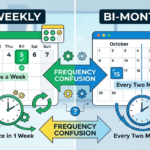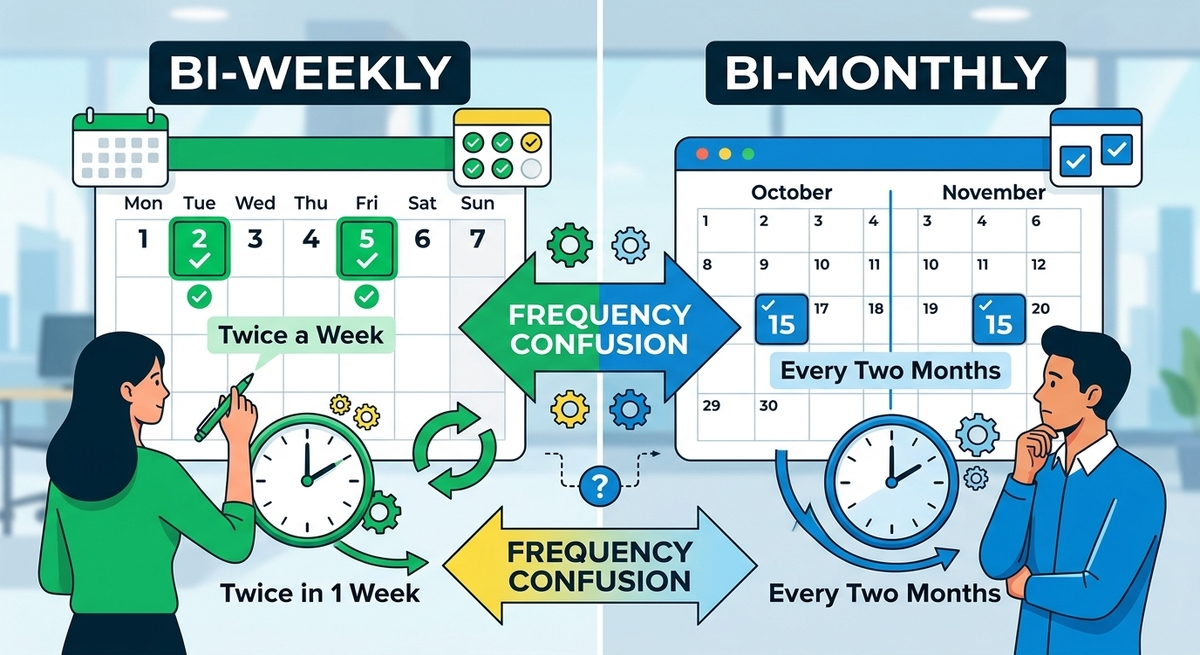
You received an email message that states that you meet “bi-weekly.” Twice a week? Once every 14 days? If you stopped, you’re not the only one. This is a very confusing combination of words in English.
There’s one main reason that people look for “bi weekly or bi monthly”: these two terms have two meanings and dictionaries don’t agree. It is important for a payroll manager to understand whether “bi-weekly pay” is 26 checks per year or 24 checks per year.
A student must be aware of whether a “bi-monthly report” is due on a monthly or every other basis. It can lead to late payments and paychecks, and inelegant workplace mixups.
This guide helps you get a quick and simple answer. You will discover the meanings of each word, where mistakes are made, how spelling and meaning differ between the US and UK, and what words to use instead to avoid getting your meaning across wrong. At the end, you will be sure about your writing.
Bi Weekly or Bi Monthly – Quick Answer.
Short Version:
- Bi-weekly can be interpreted to mean either every two weeks (most common) OR twice weekly (less common).
- The word bi-monthly can refer to twice a month or every two months (most common).
Examples:
- If you hear the phrase “the team meets bi-weekly” it typically means that the team meets every two weeks.
- The sentence “The gym class meets once every two weeks” might be interpreted as twice per week, depending on the writer.
- The newsletter is typically sent out once every two months.
- The term “invoices are sent twice every month” can be interpreted as “twice per month.
The problem is caused by the prefix “bi-“. It can be “two” (as in “two weeks”) or “twice” (as in “twice in one week”). Both readings are grammatically correct. Hence, always, the context is more important than the word itself.
The origin of Bi Weekly or Bi Monthly.
The word prefix “bi-,” is derived from the Latin language. Its meaning is “two” or “twice. This prefix was evident in Latin. Eventually, it became disarranged in English.
The early English writers used the prefix bi- as an abbreviation. Some meant ‘happening twice in a time period. Others meant “happening every other period. They both proliferated in print, business, and law. When dictionaries attempted to assign one and only one meaning, the two were already widespread. Both meanings of “bi-weekly” and “bi-monthly” are now included in Merriam-Webster and other large dictionaries. Neither is wrong.
The reason for this confusion today. There was no standardization of the word. Instead, the meaning that they felt at ease with in their local context was taken up by the English speakers and both of them remained.
British English (AE) vs American English (AE) Spelling
There are minor variations in terms of spelling and hyphens between British English and American English. In both, the meaning problem is the same but the rules of style differ.
The hyphen is often omitted in American English: biweekly, bimonthly. The hyphen is typically retained in British English: bi-weekly, bi-monthly.
Usages differ by publisher, so there is one rule of style guides in both countries: look up your organization’s style guide first.
| Feature | American English | British English |
| Common spelling | biweekly | bi-weekly |
| Hyphen use | Often dropped | Usually kept |
| The word twice means “twice a week. | Sometimes used | Sometimes used |
| Every two weeks: | Most common | Most common |
| Preferred style guide | AP Style (no hyphen) | Oxford Style (hyphen) |
| Business use | Common in payroll | Common in scheduling |
The question of which Spelling to use?
It all comes down to the audience and the goal – clarity, not style.
Follow AP style when writing for a U.S. audience: Use “biweekly” or “bimonthly” (no hyphens). However, include a qualifying word such as: biweekly (every two weeks).
Use “bi-weekly” or “bi-monthly” (with hyphen) if writing for a UK/Commonwealth audience. Always include clarifying words for even more safety.
If you’re writing for a worldwide audience: If the word is ambiguous, leave it out completely. Instead use simple words:
- Every two weeks rather than bi-weekly!
- Two days of the week” is more often than bi-weekly.
- Once every other month rather than every 2 months
- Twice monthly, rather than every other month.
When there’s no room for error and someone’s livelihood on the line, such as in contracts, HR paperwork, invoices, and any other text, this is the safest option.
bi weekly or bi monthly: some common mistakes.
Mistake 1: Everyone defines it the same way. Fix: Include an explanatory word or sentence each time you encounter the word in a meaningful text.
Mistake2: The mixing of “biweekly” and “semiweekly.The word “semiweekly” always indicates “twice a week. The one that is ambiguous is “Biweekly”. If you need a word that only means “twice a week” use “semiweekly.
Mistake3:Combining ‘bimonthly’ and ‘semimonthly’. The word “semimonthly” always refers to twice a month. The one that is ambiguous is “bimonthly”.
Mistake4:Inconsistent use of hyphens within a document. Choose one style (hyphenated or not) and use it in the entire document.
Mistake 5: Use of word in legal/payroll documents without definition. Fix: If the pay schedule is biweekly, always specify the actual day or number of days that the pay is due.
Everyday Examples Written in Bi Weekly or Bi Monthly
In e-mail: “Reminder: Our check-in (which occurs every 2 weeks) is on THURSDAY this week.
In the news, “City Council will meet bi-monthly beginning in March”.
On social media posts: “New videos being uploaded every two weeks now! 🎥 New videos every other Friday till then!”
For formal writing and contracts: “Employees shall be paid bi-weekly, on Fridays, twenty-six (26) times a year.
See, in the strongest examples, the word is always accompanied by a plain language clarifier. This habit is useful to eliminate all doubt.
Data from Google Usage and Google Trends
In every country, the number of people searching for “bi-weekly” is higher than “bi-monthly”, largely as a result of people searching for payroll and HR. In the U.S., tax season and new employee onboarding are times when searches tend to ramp up, as people look into their pay schedule. Search volume in the UK, Australia and Canada is more consistent throughout the year and is also influenced by booking appointments, deliveries and invoicing periods.
The most common use of bi-weekly is in business and finance, as it directly impacts when people receive payment. The term “bi-monthly” is more likely to be used by people when searching for it in the context of publishing or media, often in relation to the magazine and/or newsletter release schedule. In professional writing, “every two weeks” and “every other week” are gaining popularity, as there is no ambiguity in these choices, across all regions.
Create a table to compare the different keyword variations.
| Term | Most Common Meaning | Alternative Meaning | Safer Replacement |
| Bi-weekly / biweekly | Every two weeks | Twice a week | “Every two weeks” |
| Bi-monthly / bimonthly | Every two months | Twice a month | “Every other month” |
| Semiweekly | Twice a week | None | Already clear |
| Semimonthly | Twice a month | None | Already clear |
| Fortnightly (UK) | Every two weeks | None | Already clear |
FAQs
1. Is bi-weekly twice a week or once every two weeks?
Ans:Can be either, but is more often used the way “every two weeks” is used in business and payroll.
2. What word is used to mean twice a week?
Ans: For a meaning that cannot misinterpreted, use “every two weeks” or “fortnightly” (UK English).
3. What is the same about bi-monthly and semimonthly?
Ans: No- “Semimonthly” means 2 times per month. The word bi-monthly can interpreted as having a period of two months or twice a month.
4. Do I need to use the word biweekly or bimonthly?
Ans:In American English, the hyphen sometimes left out. It normally retained in British English. Both ways are OK if they used consistently.
5.If someone paid every two weeks, how many paychecks will they receive?
Ans: Bi-weekly, which translates to “every 2 weeks,” provides 26 paychecks per year, even if the month doesn’t have a full two-week period.
6.What is the logic behind the word order in the sentence?
Ans:The word “bi” derived from the Latin language and may have the meaning “two” or “twice. The two meanings were common use before a dictionary chose one of them, so neither was forgotten.
7. Can you substitute for “fortnightly” the word ‘bi-weekly’?
Ans: Yes, it is in British and Commonwealth English. The word “fortnightly” has only two meanings: every 2 weeks, and it has no other meaning.
Conclusion
There are two of the most misused words in English – and that’s no mistake – “bi-weekly” and “bi-monthly.” Both words have two valid meanings, with one going to “every two [periods]” and the other to “twice a [period]”. The root cause is the prefix “bi-“, and there is no one dictionary rule that has ever completely been able to solve it.
The fix is simple. Know your audience use biweekly in AmE, bi-weekly in BrE and always include a clarifying phrase in important documents. If it is important to get right, like payroll, contracts, or schedules, then avoid using the vague word at all. Instead, use every two weeks, twice a week, every other month or fortnightly. The use of these alternatives does not allow for misreading.
Trust created through good communication. Next time you use “bi-weekly” or “bi-monthly” , spend an additional second and include a clarifying sentence that is easy to read. It’ll help you avoid miscommunication, misreading, mischecks, and missed appointments – and it will make you appear a careful, professional writer every time.

I am Arshman Ali, a professional content writer and the author behind tensestutor.com . I am passionate about making grammar simple and accessible for everyone. Through my writing, I aim to help learners and professionals communicate with clarity and confidence.