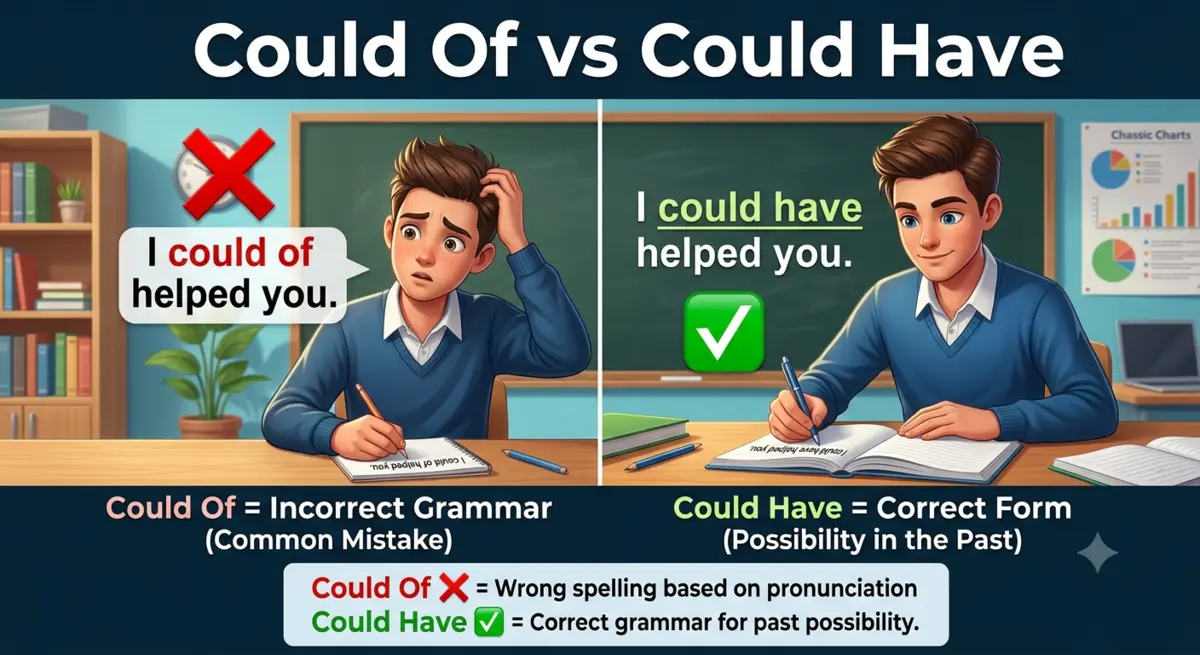
Have you ever written “could of” and wondered if it was correct? You are not alone. Thousands of people search for “could of or could have” every month because these two phrases sound very similar when spoken.
The confusion happens because the contraction “could’ve” sounds almost exactly like “could of” in everyday speech. As a result, many people write “could of” when they actually mean “could have.”
Understanding the difference is important for students, professionals, writers, and anyone who wants clear and correct English. Using the wrong phrase can make your writing look less polished, especially in emails, reports, and academic work.
In this guide, you’ll learn the quick answer, the history behind the confusion, differences between British and American English, common mistakes, real-world examples, and usage trends. By the end, you’ll know exactly when to use “could have” and why “could of” is usually considered incorrect.
Could Of or Could Have – Quick Answer
Quick Answer:
✅ Could have is correct.
❌ Could of is incorrect in standard English.
Examples
Correct:
- I could have helped you yesterday.
- She could have won the race.
- We could have arrived earlier.
Incorrect:
- I could have helped you yesterday.
- She could have won the race.
Why?
The phrase “could have” is made of:
- Could = modal verb
- Have = helping verb
The phrase “could of” does not follow English grammar rules.
Read more:Bring or Take: What’s the Difference
The Origin of Could Of or Could Have
The correct form, “could have,” has existed in English for centuries. It is used to talk about possibilities, missed opportunities, or actions that were possible in the past.
Where Did “Could Of” Come From?
The mistake comes from the contraction:
Could have → Could’ve
When spoken quickly, “could’ve” sounds like:
“could of”
Because the pronunciation is similar, many people assume the written form should be “could of.”
Example
Spoken:
- “I could’ve gone.”
Sounds like:
- “I could of gone.”
Written correctly:
- “I could have gone.”
This is why the error is common among native English speakers as well.
Read more:Borrow or Lend: Understanding the Difference
British English vs American English Spelling
Unlike many words that have different spellings in British and American English, “could have” is correct in both versions of English.
There is no spelling difference between the two.
Comparison Table
| Usage | British English | American English |
| Correct form | Could have | Could have |
| Contraction | Could’ve | Could’ve |
| Incorrect form | Could of | Could of |
| Formal writing | Could have | Could have |
| Academic writing | Could have | Could have |
Examples
British English
- You could have told me earlier.
American English
- You could have called before coming over.
Both versions follow the same grammar rule.
Which Spelling Should You Use?
The answer is simple.
For American Audiences
Use:
- Could have
- Could’ve
Avoid:
- Could of
For British Audiences
Use:
- Could have
- Could’ve
Avoid:
- Could of
For Global Audiences
If you write for an international audience, always use:
✅ Could have
It is universally accepted and understood.
Common Mistakes with Could Of or Could Have
Many learners make the same errors.
Mistake #1
❌ I could of finished the project.
✅ I could have finished the project.
Mistake #2
❌ They could of arrived earlier.
✅ They could have arrived earlier.
Mistake #3
❌ She could of been a doctor.
✅ She could have been a doctor.
Mistake #4
Confusing the contraction:
Correct:
- Could’ve = Could have
Incorrect:
- Could’ve = Could of
Remember:
Could’ve always means could have.
Could Of or Could Have in Everyday Examples
In Emails
✅ I could have responded sooner.
❌ I could of responded sooner.
In News Writing
✅ The company could have prevented the issue.
❌ The company could of prevented the issue.
On Social Media
People often write:
❌ I could of bought it yesterday.
Correct version:
✅ I could have bought it yesterday.
In Formal Writing
Formal documents should always use:
✅ Could have
Many editors will mark “could of” as a grammar mistake.
Could Of or Could Have – Google Trends & Usage Data
Search interest for “could of or could have” remains high because the mistake is extremely common in spoken English.
Countries Where the Query Is Popular
- United States
- United Kingdom
- Canada
- Australia
- New Zealand
Why People Search It
Most users want to know:
- Which version is correct
- Whether “could of” is ever acceptable
- Why the phrases sound the same
- How to avoid grammar mistakes
Usage Context
| Context | Most Common Form |
| Formal writing | Could have |
| Academic writing | Could have |
| Business emails | Could have |
| Social media mistakes | Could of |
| Spoken English | Could’ve |
The confusion comes from pronunciation, not grammar.
Comparison Table: Could Of vs Could Have
| Feature | Could Of | Could Have |
| Grammatically correct | No | Yes |
| Accepted in formal writing | No | Yes |
| Accepted in academic writing | No | Yes |
| Common online mistake | Yes | No |
| Standard English usage | No | Yes |
| Means possibility in the past | No | Yes |
FAQs
1. Is “could of” ever correct?
In standard English grammar, no. The correct phrase is “could have.”
2. Why do people write “could of”?
Because “could’ve” sounds similar to “could of” when spoken.
3. Is “could’ve” correct?
Yes. “Could’ve” is the contraction of “could have.”
4. Can I use “could of” in informal writing?
It is still considered incorrect, even in casual writing.
5. Do British people say “could of”?
Some speakers may pronounce it that way, but the correct written form remains “could have.”
6. Is “would of” also wrong?
Yes. Use “would have” instead.
7. Is “should of” wrong too?
Yes. The correct form is “should have.”
Conclusion
The debate over “could of or could have” is actually very simple once you understand the grammar. The correct phrase is “could have,” while “could of” is a common spelling mistake caused by pronunciation. When people say “could’ve,” it often sounds like “could of,” which leads many writers to use the wrong form.
No matter whether you are writing for an American, British, Australian, Canadian, or global audience, the rule stays the same. Use “could have” in formal writing, business communication, academic papers, and professional content. The contraction “could’ve” is also correct in informal situations.
If you want clear, accurate English, remember this simple rule: whenever you are talking about a possibility or missed opportunity in the past, use “could have” rather than “could of.” Following this guideline will help your writing look more professional, improve readability, and prevent one of the most common grammar mistakes in English.

I am Arshman Ali, a professional content writer and the author behind tensestutor.com . I am passionate about making grammar simple and accessible for everyone. Through my writing, I aim to help learners and professionals communicate with clarity and confidence.