You are trying to wire up a battery pack and come to a wall: Serially or Parallelly? You may ruin your batteries, your device or worse. It’s one most frequently asked questions of DIY electronics, solar systems, RC electronics, and home battery banks, and makes sense. One thing that they do very differently to voltage and current, and when you mix them up, the system under-powered, overheating or the equipment will fried.
Batteries in series or parallel are terms that sound similar but mean different.Batteries in series or parallel are terms that sound alike, but have opposite meanings. When components wired series, voltages add up. Adding capacity with parallel wiring. “Better” is not a word that applies, they solve different problems.
This article provides you with an answer in a nutshell followed by a step-by-step explanation of how each method does what, some typical pitfalls, and a couple of examples. That said, there should be no confusion, as I have included a comparison chart at the end.
Batteries in Series or Parallel : Quick Answer.
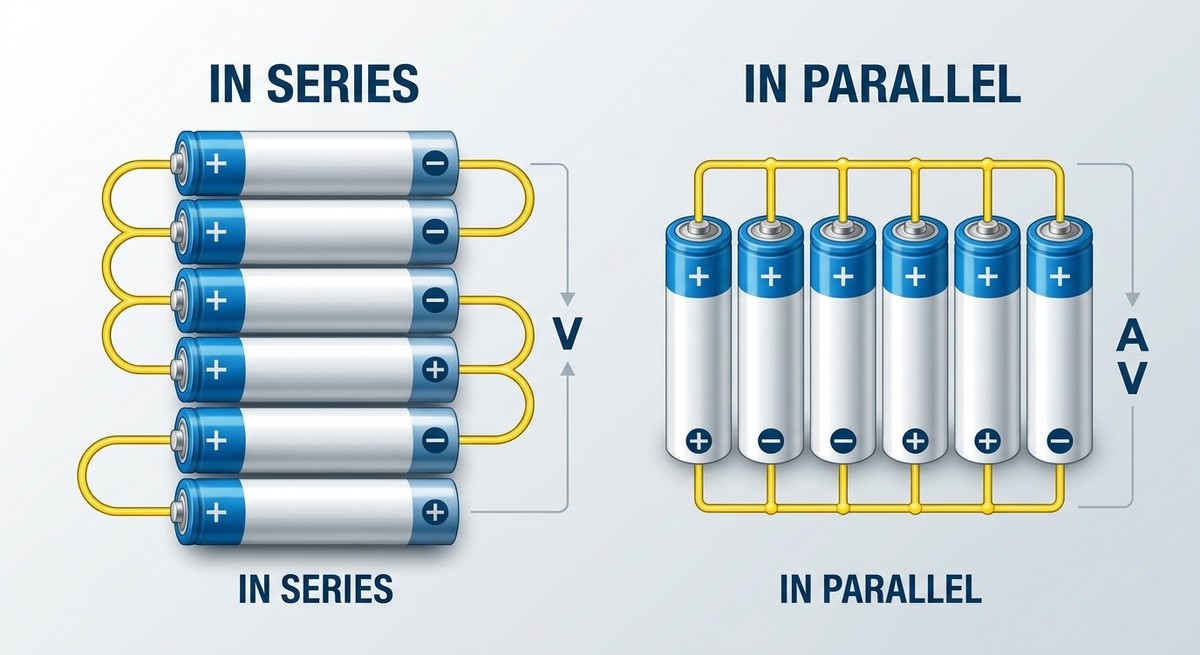
- When batteries are wired series, positive terminal of first battery connected to negative terminal of second battery. This combines the voltage, but maintains the capacity (Ah). Example: Two 12V, 100Ah batteries in series = 24V, 100Ah.
- All positive terminals connected together (as are all negative terminals) with parallel wiring. This is the sum of the capacity (Ah) and the voltage is the same. Example: Two 12V, 100Ah batteries in parallel = 12V, 200Ah.
When you need more electricity, use a series. Increase the number of cells used in parallel for extended run time at the same voltage.
Actually, how series and parallel wiring works?
Series connection: Show batteries connected in series. The chain’s positive end connects to the negative end of the next battery. There are only two end terminals to connect with your device. The voltage adds up battery by battery, the current capacity remains the same as one battery.
Parallel connection: Imagine batteries in parallel ranks, similar to a highway. All the positive terminals are connected together and all negative terminals are connected together. The voltage is the same as one battery, but the batteries take turns, therefore the capacity and available current increases.
The easy-to-remember rule is that series add voltage, parallel add capacity.
The table below summarizes and compares both series and parallel:
| Feature | Series Wiring | Parallel Wiring |
| Voltage | Adds up (e.g., 12V + 12V = 24V) | Stays the same (12V + 12V = 12V) |
| Capacity (Ah) | Stays the same | Adds up (100Ah + 100Ah = 200Ah) |
| Wiring method | From Positive to Negative, from End to End | Just as with the numbers, the same signs mean multiply. |
| Common use case | Electric-powered bikes, electric power tools, and high-voltage systems | Solar batteries with longer running time, longer battery life |
| Do not use batteries that are not matched for each other. | Weakest battery is the limiting factor of the entire chain | Increased chances of imbalance and overheating. |
| Total current output | Same as one battery | The main remaining part of the process is to identify higher, shared across batteries. |
When wiring in series and parallel circuits, make sure you avoid the following common pitfalls:
Randomly combining series and parallel without any plan. There are some configurations (series-parallel) that combine the above, but making this mistake can cause potentially dangerous voltage or current mismatches.
Using batteries with different ages or capacities. A weak battery can cause charging problems for the entire circuit in series and may overcharged by stronger batteries. At the same time, when the batteries are not correctly matched, there possibility of current running from one battery to the other which leads to heat.
Connecting terminals backward. In series wiring, polarity can reversed, which can cause a short circuit or destroy any equipment that plugged into the series circuit.
Failure to replace a fuse or breaker. Parallel connections provide more current, and therefore a higher fire risk if there is a short circuit. Always use appropriate protection.
The more batteries, the more power. Series adds voltage to the series, not time. Do not increase the run time by adding paralleled increases in voltage. The two easily confused and result underpowered or incompatible systems.
Series and Parallel Wiring in Real-life Applications:
With solar systems: Homeowners will typically connect the solar batteries together in parallel for storage to increase the amount of energy stored, and then step up the voltage with an inverter when necessary.
In product manuals: Power tool battery packs specify that they are series connected to deliver 18V or 20V from smaller cell voltages.
In news and energy related reporting: When reporting on home battery backup systems (such as Tesla Powerwall or other battery backup systems), articles frequently describe having multiple systems cascaded together to achieve greater stored energy.
When talking amongst yourself or posting about your social circles: RC enthusiasts often ask themselves, “Should I use series or parallel for more speed?” The answer is generally series, as higher voltage generally equals more power to the motors.
Analyze search trends and real-world usage:
When people interested solar power, off-grid living, e-bikes, and DIY electronics, so “batteries series or parallel.”Batteries series or parallel” popular when people interested solar power, off-the-grid living, e-bikes, and DIY electronics. People tend to research more in areas where solar energy well established, like the United States, Australia and parts of Europe, where homeowner or hobbyist often designs their own battery banks.
It also used technical education, physics course material, electrical engineering resources and in tutorials to build and modify electronics. However, there are no regional spelling or terminology differences, so search behavior remains consistent across regions – not so much in the language but in the concept.
A comparison of the key terms in the series and parallel:
| Term | Meaning | Result |
| Series circuit | Batteries in series | For the same capacity, the higher the voltage, the better. |
| Parallel circuit | Two batteries in parallel. | The same voltage but higher capacity. |
| Series-parallel | A combination of the above methods. | Increased voltage and increased capacity |
| Single battery | One unit: No and capacity. | Baseline voltage combination of units. |
FAQs:
1.Which of the following battery combinations has the longest life: series or parallel?
Ans.A series connection usually does not provide as long of a run time as a parallel connection, as it only increases voltage and not the total run time (Ah).
2.Are old and new batteries acceptable to used series or parallel?
Ans. It’s not recommended. In both systems, mismatched batteries can lead to imbalance, sub-optimal performance and safety issues.
3. What type of wiring is safer series or parallel?
Ans. Both are safe if used properly with compatible batteries and suitable protection such as fuses. Extra care needs to taken due to the elevated current flow for parallel setups.
4. Are solar batteries connected series or parallel?
Ans.This will depend on your system’s voltage requirements. The most common configuration of a home solar installation is a configuration of parallel wiring which increases the size of the installation, sometimes with series wiring to create the necessary voltage.
5.If I connect the batteries series where they should connected parallel, what happens?
Ans. Your voltage will be too high for your device and can harm it. Check the voltage requirements of your device before making connections.
6. Can I connect batteries of different voltages in series?
Ans.Yes, but batteries of equal voltages can also connected parallel. It’s not recommended. When you use batteries in series, the imbalances can reduce battery life or even cause batteries to become faulty.
7. Are series-parallel circuits prevalent?
Ans.Yes, particularly bigger battery banks-the place where both increased voltage and increased capacity required, for example at home energy storage systems.
Conclusion:
The only question to consider when deciding on whether to use batteries in series or parallel is, do you need more voltage or more capacity? The voltage will added together the series, and the capacity remains the same, which suitable for devices with a high input voltage, such as e-bikes and power tools. Parallel wiring ensures stability in the level of voltage, but provides a bigger capacity, suitable for extended runtime in solar battery banks or backup power systems.
The most common problems occur when people use batteries that are incompatible, install batteries without safety protection, or think that the more batteries an amplifier has, the more powerful it is. Knowing this difference and choosing the right battery type, age and capacity helps to ensure the safety and efficiency of your system.
From solar installations to e-bikes to school projects, understanding the principles of series and parallel wiring can help you design and build the perfect system for your needs.

I am Bahadar Ali, a professional content writer and the author behind Tensestutor.com I am passionate about making grammar simple and accessible for everyone. Through my writing, I aim to help learners and professionals communicate with clarity and confidence.