Many students who are learning English often mix up the meaning of elicit and illicit due to the fact that they sound alike. At first glance, the words appear almost identical, but they have very different meanings.
This disarray can be seen in schoolwork, e-mails, business letters and web composition. How you use one word can alter the meaning of a sentence and make your writing less professional. For instance, the statement “the question illicit a response” is missing the meaning of illicit, which is not “to draw out” information.
Knowing the difference between elicit and illicit allows you to be clear and to prevent common grammatical errors. Fortunately, separating these two words is easy once you understand the meaning and origins of each.
You will learn the quick answer, word origins, usage examples, spelling differences, common mistakes, and helpful tips for selecting the correct word each and every time.
Elicit vs Illicit – How Many Words Do You Know?
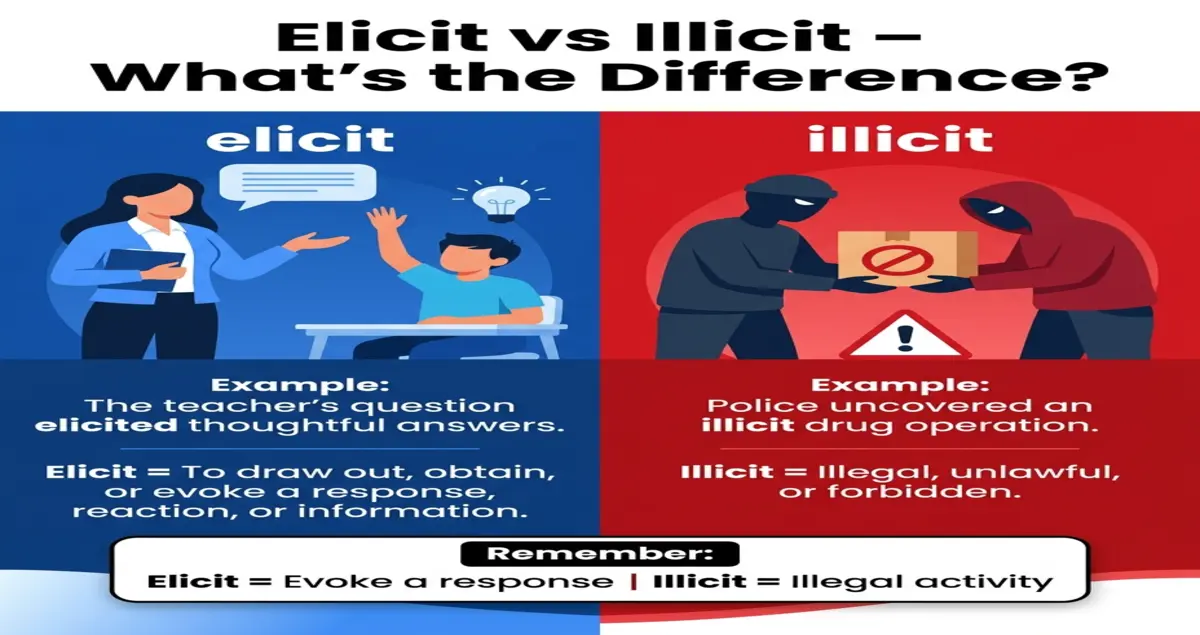
Elicit is a verb meaning to draw out, bring forth or to get a response.
The word “illegitimate” is an adjective that describes something that is against the law or does not belong according to the rules.
Examples
Word
Meaning
Example
Elicit
To obtain a response
The survey enabled honest feedback to be obtained.
Illicit
Illegal or forbidden
Police found drugs in the building.
Quick Memory Trick
Ellicti = Extract information
Illicit = Illegal activity
The bottom line is that there is a difference between Elicited and Illicited.
These are similar words, but have different Latin roots.
Elicit
Elicit is derived from the Latin word elicere, which means “to draw out” or “bring forth”.
English: e (out) + lacere/licere (to entice or draw)
Introduced into English in the 1600s.
Read more:Right or Write or Rite: What’s Difference and Which Word You Use?
Relates in All situations to the obtaining of information, feelings or reactions.
Illicit is derived from the Latin word illicitus, which means “not permitted.
The prefix il means “not.
In relation to permission, rule or law.
Introduced to English in the 1500s.
The reason for the spelling difference.
The words have different Latin origins, but sound alike in contemporary English. That’s one reason why many writers get them confused.
Read more:Passed vs Past: What’s Difference and Which One You Use
British English vs American English Spelling
Unlike words such as “colour” and “color,” elicit and illicit are spelled the same in both British and American English.
Comparison Table
Meaning
British English
American English
Draw out a response
Elicit
Elicit
Illegal or forbidden
Illicit
Illicit
Examples
British English
American English
The interview resulted in useful comments.
It was a useful interview with some comments.
The investigation of illegal trade was carried out.
Authorities conducted investigations on unlawful trading.
There is no spelling difference between the two varieties of English.
Which Spelling to Use?
BOTH words are used the same way all over the world, so it’s just a matter of what you mean by it.
Use Elicit When:
Asking questions
Getting feedback
Producing emotions
Drawing out information
Examples:
The teacher attempted to get answers from pupils.
The movie elicited tears from viewers.
Use Illicit When:
Describing illegal actions
Discussing prohibited goods
To refer to activities that are illegal
Examples:
The agency put an end to the illegal imports.
They were able to discover an illegal enterprise.
Audience-Based Advice
Audience
Recommended Usage
United States
Use standard meanings of words.
United Kingdom
Employ the standard meanings
Canada
Employ the normal definitions
Australia
Use the standard meaning of words.
Global Audience
Make sure to use the standard meanings.
Common Errors in using Elicit vs Illicit
A large number of people select the wrong word as it sounds the same.
Mistake #1
The survey was in violation of the privacy rights of customers.
✅ The survey elicits feedback from customers.
Mistake #2
❌ The police investigated elicit activities.
✅ The police investigated illicit activities.
Mistake #3
❌ The manager tried to illicit suggestions.
✅ The manager tried to elicit suggestions.
Mistake #4
❌ They were convicted of selling illegal drugs.
✅ They were caught in gambling.
Elicit vs Illicit in Everyday Examples Email Writing
Elicit
Hopefully, this form will provide useful feedback from customers.
Illicit
The company does not allow any use of confidential information that is illegal.
News Headlines
Elicit
The new report has met with a strong public reaction.The new report has garnered a lot of public response.
Illicit
The crackdown is on the illicit drug network.
Social Media
Elicit
The views presented here may be counter to those of other readers.
Illicit
The account was deleted because it was promoting illegal products.
Formal Writing
Elicit
Interviews were used to elicit detailed responses from researchers.
Illicit
The report was based on illegal monetary activities.
Google Trends & Usage Data, elicits vs Illicits.
There are numerous instances of people searching for elicit vs illicit, as the latter is also a popular misspelling.
Usage Patterns
Word
Common Context
Elicit
Education / surveys / psychology / communication
Illicit
The law, crime, and government are all part of it, as well as finance.
Popular Search Locations
This word pair is frequently most popular in:
United States
United Kingdom
Canada
Australia
India
Countries with major populations that speak English and high educational interest in grammar topics.
The term used to search for a person.The name by which someone is called.
Typically, individuals wish to know:
Which of these words is spelled correctly?
To see if the words can be switched for each other.
How to remember the difference between “left” and “right”
Which word from the following fits into a sentence?
Compare the meaning of words in the context of their usage in the text.
Feature
Elicit
Illicit
Part of Speech
Verb
Adjective
Meaning
Draw out a response
Illegal or forbidden
Related To
Information, emotions, reactions
Law, rules, regulations
Example
Elicit feedback
Illicit trade
Correct Usage
The survey elicited responses.
Illegal activities were prevented.
FAQs
What is the difference between ‘elicit’ and ‘illicit’?
Elicit: To provoke an answer. Illegal or forbidden; prohibited.
2. What is the part of speech of elicit?
Yes. Elicit is always used as a verb.
3. What is the part of speech of the word “illicit”?
Yes. An adjective is a word used to modify a noun or a pronoun. Illicit is an adjective with a meaning of “unlawful.
4. Is there a difference between ‘do’ and ‘elicit’?
They sound the same and that is why they can be mixed up.
5. Is there a way to get information by illegal means?
No, elicit: to get or extract information.
7. Does there differ between British and American spelling?
No, they are spelt the same in British and American English.
How do I get the difference in my memory?
Remember:
Elicit = Extract
Illicit = Illegal
This is a basic memory technique that can be used in most circumstances.
Conclusion
The meaning of the words is enough to distinguish between the two. Elicit means to solicit information, response, reactions, emotions. Illegal, forbidden, against the rules; an adjective used to describe something illegal, forbidden, or against the rules.
Although the sounds are similar, their meanings are entirely different in English. The right word ensures writing that is clear, accurate and professional. One of the helpful tips is to associate elicit with extract, both refer to getting something. Similarly, link the word ‘illegal’ to ‘ilicit’, as both refer to illegal actions.
The spelling is identical both in British English and American English so it depends on the meaning, not on where the word is used. Use elicit in the context of feedback, answers, emotions or reactions. If talking about crime, law, regulations, or forbidden behavior, use the word illicit.
By learning this word pair you will avoid a common grammar error and will become more confident of your use of grammar in everyday writing.
Today, you will get to know what is the difference between elicit vs illicit, the meaning of each, some examples, common mistakes, tips for using them, comparison tables and even FAQs.

I am Arshman Ali, a professional content writer and the author behind tensestutor.com . I am passionate about making grammar simple and accessible for everyone. Through my writing, I aim to help learners and professionals communicate with clarity and confidence.