Many English learners and native speakers struggle with affect vs effect. These two words look similar, sound alike, and often appear in the same topics. Because of this, people frequently use the wrong one in writing, emails, reports, and social media posts.
The confusion comes from the fact that both words relate to change or influence. However, they have different jobs in a sentence. In most cases, affect is a verb, while effect is a noun. Understanding this simple rule can help you avoid one of the most common grammar mistakes in English.
If you have ever stopped while writing and wondered whether to use affect or effect, you are not alone. This guide provides a quick answer, explains the history of the words, compares usage, highlights common mistakes, and gives practical examples. By the end, you will know exactly when to use affect and when to use effect.
Affect vs Effect – Quick Answer
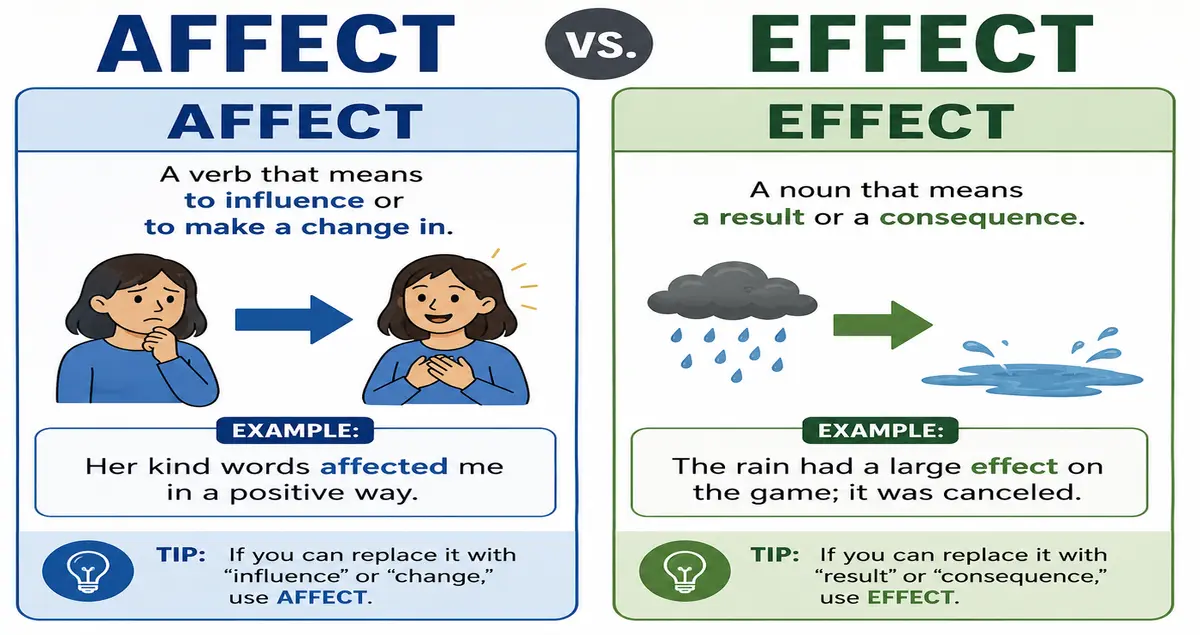
Affect usually means to influence or change something.
Effect usually means the result or outcome of a change.
Examples
- The weather can affect your mood.
- The effect of the weather was clear.
- Lack of sleep can affect performance.
- One effect of lack of sleep is poor concentration.
Easy Memory Trick
- Affect = Action (both start with A)
- Effect = End Result (both start with E)
Read more:Parentheses or Brackets : Understanding the Difference?
The Origin of Affect vs Effect
Both words come from the Latin word afficere, meaning “to influence” or “to act upon.”
Affect
The word affect entered English through French and Latin. It developed the meaning “to influence” or “to change.”
Effect
The word effect comes from the Latin word effectus, meaning “result,” “completion,” or “outcome.”
Read more:Have Went or Have Gone:The Correct Grammar Explained?
Why the Spelling Difference Exists
Although the words share similar roots, they evolved into different parts of speech:
| Word | Main Function | Meaning |
| Affect | Verb | To influence |
| Effect | Noun | Result or outcome |
This difference helps readers understand whether you are talking about an action or a result.
British English vs American English Spelling
Unlike many English words, affect and effect have the same spelling in both British and American English.
The difference is not regional. The challenge is choosing the correct word based on meaning.
Examples
| Meaning | Correct Word | Example |
| Influence | Affect | The news may affect investors. |
| Result | Effect | The effect was immediate. |
| Change behavior | Affect | Stress affects health. |
| Outcome | Effect | The policy had a positive effect. |
Comparison Table
| Usage | Affect | Effect |
| Verb | ✓ Usually | Rare |
| Noun | Rare | ✓ Usually |
| Means influence | ✓ | ✗ |
| Means result | ✗ | ✓ |
Which Spelling Should You Use?
The answer depends on the meaning, not the country.
For US Audiences
Use:
- Affect when discussing influence.
- Effect when discussing results.
For UK Audiences
The same rule applies.
For Commonwealth Countries
Countries such as Canada, Australia, New Zealand, India, and South Africa follow the same distinction.
For Global Writing
The standard recommendation remains:
- Affect = influence
- Effect = result
This rule works for almost every situation.
Common Mistakes with Affect vs Effect
Many writers accidentally swap the words.
Mistake 1
❌ The weather had a bad affect on traffic.
✅ The weather had a bad effect on traffic.
Mistake 2
❌ Stress can effect your sleep.
✅ Stress can affect your sleep.
Mistake 3
❌ The new law will have little affect.
✅ The new law will have little effect.
Mistake 4
❌ Social media effects young people.
✅ Social media affects young people.
Quick Check
Ask yourself:
- Is it an action? → Affect
- Is it a result? → Effect
Affect vs Effect in Everyday Examples
Emails
- Budget cuts may affect project timelines.
- The effect of the delay could be significant.
News Articles
- Rising prices affect consumers.
- The effect of inflation is widespread.
Social Media
- Lack of sleep affects everything.
- The effect of one good habit can be life-changing.
Formal Writing
- Economic policies affect growth rates.
- The effect of the policy was measured over five years.
Business Reports
- Market trends affect sales.
- The effect on revenue was positive.
Affect vs Effect – Google Trends & Usage Data
Search interest in affect vs effect remains high because it is one of the most commonly confused word pairs in English.
Popular Countries
The term is frequently searched in:
- United States
- United Kingdom
- Canada
- Australia
- India
Why People Search for It
Common search intentions include:
- Grammar homework
- Professional writing
- Business communication
- Academic essays
- Exam preparation
Usage Context
| Context | Common Choice |
| Describing influence | Affect |
| Describing outcomes | Effect |
| Academic writing | Both |
| Business reports | Both |
| News reporting | Both |
The popularity of this search term shows that writers want a simple way to remember the difference.
Affect vs Effect Comparison Table
| Feature | Affect | Effect |
| Part of Speech | Usually Verb | Usually Noun |
| Meaning | Influence or change | Result or outcome |
| Example | Weather affects travel. | The effect was severe. |
| Memory Tip | Affect = Action | Effect = End Result |
| Common Usage | Very common | Very common |
FAQs
1. What is the difference between affect and effect?
Affect usually means to influence. Effect usually means the result of that influence.
2. Is affect a verb or a noun?
Most of the time, affect is a verb.
Example: Stress affects health.
3. Is effect a noun or a verb?
Most of the time, effect is a noun.
Example: The effect was noticeable.
4. How can I remember affect vs effect?
Use the memory trick:
- Affect = Action
- Effect = End Result
5. Which word is more common?
Both are common, but they serve different purposes in writing.
6. Can effect be a verb?
Yes. In formal English, effect can mean “to bring about.”
Example: The manager effected change.
However, this usage is less common.
7. Can affect be a noun?
Yes. In psychology, affect can refer to emotional expression.
Example: The patient showed a flat affect.
This meaning is specialized and uncommon.
Conclusion
Understanding affect vs effect becomes much easier when you remember one simple idea: affect is usually an action, and effect is usually a result. Affect describes how something influences another thing, while effect describes the outcome of that influence. This distinction applies across American English, British English, and other forms of English around the world.
Many people confuse these words because they sound similar and are often used in related situations. However, using the correct word improves clarity and makes your writing look more professional. Whether you are writing emails, business reports, academic papers, news articles, or social media posts, knowing the difference helps you communicate with confidence.
When in doubt, ask yourself a simple question: “Am I talking about influence or a result?” If it is influenced, choose affect. If it is a result, choose effect. Following this rule will help you avoid one of the most common grammar mistakes and strengthen your writing skills.

I am Arshman Ali, a professional content writer and the author behind tensestutor.com . I am passionate about making grammar simple and accessible for everyone. Through my writing, I aim to help learners and professionals communicate with clarity and confidence.