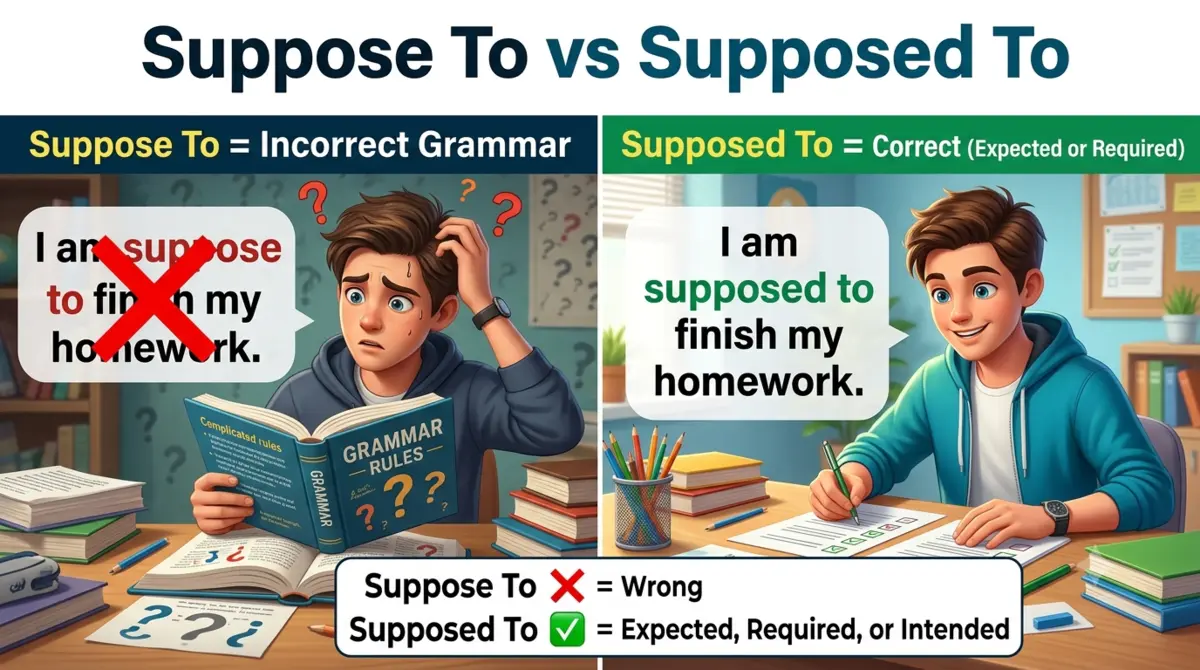
Have you ever typed “suppose to” and wondered if it was correct? You are not alone. Thousands of people search for “suppose to or supposed to” because the two phrases sound almost the same when spoken.
The confusion happens because native speakers often pronounce “supposed to” quickly. In conversation, the -d sound is soft and can seem to disappear. As a result, many people write “suppose to” even though it is usually considered incorrect in standard English.
Understanding the difference is important for emails, school assignments, business writing, social media posts, and professional communication. Using the correct phrase helps your writing look polished and clear.
In this guide, you will learn the quick answer, the history behind the expression, differences between British and American English, common mistakes, real-life examples, and expert advice on which form to use.
Suppose To or Supposed To – Quick Answer
The correct phrase is “supposed to.”
“Suppose to” is generally incorrect in standard English.
Correct Examples
✅ I am supposed to finish the report today.
✅ You are supposed to wear a seatbelt.
Incorrect Examples
❌ I am suppose to finish the report today.
❌ You are suppose to wear a seatbelt.
What Does “Supposed To” Mean?
“Supposed to” means:
- Expected to
- Required to
- Intended to
- Meant to
Example:
Students are supposed to submit their assignments before Friday.
This means students are expected or required to submit them before Friday.
Read more:Broke or Broken: Difference and Which One Should You Use?
The Origin of Suppose To or Supposed To
The phrase comes from the verb “suppose.”
The word suppose entered English through Old French and ultimately comes from the Latin word supponere, meaning “to place under” or “to assume.”
Over time, English speakers developed the expression “be supposed to.” In this structure, supposed acts as a past participle adjective.
Examples:
- I am supposed to call her.
- We are supposed to leave now.
The confusion appears because people often hear the phrase spoken quickly:
supposed to → suppose ta
When written, some people mistakenly remove the d, creating “suppose to.”
Read more:Stole or Stolen: Which Word Should You Use?
British English vs American English Spelling
Unlike many words that have different British and American spellings, “supposed to” is the standard form in both varieties of English.
Comparison Table
| English Variety | Correct Form | Incorrect Form |
| American English | supposed to | suppose to |
| British English | supposed to | suppose to |
| Canadian English | supposed to | suppose to |
| Australian English | supposed to | suppose to |
Examples
| Region | Example |
| United States | You are supposed to follow the rules. |
| United Kingdom | We are supposed to arrive by 10 a.m. |
| Australia | She is supposed to attend the meeting. |
The spelling remains the same across major English-speaking countries.
Which Spelling Should You Use?
You should use “supposed to” in nearly all situations.
If Your Audience Is American
Use:
✅ supposed to
If Your Audience Is British or Commonwealth
Use:
✅ supposed to
If Your Audience Is Global
Use:
✅ supposed to
Since English style guides, dictionaries, schools, and professional publications all prefer “supposed to,” it is the safest choice everywhere.
Common Mistakes with Suppose To or Supposed To
Many writers make the same errors.
Mistake #1: Dropping the “D”
❌ I am suppose to call him.
✅ I am supposed to call him.
Mistake #2: Writing the Phrase as Heard
❌ We were suppose to leave early.
✅ We were supposed to leave early.
Mistake #3: Using It in Formal Writing
Because the mistake is common in speech, it sometimes appears in emails and reports.
❌ The team is suppose to submit updates weekly.
✅ The team is supposed to submit updates weekly.
Quick Rule
If you mean expected to, always write:
✅ supposed to
Suppose To or Supposed To in Everyday Examples
Email Example
✅ You are supposed to send the invoice by Friday.
News Example
✅ The minister was supposed to announce the policy today.
Social Media Example
✅ Aren’t we supposed to get the update this week?
Formal Business Writing
✅ Employees are supposed to follow company guidelines.
Academic Writing
✅ Students are supposed to cite their sources correctly.
Suppose To or Supposed To – Google Trends & Usage Data
Search interest for “suppose to or supposed to” remains high because it is one of the most common English grammar mistakes.
Countries Where the Query Is Popular
- United States
- United Kingdom
- Canada
- Australia
- India
- Pakistan
Why People Search It
- The phrases sound similar.
- Spoken English often hides the final d sound.
- Learners want the correct form for writing.
- Professionals want to avoid grammar mistakes.
Usage Contexts
| Context | Preferred Form |
| School Writing | supposed to |
| Business Emails | supposed to |
| News Articles | supposed to |
| Academic Papers | supposed to |
| Social Media | supposed to |
Comparison Table: Suppose To vs Supposed To
| Feature | Suppose To | Supposed To |
| Standard English | ❌ No | ✅ Yes |
| Grammar Correct | ❌ No | ✅ Yes |
| Used in Formal Writing | ❌ No | ✅ Yes |
| Dictionary Approved | ❌ No | ✅ Yes |
| Means Expected To | ❌ No | ✅ Yes |
FAQs
1. Is “suppose to” grammatically correct?
No. In standard English, “supposed to” is the correct form.
2. Why do people say “suppose to”?
Because the d sound in “supposed” is often weak or silent in fast speech.
3. Is “supposed to” American or British English?
Both American and British English use “supposed to.”
4. Can I use “suppose to” in informal writing?
It may appear online or in casual messages, but it is still considered incorrect.
5. What does “supposed to” mean?
It means expected to, required to, intended to, or meant to.
6. Why is there a “d” in “supposed”?
The phrase comes from the past participle form “supposed.”
7. Should I always write “supposed to”?
Yes. For correct grammar, use “supposed to” in all professional and academic writing.
Conclusion
The debate over “suppose to or supposed to” is actually quite simple. In standard English, “supposed to” is the correct form, while “suppose to” is generally considered a spelling mistake. The confusion happens because the final d in “supposed” is often difficult to hear in everyday speech.
Whether you are writing an email, a school assignment, a business report, or a social media post, using “supposed to” will help you communicate clearly and professionally. The expression means “expected to,” “required to,” or “meant to,” and it is accepted in both British and American English.
Remember this easy rule: if you can replace the phrase with “expected to,” then the correct form is “supposed to.” Following this rule will help you avoid one of the most common grammar mistakes in English and improve the quality of your writing.

I am Bahadar Ali, a professional content writer and the author behind Tensestutor.com I am passionate about making grammar simple and accessible for everyone. Through my writing, I aim to help learners and professionals communicate with clarity and confidence.