Do you write “used to” or “use to”? Many English learners and native speakers get confused by these two forms. They sound almost the same when spoken, but the spelling changes depending on the grammar of the sentence.
People often search for “used to or use to” because they want to know which version is correct in questions, negative sentences, and statements. A small spelling mistake can make writing look less professional, especially in emails, school assignments, business reports, and online content.
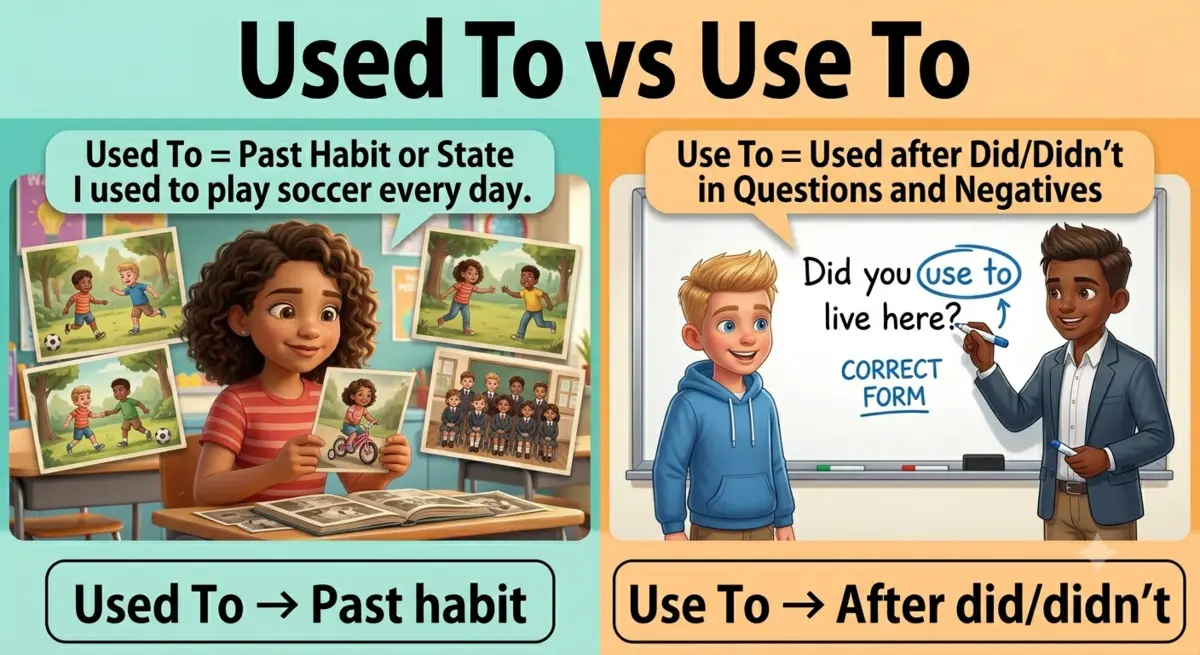
The good news is that the rule is simple once you understand it. In most cases, “used to” describes a past habit or situation. However, after the helping verb “did,” the spelling changes to “use to.”
In this guide, you will learn the difference between used to and use to, where they came from, how British and American English treat them, common mistakes to avoid, and real-world examples. By the end, you will know exactly which form to use in every situation.
Used To or Use To – Quick Answer
Quick Answer:
- Used to = Correct in positive statements about past habits or past situations.
- Use to = Correct after did, didn’t, or similar auxiliary verbs.
Examples
✅ I used to play football every weekend.
✅ She used to live in London.
✅ Did you use to work here?
✅ I didn’t use to drink coffee.
❌ Did you used to work here?
❌ I didn’t used to drink coffee.
Easy Rule
If there is did or didn’t, use use to.
If there is no did, use used to.
Read more:Drunk or Drank: Difference and Which One Should You Use?
The Origin of Used To or Use To
The phrase “used to” developed from the verb “use,” which originally meant being accustomed to something.
Over time, English speakers began using “used to” to describe actions, habits, or situations that existed in the past but no longer happen.
Historical Examples
- I used to ride horses.
- They used to live near the river.
The spelling difference appears because English grammar removes the past-tense ending when another verb already carries the past tense.
For example:
- Did you use to play?
- Didn’t she use to live here?
Here, did already shows the past tense, so use remains in its base form.
Read more:Wore or Worn: Which One Should You Use?
British English vs American English Spelling
Both British and American English follow the same grammar rules for used to and use to.
However, some informal British writing occasionally shows “used to” even after did, though many grammar guides still prefer “use to.”
Comparison Table
| Situation | American English | British English |
| Positive statement | I used to swim. | I used to swim. |
| Question | Did you use to swim? | Did you use to swim? |
| Negative | I didn’t use to swim. | I didn’t use to swim. |
| Formal writing | Use to after did | Use to after did |
| Informal writing | Use to | Sometimes used to appears |
Examples
| Correct Form | Example |
| Used to | We used to travel every summer. |
| Use to | Did you use to travel every summer? |
Which Spelling Should You Use?
The best spelling depends on grammar, not location.
For US Audiences
Use:
- Used to (statements)
- Use to (after did/didn’t)
For UK Audiences
Use the same rule:
- Used to (statements)
- Use to (after did/didn’t)
For Commonwealth Countries
Countries such as Canada, Australia, New Zealand, India, and South Africa generally follow the same grammar pattern.
For Global Audiences
The safest choice is:
- Used to in positive sentences.
- Use to after did or didn’t.
This matches modern grammar recommendations and professional writing standards.
Common Mistakes with Used To or Use To
Many writers make these mistakes:
Mistake #1
❌ Did you used to play tennis?
✅ Did you use to play tennis?
Mistake #2
❌ I didn’t used to like vegetables.
✅ I didn’t use to like vegetables.
Mistake #3
❌ I use to live in Paris.
✅ I used to live in Paris.
Mistake #4
❌ She use to sing in a choir.
✅ She used to sing in a choir.
Quick Correction Chart
| Wrong | Correct |
| Did you used to? | Did you use to? |
| Didn’t used to | Didn’t use to |
| I use to live there | I used to live there |
| She use to work here | She used to work here |
Used To or Use To in Everyday Examples
✅ I used to work with your company.
✅ Did you use to manage this project?
News Writing
✅ The factory used to employ 500 workers.
Social Media
✅ I used to watch this show every day.
✅ Didn’t we use to go here all the time?
Academic Writing
✅ Researchers used to rely on paper records.
Business Writing
✅ The company used to operate from New York.
Casual Conversation
✅ I used to play video games after school.
✅ Did you use to visit your grandparents often?
Used To or Use To – Google Trends & Usage Data
Search interest for “used to or use to” remains strong because it is a common grammar problem.
Popular Countries Searching This Topic
- United States
- United Kingdom
- Canada
- Australia
- India
- Pakistan
Why People Search It
- School and homework questions.
- English language learning.
- Business writing accuracy.
- Exam preparation.
- Grammar checking before publishing content.
Usage Context
| Context | More Common Form |
| Positive statements | Used to |
| Questions | Use to |
| Negative sentences | Use to |
| Formal writing | Both, depending on grammar |
| Everyday conversation | Mostly used to |
Used To vs Use To Comparison Table
| Feature | Used To | Use To |
| Function | Past habit or state | Used after did/didn’t |
| Positive statements | Yes | No |
| Questions | No | Yes |
| Negative sentences | No | Yes |
| Formal writing | Yes | Yes |
| Common usage | Very common | Less common |
FAQs
1. Is it “used to” or “use to”?
Both are correct. Use used to in statements and use to after did or didn’t.
2. Why do we say “did use to” instead of “did used to”?
Because did already shows the past tense, the main verb returns to its base form.
3. Is “I use to play football” correct?
No. The correct sentence is “I used to play football.”
4. Is “Did you use to” grammatically correct?
Yes. It is the standard form in modern English.
5. Can I write “Did you used to”?
Most grammar guides consider it incorrect.
6. Do British and American English use different rules?
No. Both generally follow the same grammar pattern.
7. What does “used to” mean?
It describes a habit, action, or situation that happened in the past but no longer happens now.
Conclusion
The difference between used to and use to is one of the most common grammar questions in English. The confusion happens because both forms sound almost identical when spoken. However, the rule is straightforward once you understand how auxiliary verbs work.
Use “used to” when talking about past habits, routines, or situations that no longer exist. Examples include “I used to play soccer” and “She used to live in Canada.” When a sentence contains did or didn’t, switch to “use to” because the helping verb already marks the sentence as past tense. Examples include “Did you use to play soccer?” and “I didn’t use to like coffee.”
Whether you write for American, British, or international audiences, this grammar rule remains largely the same. Following it will make your writing clearer, more professional, and easier to understand. Whenever you are unsure, remember the simple rule: no did = used to; with did = use to. This approach will help you avoid common mistakes and write confidently in any situation.

I am Bahadar Ali, a professional content writer and the author behind Tensestutor.com I am passionate about making grammar simple and accessible for everyone. Through my writing, I aim to help learners and professionals communicate with clarity and confidence.