Many English learners and writers get confused between “lying” and “lieing.” Both words may look correct at first glance. But only one spelling is accepted in standard English.
This confusion happens because English spelling rules can feel tricky. Normally, when a word ends in “ie,” people often change it to “y” before adding “-ing.” But the verb “lie” follows a special rule. That is why many people search online for the correct spelling.
If you have ever paused while writing an email, social media post, school paper, or work message, you are not alone. The good news is that the answer is simple once you understand the rule.
In this guide, you will learn:
- The correct spelling
- Why “lieing” is wrong
- British vs American English usage
- Common grammar mistakes
- Real-life examples
- Google Trends and usage insights
By the end, you will know exactly when to use “lying.”
Lying or Lieing – Quick Answer
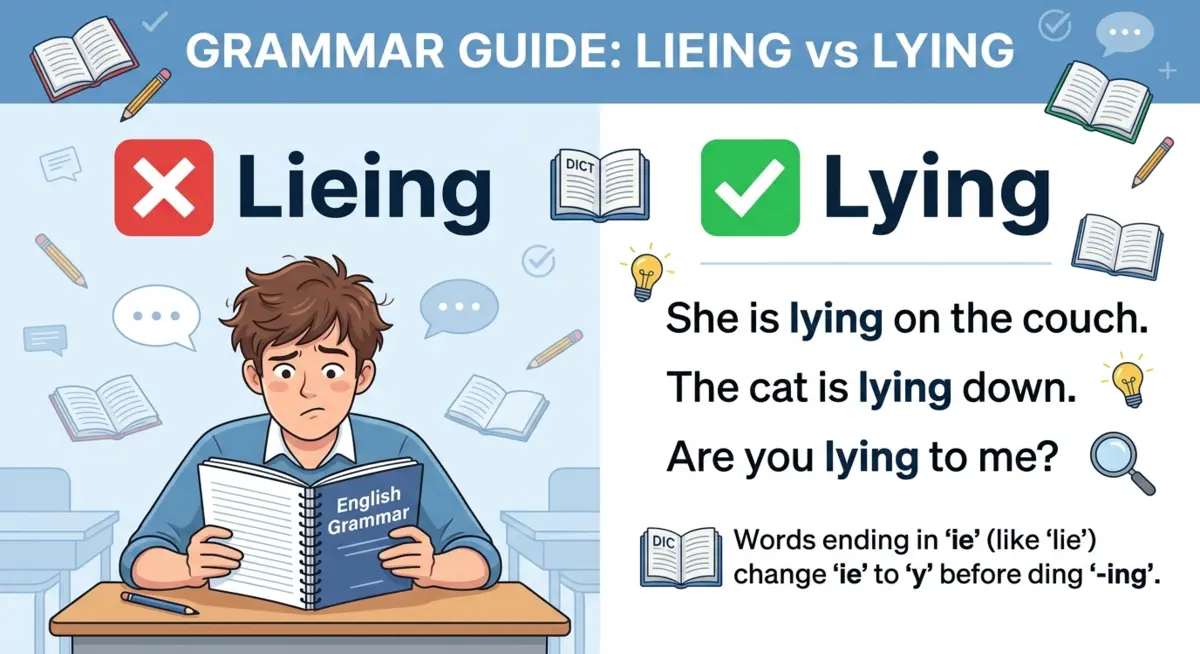
The correct spelling is “lying.”
❌ Lieing is incorrect.
✅ Lying is correct.
Examples:
- She is lying on the couch.
- He was lying about his age.
- The dog is lying near the door.
Why?
The verb “lie” changes spelling before adding “-ing.”
Instead of:
- lie + ing = lieing ❌
It becomes:
- lie → lying ✅
This is a special English spelling rule.
Chose or Choose: Meaning, Difference, and Simple Usage Guide
| Word | Correct? | Meaning |
| Lying | ✅ Yes | Resting or not telling the truth |
| Lieing | ❌ No | Incorrect spelling |
The Origin of Lying or Lieing
The word “lie” comes from Old English. It had two main meanings:
- To rest in a flat position
- To say something false
Over time, English spelling changed, but the word stayed common.
The confusion appears when adding “-ing.”
Usually, English verbs ending in “ie” change to “y” before adding “-ing.”
Examples:
| Base Word | -ing Form |
| die | dying |
| tie | tying |
| lie | lying |
That is why “lieing” never became standard English.
People still write it by mistake because it looks more natural to the eye.
Choosed or Chose: Which Is Correct ?
British English vs American English Spelling
There is no spelling difference between British English and American English for this word.
Both use:
✅ Lying
❌ Lieing
Examples in British English
- He was lying in bed all morning.
- The newspaper accused the politician of lying.
Examples in American English
- She is lying on the beach.
- Stop lying to your parents.
Comparison Table
| English Style | Correct Spelling | Incorrect Spelling |
| British English | Lying | Lieing |
| American English | Lying | Lieing |
| Australian English | Lying | Lieing |
| Canadian English | Lying | Lieing |
The spelling stays the same across all major English versions.
Which Spelling Should You Use?
You should always use “lying.”
If Your Audience Is American
Use:
✅ lying
Example:
- The witness was lying in court.
If Your Audience Is British or Commonwealth
Use:
✅ lying
Example:
- The cat is lying beside the fireplace.
If Your Audience Is Global
Use:
✅ lying
This spelling is accepted worldwide.
Professional Advice
Always avoid “lieing.” Spell-check tools, teachers, editors, and grammar software mark it as incorrect.
Common Mistakes with Lying or Lieing
Many writers make small grammar and spelling mistakes with this word.
Mistake 1: Writing “Lieing”
❌ She is lieing on the sofa.
✅ She is lying on the sofa.
Mistake 2: Confusing “Laying” and “Lying”
❌ He is laying in bed.
✅ He is lying in bed.
Quick Rule
- Lying = resting or telling falsehoods
- Laying = putting something down
Examples:
- She is lying on the floor.
- She is laying the book on the table.
Mistake 3: Wrong Verb Tense
❌ He lie yesterday.
✅ He lay down yesterday.
Common Verb Forms
| Verb Form | Word |
| Base Verb | Lie |
| Present Participle | Lying |
| Past Tense | Lay |
| Past Participle | Lain |
Lying or Lieing in Everyday Examples
Here are real-life examples showing correct usage.
In Emails
- I was lying sick at home yesterday.
- Please stop lying about the report.
In News Writing
- The article claimed the company was lying to customers.
- Police found the missing bag lying near the road.
On Social Media
- Why are people always lying online?
- My cat is lying beside me again.
In Formal Writing
- The witness admitted to lying during questioning.
- Important documents were lying on the desk.
In Casual Conversation
- He was just lying around all day.
- I think she is lying to me.
Lying or Lieing – Google Trends & Usage Data
Search data shows that many people type “lieing” into Google because they are unsure about the spelling.
However, “lying” is far more common in books, websites, news articles, and dictionaries.
Popular Usage by Country
| Country | Common Usage |
| United States | Lying |
| United Kingdom | Lying |
| Canada | Lying |
| Australia | Lying |
| India | Lying |
Why “Lieing” Still Appears Online
People often:
- Guess the spelling
- Forget the “ie → y” rule
- Type quickly on phones
Search engines usually correct:
“Did you mean: lying?”
Comparison Table: Lying vs Lieing
| Feature | Lying | Lieing |
| Correct English spelling | ✅ Yes | ❌ No |
| Used in dictionaries | ✅ Yes | ❌ No |
| Accepted in formal writing | ✅ Yes | ❌ No |
| Used in US English | ✅ Yes | ❌ No |
| Used in UK English | ✅ Yes | ❌ No |
| Grammarly approved | ✅ Yes | ❌ No |
FAQs About Lying or Lieing
Is “lieing” ever correct?
No. “Lieing” is not correct in standard English.
Why is it “lying” and not “lieing”?
Words ending in “ie” often change to “y” before adding “-ing.”
Is “lying” used in British English?
Yes. British English and American English both use “lying.”
What is the difference between “lying” and “laying”?
“Lying” means resting or being dishonest. “Laying” means placing something down.
How do you spell someone telling a lie?
The correct spelling is lying.
Is “lying” grammatically correct?
Yes. It is the proper present participle form of “lie.”
Why do people confuse “lying” and “lieing”?
Because many people try to spell the word by sound instead of grammar rules.
Conclusion
The difference between “lying” and “lieing” is simple once you learn the spelling rule. The correct word is always “lying.” The spelling “lieing” is considered incorrect in both British and American English.
This confusion happens because English changes some words ending in “ie” before adding “-ing.” Just like “die” becomes “dying” and “tie” becomes “tying,” the word “lie” becomes “lying.”
Whether you are writing emails, essays, social media posts, or business documents, using the correct spelling helps your writing look more professional and trustworthy. It also prevents grammar mistakes that spell-check tools will quickly catch.
A simple trick to remember is this:
- lie → lying
- never lieing
If you use “lying,” your writing will always match standard English rules around the world.

I am Arshman Ali, a professional content writer and the author behind tensestutor.com . I am passionate about making grammar simple and accessible for everyone. Through my writing, I aim to help learners and professionals communicate with clarity and confidence.