When you look up at a ceiling fan, you may notice that the blades can turn in two directions. This often leads to one simple question: fans clockwise or counterclockwise—which direction is correct? The answer depends on what you want the fan to do.
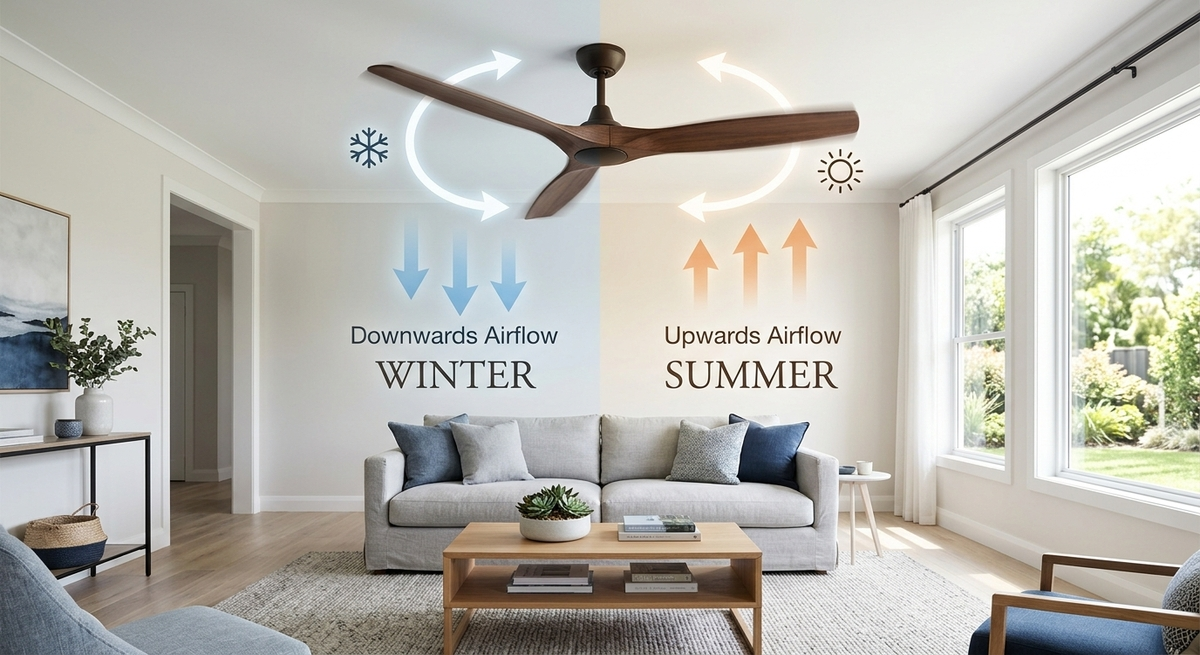
In general, a ceiling fan should turn counterclockwise in summer to push air downward and create a cooling breeze. In winter, you can switch it to clockwise at a low speed to move warm air from the ceiling back into the living space. The U.S. Department of Energy and Hunter Fan both recommend this seasonal approach. (The Department of Energy’s Energy.gov)
People also search this phrase because the words clockwise, counterclockwise, and anticlockwise can cause confusion. The difference is mainly regional: American English usually uses counterclockwise, while British English commonly uses anticlockwise. (Cambridge Dictionary)
This guide explains fan direction, the meaning of each term, regional spelling, common mistakes, and practical examples.
Fans Clockwise or Counterclockwise – Quick Answer
For a typical ceiling fan:
- Summer: Run the fan counterclockwise when viewed from below. This pushes air downward and creates a cooling breeze.
- Winter: Run the fan clockwise at a low speed. This helps circulate warm air that collects near the ceiling.
- Year-round: The correct direction depends on your goal, room, fan design, and comfort.
The U.S. Department of Energy recommends counterclockwise operation in summer and clockwise operation in winter. (The Department of Energy’s Energy.gov)
How to Check Your Fan
Stand directly below the fan and look upward.
If the blades move in the same direction as a clock’s hands, the fan is clockwise.
If they move in the opposite direction, the fan is counterclockwise.
The viewing position matters. Looking at the fan from the opposite side can make the apparent direction seem reversed. For everyday use, check the rotation from below because that is where you normally experience the airflow. (Hunter Fan Support)
The Origin of Fans Clockwise or Counterclockwise
The phrase combines several older words.
The word fan, meaning a device that moves air, comes from Old English fann, which referred to a tool used for winnowing grain. The word ultimately traces back to Latin vannus, meaning a winnowing fan. (Etymonline)
The word clockwise means moving in the direction of a clock’s hands. The term dates to the late 19th century and combines clock with the suffix -wise. (Dictionary.com)
Counterclockwise means moving in the opposite direction. Its formation combines counter- with clockwise. Historical sources date the word to the 19th century. British English developed anticlockwise as an alternative term. (Etymonline)
So:
- Clockwise = same direction as clock hands
- Counterclockwise = opposite direction
- Anticlockwise = British English equivalent of counterclockwise
The words describe the direction of rotation. They do not describe different types of fans.
British English vs American English Spelling
The main difference here involves counterclockwise and anticlockwise, rather than the word fan itself.
American English normally uses counterclockwise. British English commonly uses anticlockwise. Cambridge and Collins both identify anticlockwise as the British form and counterclockwise as the American equivalent. (Cambridge Dictionary)
| Meaning | American English | British English |
| Same direction as clock hands | clockwise | clockwise |
| Opposite direction | counterclockwise | anticlockwise |
| Alternative form | counter-clockwise | anti-clockwise |
| Fan direction in summer | counterclockwise | anticlockwise |
| Fan direction in winter | clockwise | clockwise |
Examples
American English:
Set the ceiling fan to counterclockwise for summer.
British English:
Set the ceiling fan to anticlockwise for summer.
Both sentences communicate the same basic idea.
There is no need to change clockwise between American and British English.
Which Spelling Should You Use?
Choose the form that matches your audience.
For a U.S. audience
Use counterclockwise.
Example:
The ceiling fan should rotate counterclockwise during summer.
For a UK audience
Use anticlockwise.
Example:
The ceiling fan should rotate anticlockwise during summer.
For a global audience
You can use counterclockwise if your main audience follows American English. You can also mention anticlockwise once so readers recognize both terms.
For SEO content, it can help to include both forms naturally:
A ceiling fan usually runs counterclockwise, or anticlockwise in British English, during summer.
This lets readers understand the regional difference without making the article difficult to read.
Common Mistakes with Fans Clockwise or Counterclockwise
1. Thinking counterclockwise is always better
Counterclockwise is generally used for cooling airflow in summer, but that does not make it the correct direction for every situation.
In winter, clockwise operation at low speed can help circulate warm air. (The Department of Energy’s Energy.gov)
2. Looking at the fan from the wrong side
Your viewing position changes how rotation appears.
For a ceiling fan, check the direction while standing below it.
3. Confusing clockwise with counterclockwise
Remember the clock:
- Clock hands moving normally = clockwise
- Reverse direction = counterclockwise
4. Using anticlockwise in every type of English
Anticlockwise is common in British English, while counterclockwise is standard in American English. (Cambridge Dictionary)
5. Running the fan at high speed in winter
Winter operation usually works best at a low speed. The goal is to circulate warm air without creating a strong cooling draft. (Hunter Fan Support)
Fans Clockwise or Counterclockwise in Everyday Examples
In an email
Please check whether the ceiling fan is running counterclockwise before the meeting.
In a news article
Experts recommend using a ceiling fan counterclockwise during warm weather to create a downward airflow.
On social media
Does anyone else switch their ceiling fan to clockwise when winter starts?
In formal writing
During summer, a counterclockwise ceiling-fan rotation can create a downward airflow that improves personal comfort.
In a home instruction
Turn the fan off, change the direction switch, and restart it at a low speed.
Always follow your fan manufacturer’s instructions when changing its direction.
Fans Clockwise or Counterclockwise – Google Trends & Usage Data
Search interest can change by season, country, and wording. People may search for phrases such as:
- fans clockwise or counterclockwise
- ceiling fan direction
- ceiling fan direction summer
- ceiling fan direction winter
- counterclockwise fan
- anticlockwise fan
- which way should my ceiling fan turn?
Google Trends allows users to compare search terms by location and time. However, Google notes that Trends provides relative search interest, not an exact count of searches. It also warns that spelling variations and synonyms do not automatically combine in a standard term comparison. (Google Support)
This matters for this keyword because counterclockwise and anticlockwise represent the same concept but appeal to different regional audiences.
Searches about fan direction can also become more useful during seasonal changes. In warmer months, people often want to know how to create a cooling breeze. In colder months, they may search for the reverse setting to circulate warm air.
For SEO, it makes sense to cover the main variations instead of focusing only on one phrase.
Fans Clockwise or Counterclockwise: Comparison Table
| Search phrase | Meaning | Typical use |
| Fans clockwise | Fan rotates like clock hands | Winter circulation |
| Fans counterclockwise | Fan rotates opposite clock hands | Summer cooling |
| Fans anticlockwise | Same as counterclockwise | British English |
| Ceiling fan direction | General question about rotation | Summer or winter |
| Counterclockwise fan | Fan rotating opposite clock hands | Cooling |
| Anticlockwise fan | Same as counterclockwise | UK/Commonwealth usage |
| Fan direction summer | Direction for warm weather | Counterclockwise |
| Fan direction winter | Direction for cold weather | Clockwise |
FAQs About Fans Clockwise or Counterclockwise
1. Should a ceiling fan be clockwise or counterclockwise in summer?
A typical ceiling fan should run counterclockwise when viewed from below during summer. This pushes air downward and creates a cooling breeze. (The Department of Energy’s Energy.gov)
2. Should a ceiling fan be clockwise or counterclockwise in winter?
Run the fan clockwise at a low speed in winter. This helps circulate warm air that collects near the ceiling. (The Department of Energy’s Energy.gov)
3. Is clockwise the same everywhere?
Yes. Clockwise means moving in the direction of clock hands. The regional difference mainly affects the opposite direction: Americans commonly say counterclockwise, while British speakers commonly say anticlockwise. (Cambridge Dictionary)
4. Is counterclockwise one word?
Yes. Counterclockwise is a standard one-word form in American English. You may also see the older hyphenated form counter-clockwise. (Etymonline)
5. Is anticlockwise correct English?
Yes. Anticlockwise is standard British English and means the same thing as American English counterclockwise. (Cambridge Dictionary)
6. Does fan direction really matter?
It can matter for comfort. Counterclockwise operation can push air down toward people in summer, while clockwise operation at low speed can help circulate warm air in winter. (The Department of Energy’s Energy.gov)
7. Does a ceiling fan actually cool the room?
A ceiling fan mainly creates an airflow that makes people feel cooler. It does not work like an air conditioner that lowers the room’s temperature. The U.S. Department of Energy describes the summer effect as wind chill. (The Department of Energy’s Energy.gov)
Conclusion
When asking fans clockwise or counterclockwise, the answer depends on the season and your goal. For most ceiling fans, counterclockwise rotation works well in summer because it pushes air downward and creates a cooling breeze. In winter, switch the fan to clockwise and use a low speed to help move warm air from the ceiling back into the occupied part of the room. (The Department of Energy’s Energy.gov)
The spelling also depends on regional English. American English usually uses counterclockwise, while British English commonly uses anticlockwise. Both words describe the same direction. (Cambridge Dictionary)
For everyday writing, use the term that matches your audience. If you write for an international audience, including both terms can remove confusion. When changing a fan’s direction, turn the fan off first and follow the manufacturer’s instructions.
The key point is simple: counterclockwise for summer airflow, clockwise at low speed for winter circulation, unless your specific fan’s instructions say otherwise.

I am Bahadar Ali, a professional content writer and the author behind Tensestutor.com I am passionate about making grammar simple and accessible for everyone. Through my writing, I aim to help learners and professionals communicate with clarity and confidence.