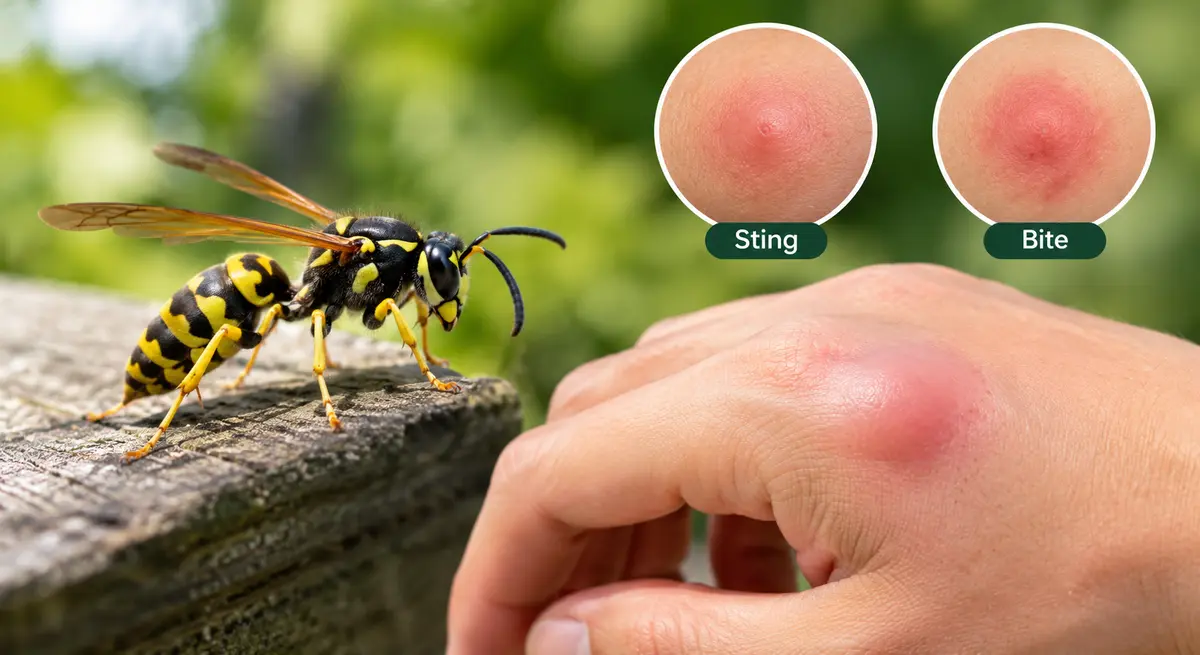
Seeing a wasp near your home can make you wonder: does wasps bite or sting? The answer is simple: wasps can both bite and sting, but they usually sting when they feel threatened. A wasp sting uses a stinger to inject venom, while a bite uses the insect’s jaws and does not normally inject venom.
People often search this question because the sharp pain from a wasp encounter can be hard to identify. A small red mark, swelling, or sudden pinch may leave you unsure about what happened. Knowing the difference can help you respond correctly and avoid another encounter.
Most wasps do not actively seek people. Social wasps may sting when they defend their nest, while many solitary wasps rarely sting humans. University of Minnesota Extension notes that social wasps and bees sting to defend their colonies, while solitary wasps generally avoid people. (University of Minnesota Extension)
This guide explains the difference between wasp bites and stings, common mistakes, regional language use, everyday examples, and basic safety advice.
Does Wasps Bite or Sting – Quick Answer
The grammatically correct question is “Do wasps bite or sting?”
The biological answer is that wasps can bite and sting, but stinging is the main concern for humans.
- Wasp sting: A wasp uses its stinger to inject venom.
- Wasp bite: A wasp uses its mandibles, or jaws, to bite or grip.
- Stings: Usually cause more pain and swelling than bites.
- Bites: Usually cause less serious local irritation.
- Repeated stings: Many wasps can sting more than once.
Wasps use their jaws for tasks such as handling food, capturing prey, and working with nesting material. Their stingers play a major role in defense. (Western Exterminator)
If a wasp stings you, you usually do not need to look for a stinger left in your skin. Unlike honey bees, wasps can usually pull their smooth stingers back and sting again. (University of Minnesota Extension)
Wasp Bite vs. Wasp Sting
| Feature | Wasp Bite | Wasp Sting |
| Body part | Mandibles | Stinger |
| Main purpose | Feeding, gripping, prey handling | Defense and prey immobilization |
| Venom | Usually no | Yes |
| Pain | Usually mild | Often sharp or burning |
| Swelling | Usually mild | Common |
| Can it happen to humans? | Yes, but less common | Yes |
| Can it happen repeatedly? | Depends on the insect | Yes, for many wasps |
The Origin of “Does Wasps Bite or Sting?”
The phrase “does wasps bite or sting” comes from a common question about insect behavior. However, it contains a grammar error.
The correct form is:
Do wasps bite or sting?
Why? Wasps is plural, so English uses do, not does.
Compare:
- Does a wasp bite or sting? — Correct
- Do wasps bite or sting? — Correct
- Does wasps bite or sting? — Incorrect
The word wasp has Old English roots. Modern English uses wasp for insects in the order Hymenoptera. Wasps include many different groups, from solitary hunting wasps to social species such as yellowjackets and paper wasps.
The difference between a bite and a sting comes from insect anatomy. A bite involves mouthparts, while a sting involves a specialized structure that delivers venom. (WebMD)
British English vs American English Spelling
There is no British-versus-American spelling difference in the key words here.
Both varieties use:
- wasp
- wasps
- bite
- bites
- sting
- stings
The main issue involves grammar, not spelling.
| Term | American English | British English |
| Wasp | wasp | wasp |
| Plural | wasps | wasps |
| Bite | bite | bite |
| Sting | sting | sting |
| Correct question | Do wasps bite or sting? | Do wasps bite or sting? |
| Singular question | Does a wasp bite or sting? | Does a wasp bite or sting? |
So, unlike words such as color/colour or catalog/catalogue, this keyword does not have a US/UK spelling variation.
Which Spelling Should You Use?
For this keyword, focus on grammar rather than spelling.
For a US audience
Use:
Do wasps bite or sting?
American readers will understand the phrase naturally.
For a UK or Commonwealth audience
Use the same form:
Do wasps bite or sting?
British English does not change the spelling of wasp, bite, or sting.
For a global audience
The best version remains:
Do wasps bite or sting?
It is short, natural, and easy for English learners to understand.
For an SEO title, you can still use the exact search keyword “does wasps bite or sting” if that phrase matches your target query. Inside the article, however, use the grammatically correct form.
Common Mistakes with “Does Wasps Bite or Sting”
1. Using “does” with “wasps”
Incorrect:
Does wasps bite or sting?
Correct:
Do wasps bite or sting?
Use does with singular subjects and do with plural subjects.
2. Assuming wasps only sting
Wasps have jaws and can bite. However, stinging creates the more important risk for humans because it delivers venom.
3. Calling every insect injury a bite
A painful puncture from a wasp is generally a sting, not a bite. Medical sources classify wasps among common stinging insects. (MedlinePlus)
4. Assuming every wasp behaves the same way
Wasp species differ greatly. Some solitary wasps rarely sting people, while social wasps may defend their colonies. (University of Minnesota Extension)
5. Trying to swat a wasp near its nest
Sudden movement can increase the chance of a defensive response. Avoid disturbing nests, especially when you cannot identify the species.
Everyday Examples
In an email
You might write:
“Do wasps bite or sting? I noticed several wasps near the garden.”
In a news article
A news report might say:
“Experts explain why wasps sting when people disturb their nests.”
On social media
Someone might post:
“Does anyone know if this wasp bites or stings?”
In formal writing
A more polished version would be:
“Wasps can bite with their mandibles, but they primarily use their stingers for defense.”
In a search query
People may type:
“does wasps bite or sting”
even though the grammatically correct question is:
“Do wasps bite or sting?”
Search engines can still understand the intended meaning of the original query.
Does Wasps Bite or Sting – Google Trends & Usage Data
Search interest around wasps, bites, and stings tends to follow seasonal insect activity. People commonly look for information when they encounter wasps outdoors, especially during warmer months.
Exact Google Trends values can change by date, country, and search setting. Google Trends also reports relative search interest, rather than an exact number of searches. Therefore, it is better to compare related terms than to treat a Trends score as a fixed search volume.
For SEO, useful related searches include:
- Do wasps bite or sting?
- Do wasps sting?
- Do wasps bite?
- What does a wasp sting look like?
- Why do wasps sting?
- Can wasps sting more than once?
- What should I do after a wasp sting?
Search interest can also vary by location because different wasp species and seasonal patterns occur in different regions.
Wasp Bite and Sting Variations Compared
| Search phrase | Meaning | Correct English? |
| Does wasps bite or sting | Search query about wasp behavior | ❌ |
| Do wasps bite or sting | General question | ✅ |
| Does a wasp bite or sting | Question about one wasp | ✅ |
| Do wasp bite or sting | Missing plural ending | ❌ |
| Do wasps sting | General question about stinging | ✅ |
| Can wasps bite? | Question about biting | ✅ |
| Can a wasp sting twice? | Question about repeated stings | ✅ |
| Wasp bite | A bite from a wasp | ✅ |
| Wasp sting | A sting from a wasp | ✅ |
What Happens When a Wasp Stings You?
A typical wasp sting can cause:
- Sharp or burning pain
- Redness
- Swelling
- Itching
- Tenderness around the sting
Most reactions remain local and improve with time. University of Minnesota Extension notes that local reactions can include burning, itching, redness, and tenderness. (University of Minnesota Extension)
Basic care may include washing the area and using a cold pack to reduce pain and swelling. (Better Health Channel)
A severe allergic reaction can cause symptoms such as difficulty breathing, throat swelling, fainting, or widespread allergic symptoms. These symptoms require immediate emergency medical care. (University of Minnesota Extension)
Why Do Wasps Sting?
Wasps often sting when they feel threatened.
Common triggers include:
- Disturbing a nest
- Swatting at a wasp
- Accidentally trapping a wasp against your skin
- Getting too close to a colony
- Handling a wasp
Social wasps can defend their colonies. Yellowjackets, paper wasps, and other social species may sting when they perceive a threat to their nest. (University of Minnesota Extension)
Solitary wasps usually pose less risk. University of Minnesota Extension reports that solitary wasps are generally not aggressive toward people and rarely sting. (University of Minnesota Extension)
Do Wasps Bite or Sting? FAQs
1. Do wasps bite or sting?
Wasps can do both, but they mainly sting when they defend themselves or their nests. Their bites usually involve their jaws.
2. Do wasp bites contain venom?
A typical wasp bite does not inject venom in the same way a sting does. A sting uses the wasp’s venom-delivery system. (Western Exterminator)
3. Can a wasp sting more than once?
Yes. Many wasps can sting repeatedly because they can withdraw their stinger after using it. (University of Minnesota Extension)
4. Do wasps die after they sting?
Usually, no. Wasps generally do not leave their stinger behind like honey bees can, so they can survive a sting and sting again. (University of Minnesota Extension)
5. Are solitary wasps dangerous?
Most solitary wasps are not aggressive toward people and rarely sting. They usually focus on finding prey or collecting food rather than defending a large colony. (University of Minnesota Extension)
6. What does a wasp sting feel like?
A sting often causes sudden pain or burning, followed by redness, swelling, itching, or tenderness. (University of Minnesota Extension)
7. When should I get medical help after a wasp sting?
Seek emergency medical help if you develop signs of a severe allergic reaction, such as difficulty breathing, throat swelling, fainting, or widespread allergic symptoms. (University of Minnesota Extension)
Conclusion
The answer to “does wasps bite or sting” is that wasps can both bite and sting, but stinging matters most when humans encounter them. A wasp uses its jaws for feeding, handling prey, and other tasks, while its stinger delivers venom and serves as an important defense tool.
The correct English question is “Do wasps bite or sting?” because wasps is plural and takes the auxiliary verb do. There is no meaningful British-versus-American spelling difference for wasp, bite, or sting.
Wasp behavior also varies by species. Many solitary wasps rarely sting people, while social wasps may defend their nests when they feel threatened. (University of Minnesota Extension)
If you encounter a wasp, avoid sudden attempts to handle it or disturb a nearby nest. After a sting, watch for severe allergic symptoms. Immediate medical attention is important when signs of anaphylaxis appear. (MedlinePlus)

I am Bahadar Ali, a professional content writer and the author behind Tensestutor.com I am passionate about making grammar simple and accessible for everyone. Through my writing, I aim to help learners and professionals communicate with clarity and confidence.