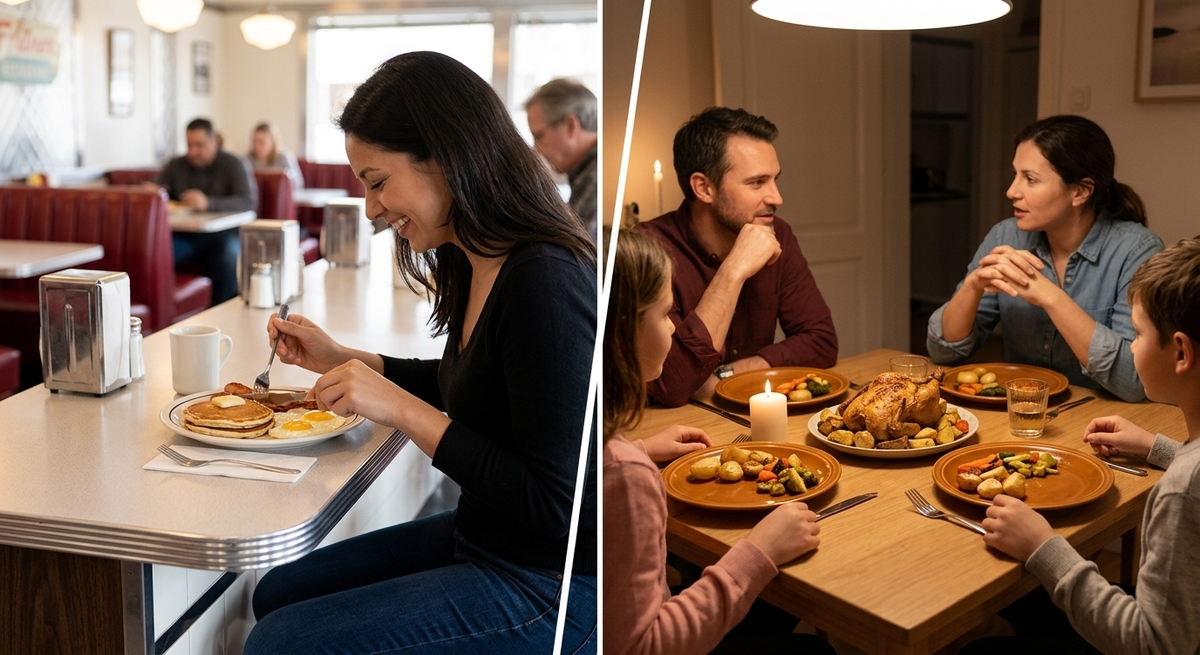
Have you ever typed “diner or dinner” and stopped to check which word you need? You are not alone. These two words look and sound very similar, but they have different meanings. One refers to a person or a type of restaurant. The other refers to an evening meal.
The confusion often comes from pronunciation. In many English accents, diner and dinner sound almost the same. Yet their meanings change completely when you write them. Choosing the wrong word can make a sentence confusing or even funny. For example, “We had a nice diner” does not mean that you enjoyed a meal. It could suggest that you had a pleasant person or restaurant, depending on the context.
This guide explains diner or dinner in simple terms. You will learn the meanings, origins, spelling differences, common mistakes, everyday examples, and regional usage. By the end, you will know exactly when to use each word in emails, schoolwork, social media posts, and formal writing.
Diner or Dinner – Quick Answer
Both diner and dinner are correct English words, but they have different meanings.
- Diner = a person who eats a meal, or a casual restaurant, especially in American English.
- Dinner = the main meal of the day, often eaten in the evening.
Examples
Diner:
- The diner ordered a burger.
- We stopped at a small diner for breakfast.
- The restaurant can seat 50 diners.
Dinner:
- We had dinner at 7 p.m.
- Dinner is ready.
- They invited us to dinner.
Quick comparison
| Word | Meaning | Example |
| Diner | A person eating a meal | The diner ordered coffee. |
| Diner | A casual restaurant | We ate at a roadside diner. |
| Dinner | A main meal | We had dinner together. |
A simple way to remember the difference is:
Diner = person or place
Dinner = meal
The Origin of Diner or Dinner
The words diner and dinner come from different word histories, even though they look and sound alike.
The origin of “dinner”
Dinner comes from Old French disner, which meant “to dine” or “to eat the first meal.” The word entered Middle English and gradually developed into the modern English dinner.
Over time, the meaning changed. In earlier periods, dinner could refer to the first or main meal of the day. Today, many English speakers use it for the main meal, often in the evening.
The origin of “diner”
Diner comes from the verb dine. A diner is literally someone who dines or eats a meal.
American English later developed another common meaning: a diner became a type of casual restaurant. These restaurants often serve familiar foods such as burgers, sandwiches, eggs, coffee, and pie.
So, although the words look similar, their meanings developed along different paths.
British English vs American English Spelling
The spelling diner and dinner remains the same in both British and American English.
The main difference involves how people use the word diner.
In American English, diner commonly means a casual restaurant. For example:
We had breakfast at a local diner.
British English speakers can understand this meaning, but they may use café, restaurant, or another term depending on the type of place.
Both varieties use dinner for a meal:
We are having dinner tonight.
Comparison table
| Word | American English | British English | Meaning |
| Diner | Common | Less common as a restaurant term | Person eating or casual restaurant |
| Dinner | Common | Common | Main meal |
| Dine | Common/formal | Common/formal | Eat a meal |
| Dining | Common | Common | Related to eating meals |
The important point is that diner is not an American spelling of dinner. They are separate words with separate meanings.
Which Spelling Should You Use?
Your choice depends on what you want to say.
For the meal: use “dinner”
Use dinner when you mean a meal.
- What time is dinner?
- We cooked dinner at home.
- She invited me to dinner.
This spelling works in American, British, Australian, Canadian, and other forms of English.
For a person: use “diner”
Use diner when you mean someone who eats or is eating.
- The diner asked for the bill.
- Each diner received a menu.
For a restaurant: use “diner”
Use diner when referring to the casual restaurant style, especially in American English.
- We found an old diner on the highway.
- The diner serves breakfast all day.
For global audiences, dinner is usually clear when you mean the meal. If you use diner for a restaurant, provide enough context when your readers may not know the term.
Common Mistakes with Diner or Dinner
Because the words look so similar, writers often mix them up.
Mistake 1: “We went to a dinner.”
If you mean a casual restaurant, use diner.
Correct:
We went to a diner.
However, a dinner can be correct when you mean a specific event or meal.
Example:
We attended a charity dinner.
Mistake 2: “What are we having for diner?”
If you mean the meal, use dinner.
Correct:
What are we having for dinner?
Mistake 3: “The dinner ordered steak.”
If you mean the person, use diner.
Correct:
The diner ordered steak.
Mistake 4: “Let’s meet at the dinner.”
If you mean a restaurant, use diner.
Correct:
Let’s meet at the diner.
Easy memory trick
Think of the extra n in dinner as part of the meal word:
Dinner = meal
Diner = person/place
Diner or Dinner in Everyday Examples
Knowing the definition helps, but real examples make the difference easier to remember.
In emails
Dinner:
Would you like to join us for dinner on Friday?
Diner:
We can meet at the diner near the station.
In news writing
Dinner:
The guests attended a formal dinner after the ceremony.
Diner:
The historic diner reopened after several months of renovation.
On social media
Dinner:
Homemade dinner tonight!
Diner:
Found a great little diner during our road trip.
In formal writing
Dinner:
The organization hosted a dinner for its members.
Diner:
Each diner received a printed menu.
Side-by-side examples
| Meaning | Correct sentence |
| Meal | Dinner starts at 6 p.m. |
| Person eating | The diner ordered soup. |
| Casual restaurant | We stopped at a diner. |
| Meal invitation | Would you like to have dinner with us? |
| Restaurant location | The diner is open all night. |
Diner or Dinner – Google Trends & Usage Data
Search interest for diner and dinner varies because the words serve different purposes.
Dinner has a broad meaning and appears in many everyday searches. People search for phrases such as:
- dinner recipes
- dinner ideas
- dinner tonight
- healthy dinner
- dinner menu
Because people use the word for a common daily activity, dinner generally has much broader search contexts.
Diner has a narrower meaning. Searches often relate to restaurants, travel, food, and American culture. Examples include:
- diner near me
- American diner
- best diner
- roadside diner
- diner menu
Search behavior also varies by country. The restaurant meaning of diner has a particularly strong connection with American English. Meanwhile, dinner has widespread use across English-speaking countries.
Google Trends data can change over time and depends heavily on the exact search term, location, date range, and search category. For current comparisons, check Google Trends with the specific countries and time period you want to study rather than treating one global result as a permanent measure.
Diner vs Dinner: Comparison Table
| Feature | Diner | Dinner |
| Part of speech | Noun | Noun |
| Main meaning | Person who eats | Main meal |
| Another meaning | Casual restaurant | None with the same everyday sense |
| Refers to food? | Not usually | Yes |
| Refers to a person? | Yes | No |
| Refers to a place? | Yes, in the restaurant sense | No |
| Example | The diner ordered coffee. | Dinner is ready. |
| Common mistake | Using it for a meal | Using it for a restaurant |
FAQs About Diner or Dinner
1. Is it “diner” or “dinner”?
Both words are correct. Diner means a person who eats at a casual restaurant. Dinner means a meal.
2. Is a diner a restaurant?
Yes. In American English, a diner commonly means a casual restaurant that serves familiar meals.
3. Is dinner a person?
No. Dinner means a meal. Diner can mean a person who eats a meal.
4. Do diner and dinner sound the same?
They can sound very similar, especially in some English accents. Their spelling and meaning remain different.
5. Is “dinner” always an evening meal?
No. Dinner often means the evening meal today, but it can also mean the main meal of the day, depending on the speaker, region, and context.
6. Which is correct: “go to dinner” or “go to diner”?
If you mean eating a meal, say go to dinner.
If you mean visiting a casual restaurant, you can say go to a diner.
7. Is “diner” British English?
British English uses diner for a person who eats, but the restaurant meaning is especially associated with American English.
Conclusion
The difference between diner or dinner becomes easy once you focus on meaning. Dinner refers to a meal, while diner usually refers to a person who eats or, especially in American English, a casual restaurant.
Use dinner when you talk about eating a meal: “We are having dinner at seven.” Use diner when you describe someone eating: “The diner ordered coffee.” You can also use diner for a casual restaurant: “We stopped at a diner after the trip.”
The two words often sound alike, which explains why people confuse them. However, their meanings and spellings remain distinct. Neither spelling replaces the other.
For everyday, academic, business, and formal writing, choose the word based on its meaning rather than its sound. Remember the simple rule: dinner is a meal, while diner is a person or place. Once you learn this difference, you can use both words with confidence.

I am Bahadar Ali, a professional content writer and the author behind Tensestutor.com I am passionate about making grammar simple and accessible for everyone. Through my writing, I aim to help learners and professionals communicate with clarity and confidence.