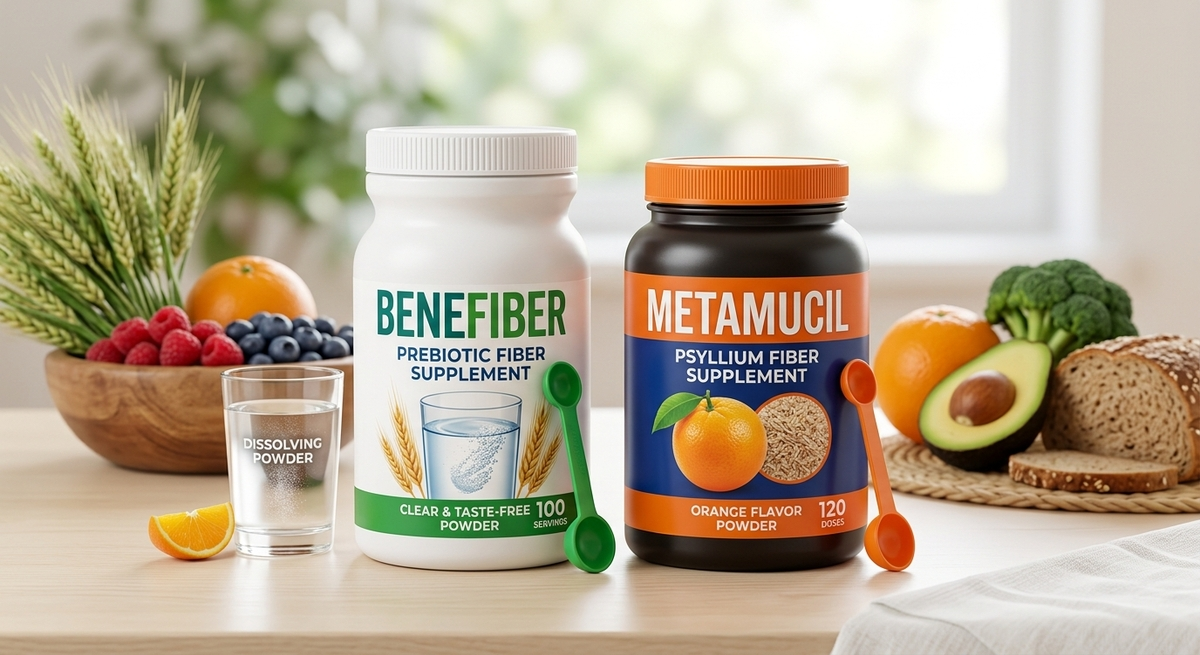
You aren’t the only one who has been standing in the supplement section, looking at these two boxes. Every year, millions of people are searching for “Benefiber or Metamucil” to determine which one will help them when it comes to digestion, regularity, or cholesterol, but not be more bloated than before.
The mix-up is understandable. Both are fibre supplements. They are both available in powder form. Both offer improved digestion. However, they are different, they are from different sources and they serve different needs.
A person who suffers from IBS may feel better on one and worse on the other. The type of fiber that only one of them has may be necessary for a person with a cholesterol problem.
This article provides you with a clear answer first, and then the detail behind the answer — which way you can choose to make the best decisions for your body, not the one that has better advertisements.
Benefiber or Metamucil – Answer as quickly as you can:
- Benefiber’s fiber is wheat dextrin, which is almost flavorless and completely soluble. Gentler and doesn’t cause gas or bloating.
- Metamucil is made with psyllium husk, a fibre that makes a gel. More effective in reducing cholesterol and bulking up the stool but may cause more gas initially.
The rule of the thumb: Opt for Benefiber if you’re looking for a mild fiber option that doesn’t have much taste or texture. Select Metamucil if you are looking for more support in regularity or cholesterol reduction.
The Origin of Benefiber and Metamucil:
In 1934, Metamucil was introduced, one of the oldest fiber supplement companies in the U.S. It is made from psyllium husk from seed of Plantago ovata plant. Psyllium is a fiber that has traditionally been used in medicine as it swells in water and promotes bowel movement.
Benefiber followed, an “easier” variant. It is made with wheat dextrin, a wheat starch fibre.
Unlike psyllium, wheat dextrin does not turn gel-like in liquid and will dissolve completely. Hence, Benefiber will not alter the consistency of the fluid in the drink, whereas the Metamucil may cause it to become slightly gritty or thick.
The “origin” of the miscommunication side is not language, but rather the fact that both products are sold as “general fiber supplements” when they have different source fiber, texture and effects.
Psyllium and Wheat Dextrin: The actual Difference:
Spelling isn’t the question here, this is the one that counts.
| Feature | Metamucil (Psyllium) | Benefiber (Wheat Dextrin) |
| Fiber type | Soluble, gel-forming | Soluble, non-gel-forming |
| Texture when mixed | Thickens, slightly gritty | NO TEXTURE, Dissolves clear. |
| Gas/bloating risk | From above, particularly initially | Lower |
| Cholesterol benefit | Clinically stronger | Minimal to none |
| Best for | Regularity, cholesterol | Spend a few minutes each day eating some fiber. |
| Taste | Mild, sometimes gritty | Virtually tasteless |
| Wheat/gluten concern | Gluten-free | Lots of processing, gluten free (except wheat sensitive), |
Which One is Best?
- If you are constipated or require more bulk: Metamucil is typically more effective since psyllium holds water and increases bulk of stool.
- Sensitive stomach / IBS: Benefiber is less gassy, as wheat dextrin isn’t fermented as aggressively in the system.
- For those controlling cholesterol: Metamucil has been backed with more clinical research to reduce LDL cholesterol.
- For those who simply want some daily fiber with their morning coffee or water: Benefiber blends in without altering flavor or texture.
- If wheat is an allergy: Avoid Benefiber which is marketed as gluten-free; use Metamucil instead.
Some common error that people make:
1 . Beginning at full strength. Both can lead to bloating if you don’t gradually start small and slowly build it up.
2 . Not getting adequate fluids. Psyllium is particularly fluid — drink it with plenty of water or risk of choking/blockage.
3 . Assuming they’re interchangeable. The change in one for another without changing the amount may alter the effect, particularly if the person is trying to manage their cholesterol.
4 . Administering them at the inappropriate time. Don’t take fiber supplements at the same time as medications as they can interfere with the absorption of medication.
5 . Expecting instant results. It takes a couple of days to see results from either.
Everyday Use contains both BenFiber and Metamucil:
- Doctor’s note: BeginMetamucil at 1 teaspoon per day and add to a healthy diet to control cholesterol.
- To a friend: “Give Benefiber a try, it’s much kinder to my stomach than Metamucil.
- A comment from an online forum: “I no longer use Metamucil, I switched to Benefiber and the bloating stopped altogether.
- In a product review: “Metamucil is very helpful when it comes to regularity but the texture is something you have to get used to.
Check the trending and popular searches:
When people make a new year’s resolution to lose weight and do healthier things, or when they visit the doctor for a cholesterol check-up, it triggers an increase in search interest for the terms “Benefiber” or “Metamucil”. In general, there is more total traffic for the U.S. of “Metamucil” because it has been on the market longer and it is more heavily advertised.
Benefiber users who have tried Metamucil before and found it did not suit them taste-wise often resort to looking for a “gentler” product which is Benefiber.
Quick Comparison Table :
| Question | Metamucil | Benefiber |
| Helps with cholesterol? | Yes | Not significantly |
| Gentle on stomach? | Moderate | Yes |
| Dissolves clear? | No | Yes |
| Suitable for every day coffee and tea? | Less ideal | Yes |
| FDA-recognized cholesterol claim? | Yes | No |
FAQs:
1 . Can I take Benefiber and Metamucil together?
Ans : It usually not required and could cause gas or bloating. Choose 1 and use the dosage of the other instead.
2 . Which one is more effective for losing weight?
Ans : They not designed to help people lose weight, but fiber can help them feel full. Metamucil’s gel-forming fiber may help promote some sense of fullness.
3 . Does Benefiber produce less gas than Metamucil?
Ans : Yes, generally, wheat dextrin takes longer to ferment in the gut than psyllium.
4 . Which is superior for lowering cholesterol (Metamucil or Bismuth?
Ans : Yes. Psyllium more clinically proven to lower LDL cholesterol than wheat dextrin.
5 . Are either of these acceptable for diabetics?
Ans : Each generally is safe, but consult a physician about the timing of medication due to the effect of fiber on blood sugar levels.
6 . Which one do you think is more natural?
Ans : Psyllium husk or Metamucil is more closely related to its plant origin. Wheat dextrin (Benefiber) subjected to more processing.
7 . When will the results be available?
Ans : The majority of people experience regularity disturbances within 2-3 days after regular use.
Conclusion:
Benefiber and Metamucil are different products that treat different problems, although they both are found on the same supermarket shelf. More clinical research supports the use of
Metamucil (from psyllium husk) for regularity and cholesterol management than the other. The less harsh version BenFiber which is produced from wheat dextrin; this nearly flavorless and won’t cause gas, and will easily blend into your daily beverage.
There is no one “best” or “worst” of the two. The right one for you will be dependent upon the digestive sensitivity, health objectives and for those with a particular health concern such as cholesterol control.
Take a low level of either and then up water intake and wait a few days to assess the results. Speaking to a doctor if symptoms continue or get worse, as there are several other factors that will influence the amount of fiber required.
Follow the guidance in this guide as a starting point, not a diagnosis, as the final decision is yours, your goals and your doctor’s advice.

I am Bahadar Ali, a professional content writer and the author behind Tensestutor.com I am passionate about making grammar simple and accessible for everyone. Through my writing, I aim to help learners and professionals communicate with clarity and confidence.