Have you ever stopped while writing and wondered whether to use who or whom? You are not alone. This is one of the most common grammar questions in English. Many people know both words are correct, but they are often unsure when to use each one.
The confusion happens because who and whom both refer to people, yet they play different roles in a sentence. Modern English speakers often use who in everyday conversation, while whom appears more often in formal writing. As a result, many writers avoid whom completely, even when it is grammatically correct.
If you want to write clearer emails, essays, reports, or social media posts, understanding the difference can help. The good news is that the rule is simpler than many people think.
In this guide, you’ll learn the quick answer, the history behind the words, common mistakes, real-world examples, and practical advice on when to use each form.
Who vs Whom – Quick Answer
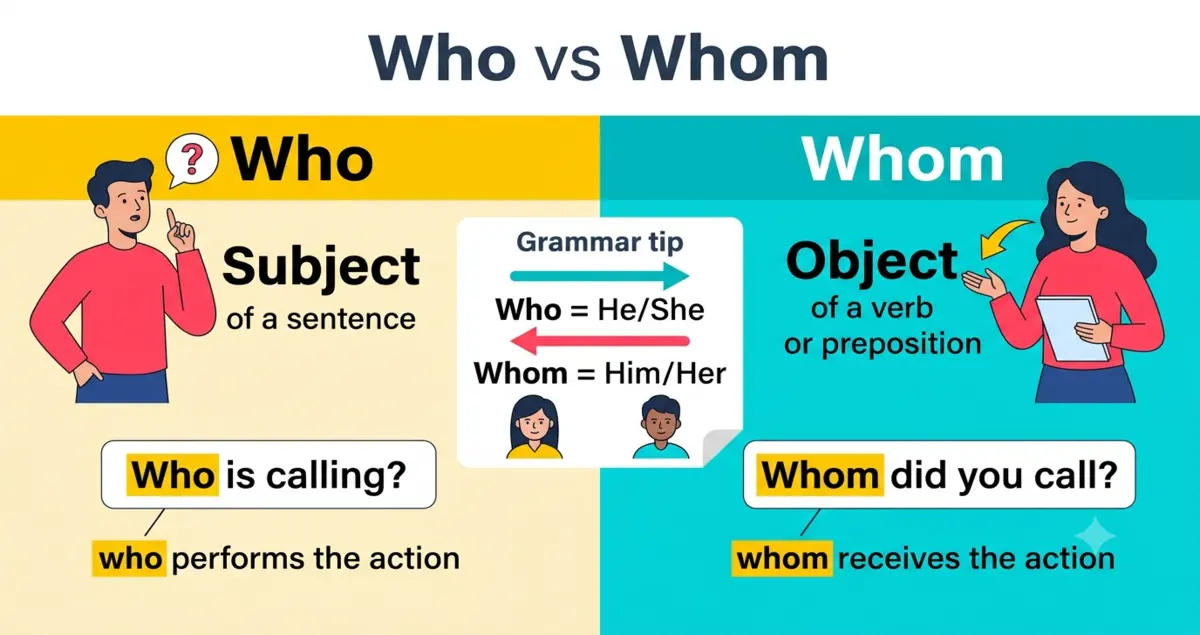
The simplest rule is:
- Who = subject of a sentence
- Whom = object of a verb or preposition
Examples
✅ Who called you yesterday?
(“Who” is doing the action.)
✅ Whom did you call yesterday?
(“Whom” receives the action.)
✅ Who is coming to dinner?
✅ To whom should I send the email?
Easy Test
Replace the word with:
- He/She → use Who
- Him/Her → use Whom
Example:
___ invited you?
“He invited you.”
Since “he” fits, use Who.
You invited ___?
“You invited him.”
Since “him” fits, use Whom.
Read more:Oxford Comma or No Oxford Comma: Which Style Is Correct?
The Origin of Who vs Whom
Both words come from Old English.
- Who developed from the Old English word hwā.
- Whom came from grammatical forms used to show an object in a sentence.
In earlier forms of English, grammar cases were much more important. Different word forms showed whether a noun was a subject, object, or possession.
Over time, English became simpler. Many case endings disappeared, but who, whom, and whose remained.
Today, who is far more common in everyday speech, while whom survives mainly in formal writing and traditional grammar.
British English vs American English Spelling
Unlike words such as “color” and “colour,” who and whom are spelled the same in both British and American English.
The difference is not spelling but usage.
American English tends to use who more often, even where traditional grammar suggests whom.
British English is slightly more likely to keep whom in formal contexts.
Read more:Comma Before and Comma: Rules and Examples used Correctly ?
Comparison Table
| Context | British English | American English |
| Formal writing | Whom is common | Whom is common |
| Business letters | Often uses whom | Often uses whom |
| Casual speech | Usually who | Usually who |
| Social media | Mostly who | Mostly who |
| Everyday conversation | Mostly who | Mostly who |
Examples
British English (Formal)
- To whom it may concern.
American English (Formal)
- To whom should the report be addressed?
Casual English Everywhere
- Who are you talking to?
Which Spelling Should You Use?
Since there is no spelling difference, the choice depends on grammar and audience.
For US Audiences
Use:
- Who in casual writing.
- Whom in formal documents when it is grammatically correct.
For UK Audiences
Use:
- Who in everyday communication.
- Whom in professional and academic writing.
For Global Audiences
Using who is often acceptable in most situations.
Use whom when:
- Writing formal business documents.
- Creating academic content.
- Following strict grammar standards.
Common Mistakes with Who vs Whom
Mistake 1: Using “Whom” as a Subject
❌ Whom is coming to the meeting?
✅ Who is coming to the meeting?
Mistake 2: Using “Who” After a Preposition
❌ To who should I send this?
✅ To whom should I send this?
Mistake 3: Using “Whom” Just to Sound Formal
❌ Whom wants coffee?
✅ Who wants coffee?
Mistake 4: Ignoring the He/Him Test
❌ Who did you invite?
(Formally incorrect)
✅ Whom did you invite?
(“You invited him.”)
Who vs Whom in Everyday Examples
Emails
✅ Who will handle this project?
✅ Whom should I contact for support?
News Writing
✅ Who won the election?
✅ The candidate whom voters supported won easily.
Social Media
✅ Who is excited for the weekend?
✅ Who are you talking about?
(Most social media users prefer “who.”)
Formal Writing
✅ The applicant whom the committee selected accepted the offer.
✅ To whom should the application be submitted?
Who vs Whom – Google Trends & Usage Data
Search data and language studies show that who is dramatically more common than whom.
General Trends
| Word | Usage Popularity |
| Who | Very High |
| Whom | Much Lower |
Countries Where “Whom” Appears More Often
| Country | Common Usage Context |
| United States | Academic and formal writing |
| United Kingdom | Professional communication |
| Canada | Formal documents |
| Australia | Education and business writing |
Why “Who” Dominates
- Easier to remember.
- Common in speech.
- Accepted in many informal situations.
- Modern English favors simpler grammar.
Who vs Whom Comparison Table
| Feature | Who | Whom |
| Grammar Role | Subject | Object |
| Informal Use | Very Common | Rare |
| Formal Use | Common | Common |
| Spoken English | Preferred | Rare |
| Written English | Common | Formal contexts |
| Example | Who called? | Whom did you call? |
FAQs About Who vs Whom
1. Is “whom” still used today?
Yes. It is still used in formal writing, legal documents, and professional communication.
2. Can I always use “who”?
In casual conversation, often yes. In formal grammar, some sentences still require “whom.”
3. What is the easiest way to remember the difference?
Use the he/him test:
- He = Who
- Him = Whom
4. Is “Who are you talking to?” correct?
Yes. It is natural and widely accepted in modern English.
5. Why does “To whom it may concern” use “whom”?
Because the word follows the preposition “to” and functions as an object.
6. Is “whom” disappearing from English?
Its use is decreasing, especially in speech, but it remains important in formal writing.
7. Which is more common in daily conversation?
Who is much more common than whom.
Conclusion
The difference between who and whom is based on grammar, not spelling. Who acts as the subject of a sentence, while whom functions as the object of a verb or preposition. Although this rule has existed for centuries, modern English speakers often use who in casual conversation, making whom seem less common than it once was.
The easiest way to choose the correct word is to use the he/him test. If “he” or “she” fits, choose who. If “him” or “her” fits, choose whom. This simple trick solves most grammar questions quickly.
For everyday emails, texts, and social media posts, using who is usually acceptable. However, in academic writing, business communication, legal documents, and formal reports, understanding when to use whom can make your writing appear more polished and professional.
By learning this one grammar rule, you can avoid a common mistake and write with greater confidence in any situation.

I am Bahadar Ali, a professional content writer and the author behind Tensestutor.com I am passionate about making grammar simple and accessible for everyone. Through my writing, I aim to help learners and professionals communicate with clarity and confidence.