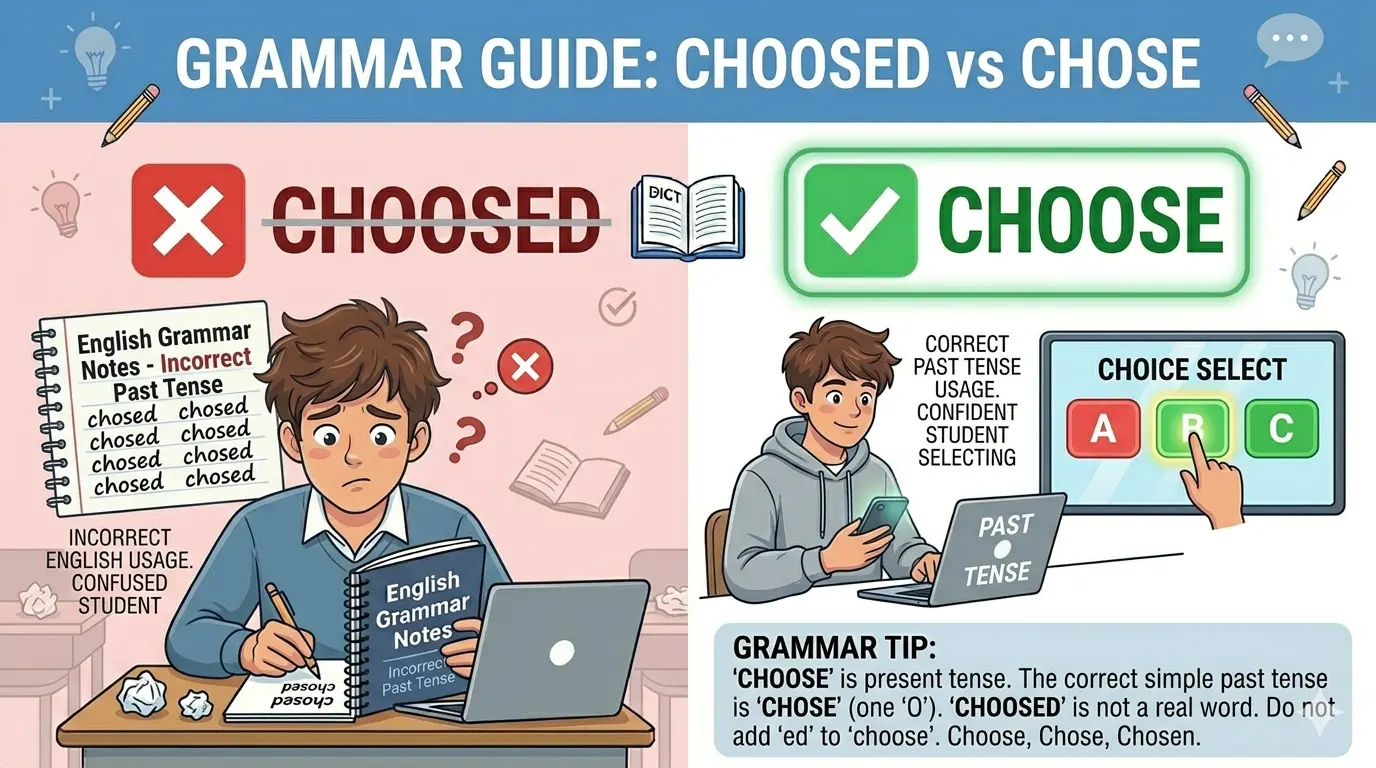
Many English learners often get confused between “choosed” or “chose” when talking about past actions. At first glance, both may look similar and logical, but only one of them is actually correct in standard English.
This confusion usually happens because English verbs don’t always follow a simple rule when changing tense. Instead, many verbs are irregular, meaning their past forms are different from what learners expect.
People search for this keyword because they want a quick answer for exams, writing emails, social media posts, and professional communication. Using the wrong form can make writing look incorrect or unprofessional. The confusion mainly arises from assuming that all verbs take “-ed” in the past tense, like “walk → walked.” However, verbs like “choose” behave differently.
In this article, you will clearly understand why “chose” is correct, why “choosed” is wrong, and how to use the word confidently in real-life situations.
Choosed or Chose – Quick Answer
The correct past tense of “choose” is “chose”, not “choosed.”
- Present tense: I choose
- Past tense: I chose
- Past participle: I have chosen
Examples:
- ✔ I chose the red shirt yesterday.
- ✔ She chose to study medicine.
- ❌ I choosed the blue option. (Incorrect)
“Choosed” is not standard English and should not be used in writing or speech.
Smooth or Smoothe: Which Spelling Is Correct ?
The Origin of Chose
The word “choose” comes from Old English “ceosan”, which meant “to pick or decide.” Over time, English evolved and many verbs became irregular.
Instead of following the common “-ed” rule, “choose” developed a unique past form:
- choose → chose → chosen
This change happened naturally in language history as pronunciation shifted. “Chose” became the accepted past tense form in Middle English and has remained standard ever since.
“Choosed” likely appears because learners apply the regular verb rule incorrectly.
British English vs American English Spelling
Good news: there is no difference between British and American English for this word.
Both use:
- Choose (present)
- Chose (past)
- Chosen (past participle)
Comparison Table
| Form Type | Correct Word | Incorrect Word |
| Present Tense | choose | — |
| Past Tense | chose | choosed ❌ |
| Past Participle | chosen | choosed ❌ |
No regional variation exists—“chose” is universal English.
Perform or Preform: Meaning and Correct Usage Explained?
Which Spelling Should You Use?
Use “chose” in all cases, regardless of audience:
- US English: chose ✔
- UK English: chose ✔
- Canada, Australia, Global English: chose ✔
If you are writing exams, emails, academic papers, or professional content, always use “chose.”
Avoid “choosed” completely.
Common Mistakes with Chose or Choosed
Here are frequent errors learners make:
- ❌ I choosed the wrong answer.
✔ I chose the wrong answer. - ❌ She choosed him as leader.
✔ She chose him as leader. - ❌ They choosed a new house.
✔ They chose a new house.
Why this mistake happens:
- Confusion with regular verbs like “walked” or “played”
- Over-adding “-ed” to all past tense forms
Chose in Everyday Examples
Email Example:
- “I chose your proposal after reviewing all options.”
Social Media Example:
- “I finally chose my favorite travel destination!”
News Example:
- “The committee chose a new chairman yesterday.”
Formal Writing:
- “The board chose to approve the budget proposal unanimously.”
Chose – Google Trends & Usage Data
Search behavior shows that:
- “choosed” is searched mostly by English learners trying to confirm correctness
- “chose” is widely used in education, writing, and professional contexts
- Interest is higher in countries where English is a second language, such as South Asia, the Middle East, and parts of Africa
Overall usage pattern:
- “chose” → extremely common and standard
- “choosed” → incorrect but frequently searched for clarification
This shows that confusion exists, but correct usage dominates real-world writing.
Comparison Table: Choose, Chose, Chosen
| Base Form | Past Tense | Past Participle | Example |
| choose | chose | chosen | I have chosen my path |
| — | choosed ❌ | — | Incorrect form |
FAQs about Choosed or Chose
1. Is “choosed” a correct word?
No, “choosed” is incorrect in standard English.
2. What is the past tense of choose?
The past tense of choose is chose.
3. Why do people say “choosed”?
Because they mistakenly apply the regular “-ed” rule.
4. Is “chosen” the same as “chose”?
No. “Chose” is past tense; “chosen” is past participle.
5. Can I use “choosed” in informal writing?
No, it is still considered wrong in all contexts.
6. What is the easiest way to remember it?
Think: choose → chose → chosen (no -ed form)
7. Is “chose” used in both US and UK English?
Yes, it is the same in both.
Conclusion
Understanding the difference between “choosed or chose” is important for clear and correct English communication. The correct past tense is always “chose,” while “choosed” is a common mistake made by learners who apply regular verb rules incorrectly.
English has many irregular verbs, and “choose” is one of them. Its forms choose, chose, and chosen—must be memorized as a set. Once you understand this pattern, your writing becomes more accurate and professional.
Whether you are writing an email, taking an exam, or posting on social media, always use “chose” instead of “choosed.” This small correction improves your grammar and makes your English sound natural and fluent. Mastering such verbs is a key step toward confident communication in English.

I am Bahadar Ali, a professional content writer and the author behind Tensestutor.com I am passionate about making grammar simple and accessible for everyone. Through my writing, I aim to help learners and professionals communicate with clarity and confidence.