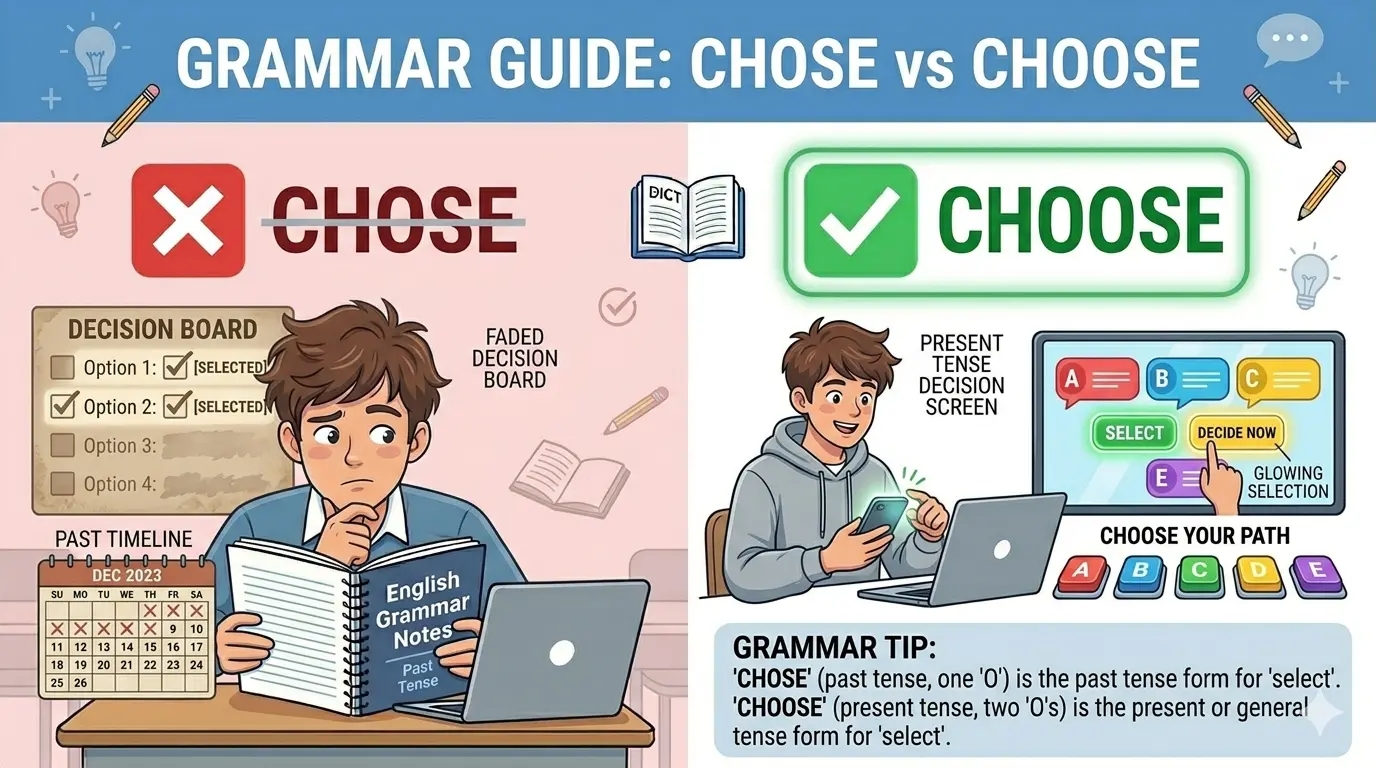
Many English learners get confused between “chose” or “choose”. They look similar, but they are not the same. One is present tense, and the other is past tense. This small difference can change the meaning of your sentence completely.
People search for this keyword because they want to write correct English in school, emails, exams, and daily conversation. It is very common to mix them up, especially when speaking fast or writing without checking grammar. Some also confuse spelling because both words come from the same base verb “choose.”
This confusion often leads to mistakes like “I choose yesterday” or “I chose tomorrow,” which sound wrong in English. Understanding the difference helps you speak and write clearly and correctly.
In this article, you will learn the simple difference between chose and choose, their origin, correct usage, common mistakes, and easy examples. You will also see when to use each word in British and American English. By the end, you will never mix them up again.
Chose or Choose – Quick Answer
Choose = present tense (now or future)
Chose = past tense (already happened)
Simple Examples:
- I choose tea every morning. (present)
- I chose tea yesterday. (past)
Grammar or Grammarly: Meaning, Difference, and Correct Usage ?
The Origin of Chose or Choose
The word choose comes from Old English “ceosan”, meaning “to select or decide.”
Over time:
- “Ceosan” → Middle English chese
- Then modern English split into:
- choose (present form)
- chose (past form)
English verbs often change form to show time (tense). That is why we have two versions of the same idea.
British English vs American English Spelling
Good news: British and American English use the same spelling for these words.
The difference is not spelling—it is usage and pronunciation style.
Comparison Table
| Form | Meaning | Example |
| choose | present / future action | I choose healthy food |
| chose | past action | I chose healthy food |
| chosen | past participle | I have chosen healthy food |
Both UK and US English follow the same rules here.
Truely or Truly: Which Spelling Is Correct?
Which Spelling Should You Use?
- US English: choose / chose (same as British)
- UK English: choose / chose (same as American)
- Global English: use standard grammar rules
👉 Rule:
- Use choose for now/future
- Use chose for past
Common Mistakes with Chose or Choose
❌ I choose yesterday
✔ I chose yesterday
❌ I chose every day
✔ I choose every day
❌ She choose the dress
✔ She chose the dress
❌ I am chose it
✔ I am choosing it / I chose it
Chose or Choose in Everyday Examples
Emails:
- I chose the meeting time yesterday.
- Please choose a suitable time.
Social Media:
- I always choose happiness.
- I chose this path for my future.
News:
- The company chose a new CEO.
- Leaders will choose new policies next year.
Formal Writing:
- The committee chose the best candidate.
- Students must choose one subject.
Chose or Choose – Google Trends & Usage Data
Search interest shows:
- “choose” is searched more globally (present tense usage in learning)
- “chose” appears often in grammar correction searches
- High confusion in countries where English is second language (South Asia, Middle East)
Most users search this keyword for:
- Grammar learning
- Exam preparation
- Writing improvement
Comparison Table (Chose vs Choose vs Chosen)
| Word | Tense | Meaning | Example |
| choose | present | decide now | I choose rice |
| chose | past | decided before | I chose rice |
| chosen | past participle | already selected | I have chosen rice |
FAQs
1. Is it “chose” or “choose” for today?
Use choose for today or present actions.
2. What is the past tense of choose?
The past tense is chose.
3. What is the past participle of choose?
It is chosen.
4. Can I say “I choose yesterday”?
No. Correct form is I chose yesterday.
5. Why are chose and choose different?
Because English changes verb forms to show time (tense).
6. Is choose British or American English?
Both. It is used the same in both.
7. What is an easy trick to remember?
Choose = now, Chose = before.
Conclusion
Understanding the difference between chose or choose is simple once you know the rule. The main idea is time. “Choose” is used for present and future actions, while “chose” is used for past actions. Both words come from the same root verb, but their forms change depending on tense.
Many learners make mistakes because both words look similar. However, remembering one simple rule can solve the problem: if the action already happened, use chose. If it is happening now or will happen later, use choose.
This rule works in speaking, writing, exams, emails, and professional communication. It is the same in both British and American English, so you do not need to worry about regional differences.
By practicing a few examples daily, you will naturally stop mixing them up. Over time, your grammar will become more accurate and confident. Keep this guide as a quick reference whenever you feel unsure. English becomes easy when you break it into small rules like this.

I am Arshman Ali, a professional content writer and the author behind tensestutor.com . I am passionate about making grammar simple and accessible for everyone. Through my writing, I aim to help learners and professionals communicate with clarity and confidence.