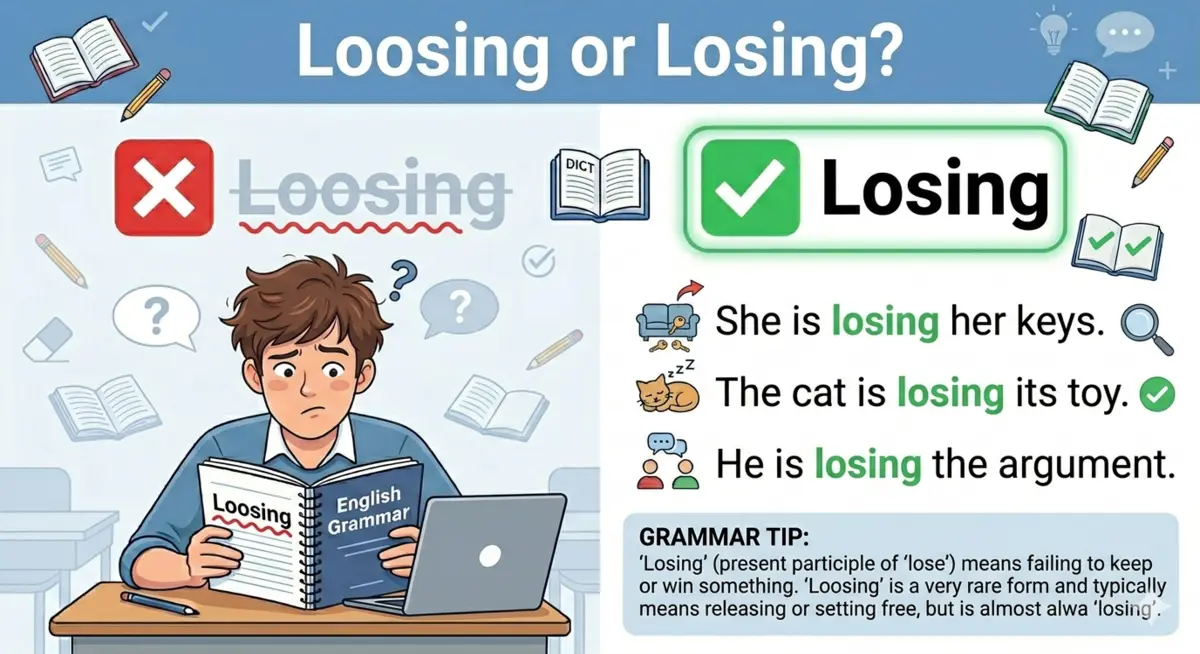
Many English learners and even native speakers get confused between “loosing” and “losing.” The words look almost the same, but they have very different meanings. One small extra “o” changes the whole meaning of the word.
People often search for “loosing or losing” because they want to avoid spelling mistakes in emails, school work, business writing, or social media posts. It is one of the most common English spelling errors online. Autocorrect may not always catch it because both words are real English words.
The confusion happens because English spelling rules are not always simple. The pronunciation of “losing” can sound similar to “loosing,” especially for non-native speakers. Many writers type quickly and accidentally add an extra “o.”
This guide explains the difference in a simple way. You will learn the meaning, spelling, origin, grammar rules, examples, common mistakes, and which word to use in different situations. By the end, you will know exactly when to use “losing” and when “loosing” is correct.
Loosing or Losing – Quick Answer
“Losing” is the correct spelling when talking about not winning or no longer having something.
“Loosing” is a different word that means releasing, setting free, or loosening something.
Correct Examples
- I am losing my keys again.
- Our team is losing the game.
- She is losing patience.
“Loosing” Examples
- The farmer is loosing the horses into the field.
- The soldier is loosing an arrow.
Simple Rule
- Use losing for defeat or absence.
- Use loosing for releasing or letting go.
Truely or Truly: Which Spelling Is Correct?
The Origin of Loosing or Losing
The word losing comes from the Old English word losian, which meant “to perish” or “to be destroyed.” Over time, it became connected with failure, defeat, or not keeping something.
The word loosing comes from the word loose, meaning free or not tight. It later became a verb meaning “to release” or “to untie.”
Because both words are connected to old English roots and have similar spellings, many people mix them up today.
Why the Spelling Difference Exists
English often changes spelling when adding endings like “-ing.”
- Lose → Losing
- Loose → Loosing
The extra “o” stays only with the word loose.
Kickoff or Kick-off: Meaning and Correct Usage Explained?
British English vs American English Spelling
There is no major spelling difference between British English and American English for these words. Both forms use:
- Losing for defeat or absence
- Loosing for releasing something
However, British English may use “loosing” slightly more often in historical or literary writing.
Comparison Table
| Meaning | Correct Word | British English | American English |
| Not winning | Losing | Losing | Losing |
| Misplacing something | Losing | Losing | Losing |
| Releasing something | Loosing | Loosing | Loosing |
| Untying or freeing | Loosing | Loosing | Loosing |
Examples
| Sentence | Correct Usage |
| We are losing money. | Losing |
| The dog is losing fur. | Losing |
| The hunter is loosing arrows. | Loosing |
| She is loosing the ropes. | Loosing |
Which Spelling Should You Use?
The correct choice depends on what you mean.
Use “Losing” When:
- Talking about failure
- Misplacing something
- No longer having something
- Defeat in sports or games
Examples
- I am losing my wallet.
- They are losing the match.
- The company is losing customers.
Use “Loosing” When:
- Releasing something
- Untying something
- Letting something move freely
Examples
- The sailor is loosing the ropes.
- The archer is loosing arrows.
Audience-Based Advice
| Audience | Recommended Word |
| US readers | Losing |
| UK readers | Losing |
| Commonwealth countries | Losing |
| Global audience | Losing |
In modern everyday English, losing is far more common.
Common Mistakes with Loosing or Losing
Many people accidentally use “loosing” instead of “losing.” This is one of the most common spelling errors online.
Frequent Errors
| Incorrect | Correct |
| I am loosing weight. | I am losing weight. |
| We are loosing the game. | We are losing the game. |
| She keeps loosing her phone. | She keeps losing her phone. |
| They are loosing money. | They are losing money. |
Why People Make This Mistake
- The pronunciation sounds similar.
- The word “loose” is very common.
- Fast typing adds an extra “o.”
- Spellcheck may miss it.
Easy Memory Trick
- Lose → Losing
- Loose → Loosing
If you mean defeat or absence, never add the extra “o.”
Loosing or Losing in Everyday Examples
In Emails
- We are losing clients this month.
- The company is losing profits quickly.
In News Headlines
- Local team losing championship hopes.
- Business losing millions in sales.
On Social Media
- I keep losing my charger.
- Why am I losing followers?
In Formal Writing
- The organization is losing public trust.
- Scientists warn the species is losing habitat.
Rare Use of “Loosing”
- The army was loosing arrows at night.
- The captain was loosing the sails.
Loosing or Losing – Google Trends & Usage Data
Search data shows that “losing” is much more popular than “loosing.” Most searches happen because users want to check the correct spelling.
Popular Countries Searching This Keyword
- United States
- United Kingdom
- Canada
- Australia
- India
- Pakistan
Usage Context
| Word | Common Context |
| Losing | Sports, business, daily conversation |
| Loosing | Historical writing, archery, literature |
Important Trend
Most people searching “loosing or losing” actually want the spelling “losing.”
Comparison Table: Loosing vs Losing
| Feature | Losing | Loosing |
| Part of Speech | Verb | Verb |
| Main Meaning | Not winning or not having | Releasing or setting free |
| Everyday Use | Very common | Rare |
| Example | Losing money | Loosing arrows |
| Correct for mistakes? | Yes | Usually no |
| Used in modern writing | Frequently | Occasionally |
FAQs About Loosing or Losing
Is “loosing” ever correct?
Yes. “Loosing” is correct when talking about releasing or freeing something.
Why do people confuse losing and loosing?
The words look and sound similar, so many writers accidentally add an extra “o.”
Is “losing weight” correct?
Yes. “Losing weight” is the correct phrase.
Is “loosing weight” wrong?
Yes. It is incorrect because “loosing” means releasing something.
Which word is more common?
“Losing” is much more common in modern English.
Do British and American English spell them differently?
No. Both use the same spellings.
How can I remember the difference?
If you mean defeat, failure, or absence, use losing without the extra “o.”
Conclusion
The difference between “loosing” and “losing” is simple once you know the meanings. “Losing” is the correct word for defeat, failure, or no longer having something. It is the word most people need in everyday English. “Loosing,” on the other hand, is a rare word that means releasing or setting something free.
This spelling mistake happens often because the two words look very similar. Still, using the wrong one can make your writing appear unprofessional. Whether you are writing emails, social media posts, essays, or business documents, choosing the correct spelling matters.
A quick memory trick can help: if you mean not winning or not keeping something, use losing. If you mean releasing or untying something, use loosing.
For most writers, “losing” will almost always be the right choice. Understanding this difference improves your grammar, spelling, and confidence in English writing.

I am Arshman Ali, a professional content writer and the author behind tensestutor.com . I am passionate about making grammar simple and accessible for everyone. Through my writing, I aim to help learners and professionals communicate with clarity and confidence.