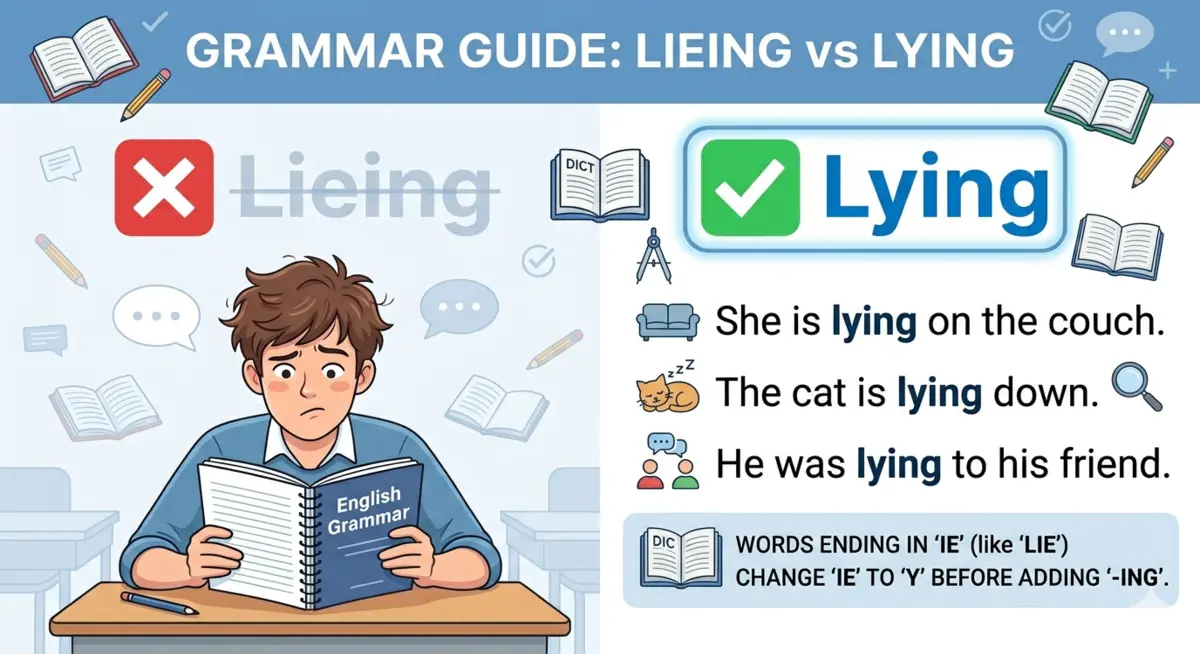
Have you ever typed “lieing” and seen a red spell-check line appear? Many English learners and even native speakers get confused between lieing and lying. The problem comes from English spelling rules, especially when verbs change form.
People search for “lieing or lying” because they want the correct spelling for school, emails, social media posts, blogs, and professional writing. Since English has many unusual spelling patterns, it is easy to wonder if both words are correct.
The short answer is simple: “lying” is the correct spelling in modern English. The form “lieing” is considered incorrect in almost all situations.
This guide explains why “lying” is correct, where the confusion comes from, how British and American English treat the word, and how to avoid common mistakes. You will also see real-life examples, comparison tables, FAQs, and writing tips to help you use the word correctly every time.
Lieing or Lying – Quick Answer
The correct spelling is lying.
✅ Correct: He is lying about his age.
❌ Incorrect: He is lieing about his age.
The verb lie changes to lying when used in the present participle form.
Loosing or Losing: Which Spelling Is Correct?
Examples
| Correct Usage | Incorrect Usage |
| She is lying on the sofa. | She is lieing on the sofa. |
| They are lying to us. | They are lieing to us. |
| The dog is lying near the door. | The dog is lieing near the door. |
Why?
In English, verbs ending in -ie often change to -y before adding -ing.
Examples:
- die → dying
- tie → tying
- lie → lying
That is why lieing is not standard English.
The Origin of Lieing or Lying
The word lie comes from Old English. It had two meanings:
- To rest in a flat position
- To say something false
Over time, English spelling rules changed. When adding -ing to verbs ending in -ie, the ie changed to y.
Lose or Loose: What’s the Difference and How to Use It Correctly?
Historical Pattern
| Base Verb | Correct -ing Form |
| die | dying |
| tie | tying |
| lie | lying |
This spelling rule makes words easier to pronounce and read.
Why the Confusion Exists
Many English words simply add -ing directly:
- walk → walking
- jump → jumping
- speak → speaking
Because of this pattern, people naturally assume:
- lie → lieing
But English grammar follows a special rule for -ie verbs.
British English vs American English Spelling
Good news: both British English and American English use the same spelling — lying.
There is no regional difference here.
Comparison Table
| English Type | Correct Form | Incorrect Form |
| American English | lying | lieing |
| British English | lying | lieing |
| Canadian English | lying | lieing |
| Australian English | lying | lieing |
Examples in British English
- The cat is lying by the fire.
Examples in American English
- He is lying during the interview.
Both forms follow the same grammar rule worldwide.
Which Spelling Should You Use?
You should always use lying in formal and informal writing.
Use “lying” for:
- School assignments
- Blog posts
- News articles
- Emails
- Social media captions
- Business writing
Audience-Based Advice
| Audience | Best Spelling |
| US readers | lying |
| UK readers | lying |
| Commonwealth countries | lying |
| Global audience | lying |
Professional Advice
If you use lieing, readers may think it is a spelling mistake. Spell-check tools and grammar software also flag it as incorrect.
For clear and professional writing, always choose lying.
Common Mistakes with Lieing or Lying
Many writers make simple grammar mistakes with this word.
Mistake 1: Adding “-ing” Directly
❌ lieing
✅ lying
Mistake 2: Confusing “Laying” and “Lying”
- lying = resting or not telling the truth
- laying = placing something down
Examples:
- She is lying on the bed.
- She is laying the book on the table.
Mistake 3: Using Informal Spellings Online
Some people type lieing quickly on social media. Even though it appears online, it is still incorrect.
Quick Correction Table
| Wrong | Correct |
| lieing down | lying down |
| stop lieing | stop lying |
| he is lieing | he is lying |
Lieing or Lying in Everyday Examples
Here is how “lying” appears in daily writing.
Emails
- I think the file is lying on your desk.
News Writing
- Police said the suspect was lying during questioning.
Social Media
- Why are people always lying online?
Formal Writing
- The witness was accused of lying under oath.
Casual Conversation
- My phone has been lying there all day.
Lieing or Lying – Google Trends & Usage Data
Search data shows that many users type “lieing” into search engines because they are unsure about the spelling.
However, “lying” is far more common in books, websites, news articles, and dictionaries.
Usage by Context
| Context | Common Form |
| Dictionaries | lying |
| News articles | lying |
| Academic writing | lying |
| Search mistakes | lieing |
Countries Where Confusion Is Common
The spelling confusion appears in:
- United States
- United Kingdom
- Canada
- Australia
- India
This happens because English learners worldwide follow similar spelling habits.
Comparison Table: Lieing vs Lying
| Word | Correct? | Meaning | Example |
| lieing | ❌ No | Misspelling | Incorrect in standard English |
| lying | ✅ Yes | Resting or not telling truth | He is lying on the couch. |
FAQs About Lieing or Lying
1. Is “lieing” ever correct?
No. “Lieing” is considered a spelling mistake in modern English.
2. Why is it “lying” and not “lieing”?
English grammar changes ie to y before adding -ing.
3. Is “lying” used in British English?
Yes. British English and American English both use “lying.”
4. What is the difference between “lying” and “laying”?
“Lying” means resting or being dishonest. “Laying” means putting something down.
5. Is “lying down” correct?
Yes. “Lying down” is the correct phrase.
6. Why do people write “lieing”?
People often apply the normal “add -ing” rule without remembering the special -ie spelling change.
7. Does spell-check accept “lieing”?
Most spell-check tools mark “lieing” as incorrect.
Conclusion
The difference between lieing and lying is simple once you know the spelling rule. The correct form is always lying. English changes verbs ending in -ie to -y before adding -ing. That is why we write dying, tying, and lying instead of dieing, tieing, or lieing in most modern usage.
Both British and American English follow the same rule, so there is no regional difference to remember. Whether you are writing an email, blog post, school paper, or social media caption, lying is the safe and professional choice.
A quick way to remember the rule is this:
If the verb ends in “ie,” change it to “y” before adding “ing.”
By understanding this pattern, you can avoid one of the most common English spelling mistakes and write with more confidence. Clear spelling improves readability, professionalism, and communication in every type of writing.

I am Arshman Ali, a professional content writer and the author behind tensestutor.com . I am passionate about making grammar simple and accessible for everyone. Through my writing, I aim to help learners and professionals communicate with clarity and confidence.